

I remember the first time I searched for a hotel and almost closed the tab immediately.
The prices were insane. And I had not even picked a fancy city. I was looking at a basic room in a regular neighbourhood, nothing special, no view, no breakfast included. Just four walls and a bed. And somehow it was going to cost me more than my monthly phone bill.
I almost convinced myself that travel was just expensive. That accommodation was always going to eat the biggest chunk of any trip budget.
But that was before I learned how to actually find cheap accommodation anywhere.
Not by getting lucky. Not by using some secret no one talks about. Just by understanding a few things that most people skip entirely.
This guide covers everything I have learned from years of travelling on a budget, mostly from Germany, across Europe and beyond. Real steps. Real platforms. Real numbers. If you are serious about budget accommodation travel, read every section.
If you have ever felt like accommodation prices make no sense, keep reading.
Table of Contents
- Why Finding Cheap Accommodation Feels Hard But Is Not
- How I Personally Find Cheap Accommodation Step by Step
- Best Websites to Find Cheap Accommodation
- Hotel vs Airbnb vs Hostel: Which Is Actually Cheaper?
- How to Choose the Right Location Without Overpaying
- When to Book for the Cheapest Prices
- How to Find Last-Minute Deals
- Best Countries in Europe for Cheap Accommodation
- How to Avoid Overpaying and Hidden Costs
- How to Read Reviews Like a Smart Traveller
- Common Mistakes People Make
- My Personal Travel Experience and Lessons
- FAQ
- Conclusion
Why Finding Cheap Accommodation Feels Hard But Is Not
The first problem is how most people search for cheap accommodation anywhere.
They open one website. They look at the first results that come up. They see prices that feel high. And they either book immediately because they are stressed, or they close the tab and decide it is too expensive.
Both are mistakes.
The second problem is timing. Most people search for accommodation the same way they check their messages, casually, whenever they think of it. There is no strategy. No awareness of when prices shift or why.
And the third problem is comparison. People compare accommodation prices the same way they compare phones in a store. They pick the cheapest option without thinking about what they are actually comparing.
Once you understand why prices behave the way they do, everything changes. Accommodation pricing is dynamic. Hotels and booking platforms change their prices multiple times a day based on demand, availability, seasonality, and even what they think you are willing to pay. That is not a conspiracy. That is just how it works.
And that means there is always a better price somewhere. You just need to know how to find it. This applies whether you are looking for cheap hotels in Europe or budget stays anywhere else in the world.
How I Personally Find Cheap Accommodation Anywhere Step by Step
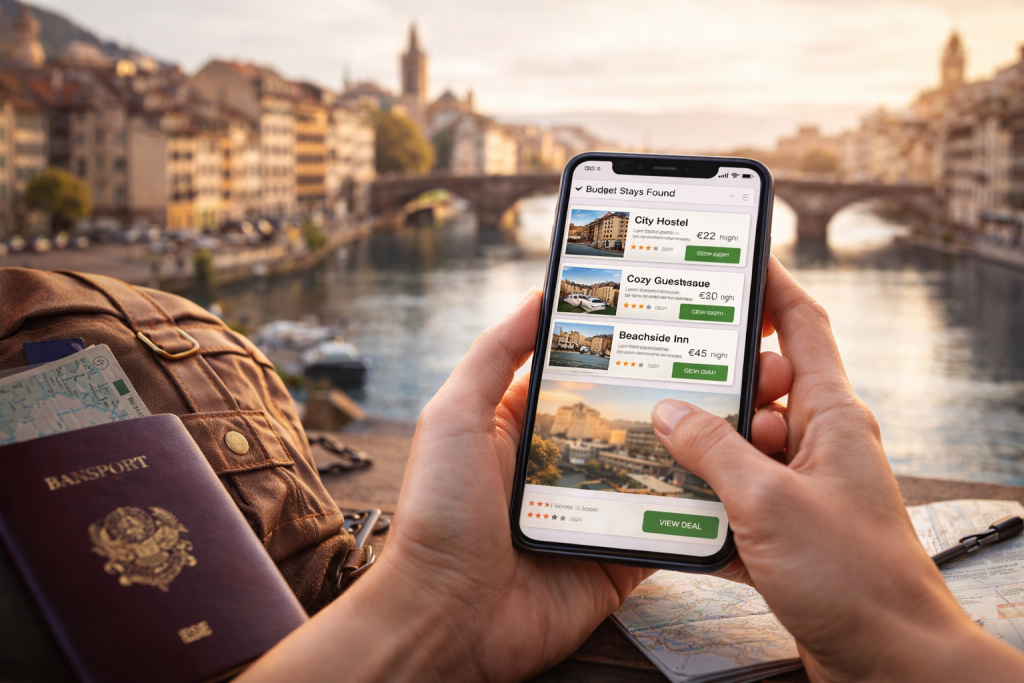
This is my actual process. I use this every time I travel, whether I am booking one week ahead or three months ahead. It works for how to find cheap hotels, hostels, and apartments consistently.
Step 1: Define Your Real Budget First
Before I open any booking platform, I decide what I am actually willing to spend per night. Not what I hope to spend. What I can realistically spend and still enjoy the trip.
For solo travel in Eastern Europe, my personal ceiling is around 25 to 35 euros per night for a private room. For Western Europe, I allow up to 50 euros. For hostels, I aim for under 18 euros. Having that number before you start searching stops you from drifting into overpriced territory. This is the foundation of smart budget travel from Germany and anywhere else.
Step 2: Search Without Fixed Dates First
Most platforms let you search by flexible dates. I use this to see which days are cheaper. Tuesday and Wednesday check-ins are almost always cheaper than Friday or Saturday. Even a one-day shift can save you 20 to 40 percent on the same room.
Step 3: Compare Across at Least Three Platforms
The same room can show completely different prices on different platforms. I always check at least three. The price difference for the same cheap accommodation anywhere listing can be 20 to 30 percent depending on where you look.
Step 4: Look at the Neighbourhood, Not Just the Price
A cheap hotel in the wrong location costs you more in the end. You spend money on transport, waste time, and feel disconnected from the city. I always map the location before I book.
Step 5: Read Recent Reviews, Not the Rating
A 7.8 score with fresh reviews saying the place is clean and the staff is helpful tells me more than a 9.2 score with no reviews in the last six months.
Step 6: Book With Free Cancellation When Possible
This gives me the flexibility to find something better if prices drop or my plans change. This is especially useful when you are planning a trip on almost no money and need to stay flexible throughout the process.
Best Websites to Find Cheap Accommodation Anywhere
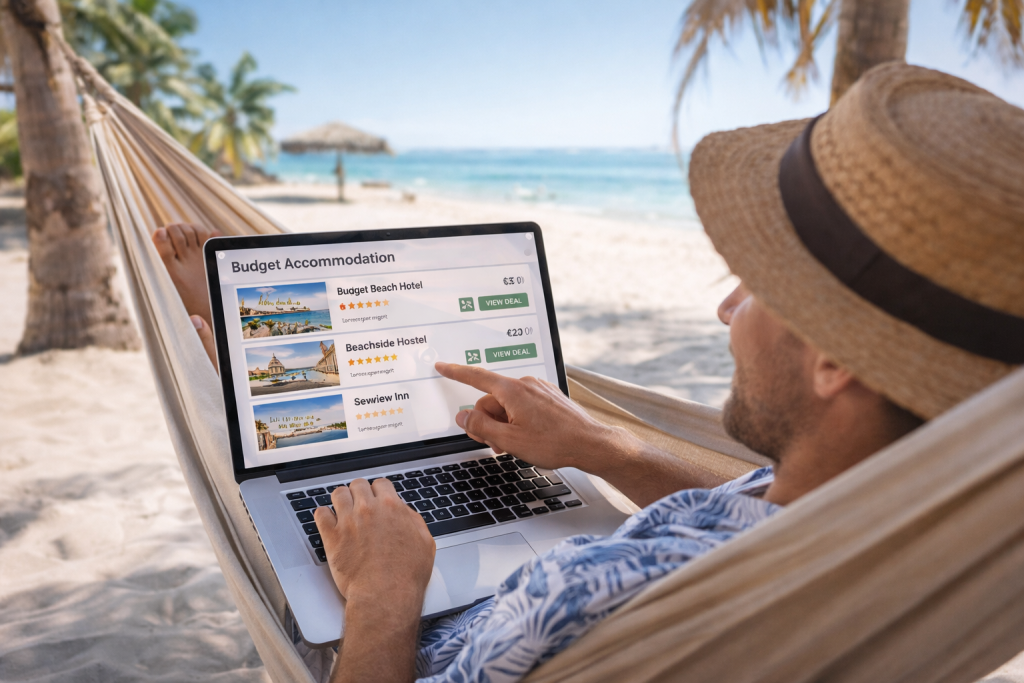
Not all platforms are created equal. Here is what I actually use and why. These are the best tools for finding budget accommodation travel deals consistently.
Booking.com
Still the most comprehensive for Europe. The filter options are strong and you can sort by distance from the city centre, price, and review score simultaneously. I always start here for cheap hotels in Europe and apartments.
Hostelworld
The best dedicated platform for hostels. If you are a solo traveller or comfortable with shared spaces, this is where the real budget deals live. I have found beds for under 10 euros a night in cities that people assume are expensive. Hostelworld is worth bookmarking if you travel solo regularly.
Airbnb
Better for longer stays of four or more nights. For a single night, the cleaning fees usually cancel out any savings. But for a week in one city, renting a private apartment often works out cheaper than a hotel.
Google Hotels
People overlook this completely. Google Hotels aggregates prices from multiple platforms and shows you price trends over time. It is excellent for spotting when prices are about to spike.
GrandRoyal Travel Booking Tool

This is the comparison tool I built specifically for budget travellers. You can compare hotel and flight deals side by side and find combinations that save you more than booking separately. If you are travelling from Germany, this is the smartest place to start before committing anywhere else: booking.grandroyaltravel.com.
Platform Comparison Table
| Platform | Best For | Price Range | Notes |
|---|---|---|---|
| Booking.com | Hotels and apartments | Variable | Widest selection in Europe |
| Hostelworld | Hostels and dorms | €8 to €25 per night | Best for solo budget travel |
| Airbnb | Weekly apartment rentals | Variable | Check total price including fees |
| Google Hotels | Price trend research | Aggregated | Free, no booking fees |
| booking.grandroyaltravel.com | Budget travel from Germany | Budget focused | Hotel and flight bundles |
| Trivago | Multi-platform comparison | Variable | Good cross-check tool |
| Kayak | Flights and hotel bundles | Variable | Good for package deals |
Hotel vs Airbnb vs Hostel: Which Is Actually Cheaper?
The honest answer is: it depends on the trip. But understanding the difference is key to finding cheap accommodation anywhere consistently.
Hostels are cheapest for solo travellers, especially on short trips of one to three nights. A bed in a shared dorm can cost as little as 8 euros in cities like Krakow, Lisbon, or Sofia. Some hostels now offer private rooms that are cheaper than budget hotels and still include breakfast and a social atmosphere.
Hotels make more sense when you are travelling as a couple or a small group. The price per person often drops to a level competitive with hostels. Budget hotels in Eastern Europe regularly come in at 30 to 45 euros total for a private double room, which for two people is around 15 to 22 euros each.
Airbnb is best for stays of five nights or more. The cleaning fees, which can be 30 to 80 euros on top of the nightly rate, make short stays expensive. But for a full week, renting an apartment often gives you a kitchen, more space, and a local feeling that hotels cannot match.
Accommodation Type Comparison
| Accommodation Type | Average Price Range | Pros | Cons |
|---|---|---|---|
| Hostel dorm | €8 to €20 per night | Cheapest option, social, often central | Shared space, less privacy |
| Hostel private room | €20 to €45 per night | Budget-friendly with privacy | Still basic amenities |
| Budget hotel | €30 to €65 per night | Private, reliable, Wi-Fi included | Less character, sometimes noisy |
| Airbnb apartment | €35 to €90 per night | Full apartment, kitchen, local feel | Cleaning fees, inconsistent quality |
| Guesthouse | €25 to €55 per night | Homey, often includes breakfast | Fewer available in big cities |
How to Choose the Right Location Without Overpaying
Location is where a lot of people make expensive mistakes when searching for cheap accommodation anywhere.
The most central hotel is not always the best value. In many European cities, the best neighbourhoods for budget travellers are one or two metro stops from the centre. In Budapest, staying in the 7th district gives you a better atmosphere and cheaper prices than the tourist-heavy Castle District. In Prague, Vinohrady offers great cafes, good transport links, and rooms at 30 to 40 percent less than the Old Town.
What I look for:
Public transport access. A room that is 10 euros cheaper but 40 minutes from everything is not actually cheaper. Calculate the transport cost and the time cost before you decide.
Supermarket nearby. Being able to buy breakfast and snacks instead of paying hotel or cafe prices makes a significant difference over several days.
Safety and walkability at night. Read recent reviews specifically about the area at night. Google Street View is your friend here.
When to Book for the Cheapest Prices
Timing matters more than most people realise when looking for budget accommodation travel deals.
Book 4 to 8 weeks in advance for most cities. This is the window where availability is still good but prices have not yet risen due to scarcity. Book 3 to 5 months in advance for peak summer season, especially July and August in popular cities like Barcelona, Amsterdam, or Rome.
Avoid booking on weekends. Prices across most platforms are marginally higher on Friday and Saturday, even for mid-week stays. I always do my searching on Tuesday.
The cheapest days to check in: Sunday, Monday, and Tuesday check-ins are consistently cheaper than Thursday, Friday, and Saturday. This is true across most of Europe and connects directly with how you should plan your cheap flights from Germany to match cheap accommodation check-in days.
How to Find Last-Minute Deals
Last-minute booking works in some situations and is a gamble in others. It can be a powerful way to find cheap accommodation anywhere but only under the right conditions.
It works well in low season, in cities with lots of accommodation options, and when you are flexible about where exactly you stay. Hotels and hostels would rather fill a room at 50 percent of the rate than leave it empty.
HotelTonight is specifically designed for same-day and next-day bookings. The deals can be genuinely impressive, sometimes 40 to 60 percent off standard rates.
Booking.com last-minute filter also surfaces properties with flash deals in the 48-hour window before check-in. The risk is obvious. During high season or major events, last-minute prices are often the highest of all. I do not recommend relying on last-minute booking during summer months in popular cities.
Best Countries in Europe for Cheap Accommodation
Living in Germany gives you something most travellers from outside Europe do not have. You are already close to some of the most affordable travel destinations on the continent. Finding cheap hotels in Europe is genuinely easier when you are already based here.
If you want to understand how to get to these places cheaply first, the budget travel from Germany guide covers exactly that and pairs perfectly with this accommodation guide.
| City | Average Nightly Budget Hotel | Budget Level | Notes |
|---|---|---|---|
| Sofia, Bulgaria | €20 to €35 | Very Low | Best value in Europe right now |
| Krakow, Poland | €22 to €40 | Very Low | Great hostels, lively city |
| Belgrade, Serbia | €18 to €35 | Very Low | Underrated, good nightlife |
| Bucharest, Romania | €20 to €38 | Very Low | Surprisingly affordable |
| Budapest, Hungary | €28 to €50 | Low | Still very affordable |
| Lisbon, Portugal | €35 to €65 | Moderate | Slightly more but worth it |
| Prague, Czech Republic | €30 to €55 | Low to Moderate | Many hostel options |
| Warsaw, Poland | €25 to €45 | Low | Good value for capital city |
| Skopje, North Macedonia | €18 to €32 | Very Low | Overlooked gem |
| Tirana, Albania | €15 to €30 | Extremely Low | One of cheapest in Europe |
How to Avoid Overpaying and Hidden Costs
The listed price is rarely the final price. This is one of the biggest traps when trying to find cheap accommodation anywhere. Here is what to watch for.
Resort fees. Common in the US but increasingly creeping into European hotels. Always read the small print under the price breakdown before confirming.
City taxes. Most European cities charge a small nightly tourist tax, usually between 1 and 5 euros per person per night. Some platforms include this, some add it at checkout, and some you pay at the hotel directly.
Airbnb cleaning fees. These can be 30 to 80 euros and are not always visible until the final checkout screen. Always click through to the total price before comparing.
Non-refundable rates. The cheapest price you see is usually non-refundable. It looks attractive but locks you in completely. If your plans might change, the slightly higher flexible rate is worth it.
Breakfast not included. A hotel showing a great nightly rate that adds 12 to 18 euros for breakfast is not actually that cheap. I always check if breakfast is genuinely worth it or if I can eat better and cheaper nearby.
How to Read Reviews Like a Smart Traveller
The rating alone tells you almost nothing useful when evaluating budget accommodation travel options.
Recent reviews only. I filter to the last three months. A place can change completely in six months due to new management, renovations, or declining standards.
Reviews from people like me. Most platforms let you filter by traveller type. If I am travelling solo on a budget, I read solo traveller reviews. A business traveller’s priorities are completely different from mine.
Negative reviews with specifics. Vague negative reviews like “not great” or “disappointing” tell me nothing. But specific ones like “the walls are paper thin and you hear everything from the street” tell me exactly what to expect.
How management responds. A hotel that responds to negative reviews professionally shows me they care. One that argues with guests or ignores complaints is a red flag.
Photos from guests, not the hotel. Professional photos are always flattering. Guest photos show reality.
Common Mistakes People Make When Looking for Cheap Accommodation
Booking the first result they see. The first result is almost never the best value. It is usually the most heavily advertised. Take five more minutes to scroll.
Only using one platform. This might be the most expensive habit in budget travel. The price difference for the same room across platforms can be 20 to 30 percent. Always compare.
Ignoring location completely. A cheap room that is inconveniently located will cost you money in transport and time. Balance is important.
Booking peak dates without checking alternatives. Shifting your travel by two or three days can sometimes halve your accommodation cost. Flexibility is the biggest advantage a budget traveller has.
Overlooking hostels because of assumptions. Modern hostels are nothing like what people imagine. Many have private rooms, excellent common areas, and include breakfast. Do not dismiss them before looking.
Not reading the cancellation policy. Life changes. A booking you cannot cancel is a risk you might not need to take. Always check this before you pay.
My Personal Travel Experience and Lessons
I have slept in 8-euro hostel dorms and 180-euro hotel suites. Both had their place. But the best experiences I have had were not determined by how much I paid for the room.
Some of my favourite stays were places I nearly skipped because they looked too simple online. A small guesthouse in Sofia run by a retired teacher who left books and notes about the city for guests. A hostel in Krakow where I ended up spending an extra night just because of the people I met.
What I know now is that finding cheap accommodation anywhere does not mean uncomfortable or forgettable. It means you spent that money on something else. On food. On experiences. On staying longer.
Every euro you save on accommodation is a euro you can spend on actually being somewhere. That is the whole point of budget travel from Germany and beyond. Not to suffer. To be smart about where the money goes.
If you want to go deeper on planning, the guide on how to plan a trip with almost no money covers the full picture from flights to daily spending, not just accommodation.
FAQ: Cheap Accommodation Anywhere
What is the cheapest type of accommodation for solo travellers?
Hostel dorms are consistently the cheapest option for solo travellers, often between 8 and 20 euros per night in Europe. Many modern hostels also offer private rooms that are still cheaper than budget hotels. For the most affordable solo option, search Hostelworld alongside Booking.com to compare.
How far in advance should I book cheap accommodation?
For most European destinations, 4 to 8 weeks in advance is the sweet spot for finding cheap accommodation anywhere without sacrificing choice. Book 3 to 5 months ahead for peak summer season. Last-minute works in low season but is a gamble in July and August.
Is Airbnb actually cheaper than a hotel?
Not always. For short stays, cleaning fees often make Airbnb more expensive than a budget hotel. For stays of five or more nights, Airbnb apartments often work out cheaper and give you more space and a kitchen to cook in.
What are the cheapest cities in Europe for accommodation?
Sofia, Tirana, Belgrade, Krakow, and Bucharest are among the most affordable right now. You can find good private rooms for under 30 euros per night in all of these cities. These are the best destinations for cheap accommodation travel in 2026.
How do I avoid hidden costs when booking accommodation?
Always click through to the total price before comparing platforms. Look for city taxes, resort fees, and cleaning charges. Read the cancellation policy carefully and check whether breakfast is included or an extra cost charged separately.
Can I find cheap accommodation in expensive cities like Paris or Amsterdam?
Yes, but you need to look harder and book earlier. Hostels in both cities have beds from around 20 to 30 euros. Staying slightly outside the centre and using public transport also opens up much cheaper options. It takes more patience but cheap accommodation anywhere is possible, even in expensive cities.
Conclusion: Cheap Accommodation Anywhere Starts With How You Search

Finding cheap accommodation anywhere is not about luck or timing or some secret app that nobody else knows.
It is about changing how you search. Comparing properly. Understanding how pricing works. And knowing what you actually need from a place to sleep.
I have taken budget trips from Germany to countries most people assume are expensive and spent less on four nights of accommodation than some people spend on one hotel night in the same city. Not because I was lucky. Because I looked properly.
That is what this guide is for. To help you see what is already there.
Start with the platforms. Compare properly. Check the location. Read recent reviews. And remember that the money you save on where you sleep is money you get to spend on why you travelled in the first place.
If you are ready to start searching, check out the deals at booking.grandroyaltravel.com and compare hotels with flights together. And if you want to understand how to get there cheaply too, the guide on finding cheap flights from Germany is the next step.
Smart travel is not complicated. You just have to actually do it.