


Living in Germany as a student gives you an advantage most people don’t talk about. You are already in the center of Europe, surrounded by countries you can reach in just a few hours.
Before committing to a university, it is worth knowing which institutions actually charge nothing for international students. The guide on how to study in Europe for free is the most detailed breakdown of this topic, covering Germany, France, Norway, and Austria with the exact steps to apply.
The question is not whether you can travel, it is how to do it without spending everything you have.
I learned this the hard way. At first, I thought traveling around Europe would be expensive. But once I figured out the system, buses, budget flights, student discounts, everything changed.
In this guide, I’ll show you exactly how to travel Europe as a student in Germany, what it really costs, and the small tricks that make a big difference. For the broader picture of affordable European travel, start with our complete guide to budget travel in Europe. Additionally, as you navigate the beautiful cities and landscapes, you will see how to effectively travel Europe as a student in Germany to maximize your experiences.
Table of Contents
When considering your options, remember that to travel Europe as a student in Germany opens doors to countless adventures and cultural experiences. Be sure to plan your itinerary wisely to cover as many fascinating destinations as possible.
- Why Germany Is the Best Base for Student Travel in Europe
- Cheapest Countries for Students Travelling from Germany
- Real Student Budget Breakdown
- How to Find Cheap Flights from Germany
- Student Discounts and Travel Hacks
- Visa and Schengen Rules for Students in Germany
- Best Travel Seasons for Students
- Common Mistakes Students Make
- My Personal Experience Travelling Europe from Germany
- Frequently Asked Questions
Quick answer: Is it expensive to travel Europe as a student?
Not rNot really. If you plan properly, you can travel to another country for a weekend with around €100 to €200.
The key is knowing when to book, how to move, and where to stay.
Why Germany Is the Best Base for Student Travel in Europe

One of the best decisions you can make as a student is to travel Europe as a student in Germany. The continent opens up in ways that simply are not possible from most other study destinations.
There is a reason so many international students choose Germany for their studies, and it is not just the tuition fees (or lack of them). Germany sits right in the geographical heart of Europe, which means almost any destination on the continent is within two to three hours by plane and reachable within a day by train or bus.
If you are based in Nigeria and planning to study in Germany, our complete guide to studying in Germany for free as a Nigerian student covers tuition-free universities, the application process, and how to fund the move from scratch.
From Frankfurt alone, you can reach Paris in under two hours, Budapest in two hours, and Athens in under three. No other major student destination in Europe gives you that kind of range.
Beyond the location, Germany is home to some of Europe’s busiest budget airline hubs. Ryanair operates extensively from Frankfurt Hahn and Berlin, easyJet from Berlin and Munich, Wizz Air from multiple German cities to Eastern Europe.
These connections regularly cost €10 to €40 return when booked in advance. For students with a semester card (Semesterticket) that already covers regional trains and local transport, the only real cost is the flight or intercity bus.
Germany also has an excellent intercity coach network. FlixBus and BlaBlaCar connect German cities to Prague, Vienna, Amsterdam, Brussels, Paris, and Warsaw at prices that regularly undercut train fares.
A Berlin to Prague FlixBus can cost as little as €5 if you book early. Our full guide to budget travel from Germany covers all the transport options in detail.

Cheapest Countries for Students Travelling from Germany
Once you decide to travel Europe as a student in Germany, the next decision is where to go first. Not all European destinations are equal for student budgets.
The sweet spot for cheap student travel Europe is Central and Eastern Europe, where your euros go two to three times further. Here are the four destinations I recommend every student in Germany visits first.
Budapest, Hungary

Budapest is consistently one of the best value cities in Europe for students. Extraordinary architecture, famous thermal baths, and a nightlife scene that competes with any Western European capital, at a fraction of the price.
A sit-down dinner costs €5 to €8. A hostel bed runs €12 to €18 per night. Flights from Frankfurt or Munich with Wizz Air or Ryanair cost €15 to €45 return when booked 4 to 6 weeks ahead.
Prague, Czech Republic
Prague is visually stunning, walkable, and rich with history, and for students, remarkably affordable.
A proper Czech meal with a beer costs €4 to €6. A hostel in the old town costs €14 to €20 per night.
FlixBus from Berlin takes around four and a half hours and costs €5 to €20. Ryanair flies Berlin to Prague from €19.
Taking the time to travel Europe as a student in Germany will be one of the most rewarding experiences of your academic journey.

Many students find that to travel Europe as a student in Germany enhances their educational experience beyond the classroom. Engaging with different cultures and languages is invaluable.
When you decide to travel Europe as a student in Germany, ensure you have all necessary travel documents and student identification to take advantage of discounts.
Remember that the thrill of traveling Europe as a student in Germany is not just about the destinations, but also about the journeys in between.
Kraków, Poland
From exploring museums to enjoying local cuisine, to travel Europe as a student in Germany is to engage fully with the unique offerings of each city.
Kraków might be the single best value destination in Europe right now. A UNESCO World Heritage city with daily costs lower than anywhere else on this list.
A full meal costs €3 to €5. Beer is under €2 in local bars. Accommodation starts at €10 to €14 per night. Ryanair flies Frankfurt to Kraków from €20 return.
Three days including a day trip to Auschwitz-Birkenau can cost under €100 total.
Your decision to travel Europe as a student in Germany could lead to unforgettable encounters and personal growth.
Sofia, Bulgaria
Whether through organized trips or solo adventures, to travel Europe as a student in Germany can be versatile and exciting.
As you explore, remember that to travel Europe as a student in Germany is about making connections and learning beyond the textbooks.
Sofia is the most underrated destination on this list. Daily costs are lower than any other EU capital.
A hostel bed costs €8 to €12. A full meal is €3 to €5.
Wizz Air flies Frankfurt to Sofia from €20 to €45 return. Sofia also works as a gateway to Plovdiv, one of Europe’s oldest continuously inhabited towns, accessible by bus for under €5.
With every new destination, to travel Europe as a student in Germany becomes a journey of discovery and self-awareness.
Keep in mind that to travel Europe as a student in Germany not only enriches your life but also builds lifelong memories and friendships.

Here is an honest comparison of what a realistic student weekend trip costs from Germany to each destination, based on actual prices.
Here is an honest comparison of what a realistic student weekend trip costs from Germany to each destination, based on actual prices.
As you budget for your experiences, keep in mind the costs associated when you travel Europe as a student in Germany to ensure a stress-free adventure.
Overall, to travel Europe as a student in Germany provides countless opportunities for adventure, education, and cultural exchange.
Each destination you choose to visit while you travel Europe as a student in Germany has its own unique charm and lessons to offer.
To make things clearer, here’s a quick comparison of your main transport options:
| Transportation Options | Price Range | Best for |
| Bus (FlixBus) | €10 – €40 | Cheapest option |
| Train (DB) | €30 – €120 | Comfort and speed |
| Budget Flights | €20 – €80 | Long distances |
Finally, to travel Europe as a student in Germany can foster friendships that last a lifetime, as you bond with fellow travelers and locals.
| Destination | Daily Budget (€) | Return Flight from Germany (€) | Total 3-Day Trip Cost (€) |
|---|---|---|---|
| Budapest | €35–45 | €20–45 | €125–180 |
| Prague | €35–50 | €15–35 | €120–185 |
| Kraków | €25–40 | €20–45 | €95–165 |
| Sofia | €25–38 | €20–50 | €95–164 |
| Vienna | €55–75 | €20–50 | €185–275 |
| Amsterdam | €70–100 | €25–60 | €235–360 |
Daily budget includes accommodation, food, local transport, and one or two paid attractions. Flights are return prices booked 4–8 weeks in advance. Our guide to the cheapest cities in Europe covers the full cost breakdown across all major destinations.
How to Find Cheap Flights from Germany

This is one of the most important things to understand when traveling around Europe as a student in Germany. Choosing the right transport can save you more money than almost anything else.
If you are trying to travel on a budget, transport will always be your biggest decision.
For example, I’ve seen trips from Frankfurt to Prague for as low as €25 using buses. It takes longer, but the savings are worth it if you are trying to keep costs down.
Trains are faster and more comfortable, but prices can increase quickly if you book late. On the other hand, flights can sometimes be even cheaper than both, especially if you travel light and avoid extra charges.
The trick is simple. Always compare your options before booking.
Use Google Flights First
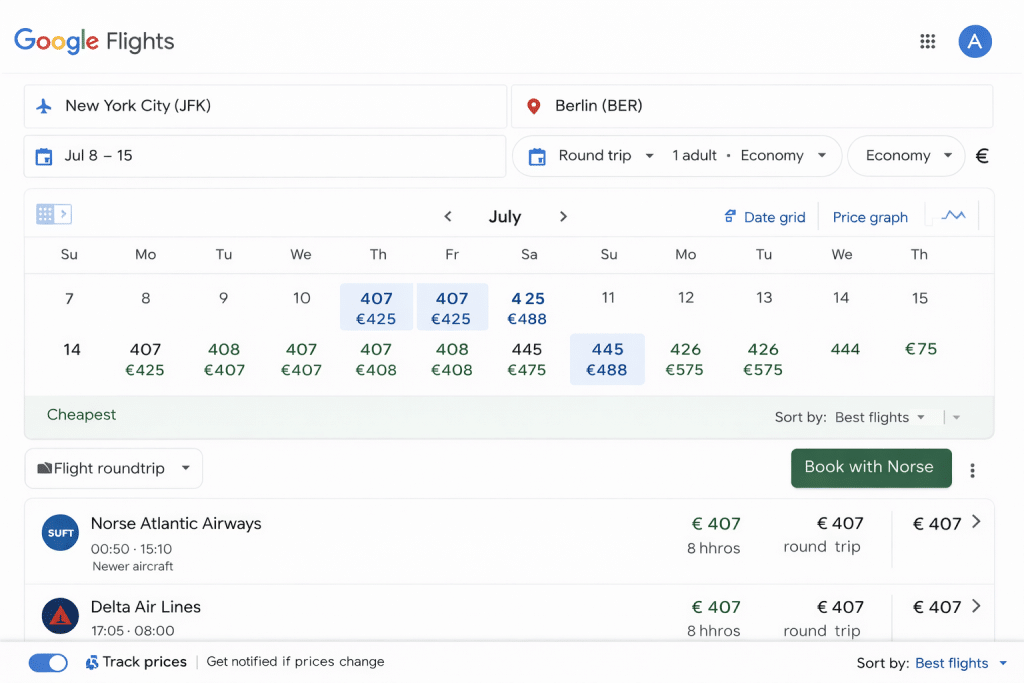
Google Flights is my starting point for every trip. The price calendar view shows you an entire month of fares at once. Set your departure airport to Frankfurt, Berlin, or Munich and search “Everywhere” on Skyscanner or Google Flights to see which destinations are cheapest on your available dates. This is how I found a €12 return to Kraków. As a student with semester breaks, you have more schedule flexibility than most travelers, which is your biggest advantage.
Book 4 to 8 Weeks in Advance
For European short-haul routes from Germany, the sweet spot is booking 4 to 8 weeks before departure. Later than 2 weeks and prices climb sharply. Set a Google Flights price alert on your target route and you will be notified automatically when fares drop, no need to check manually every day.
One of the best student weekend trips from Germany is Kotor in Montenegro. It is genuinely affordable and takes less effort to reach than most people expect. The budget travel guide to Kotor from Germany has a complete breakdown of how to get there, where to stay, and what it costs on a student budget.
Use the Right Booking Platform
For the actual booking, booking.grandroyaltravel.com makes it straightforward to compare and lock in the best fares quickly. Our guide to the best budget airlines in Europe covers each carrier’s German network and which routes consistently offer the lowest fares. For the full strategy including error fares and price alerts, see our guide on how to find cheap flights.
Consider FlixBus and Night Trains
For destinations within 6 hours of major German cities, FlixBus and night trains are worth comparing against flights. A Berlin to Prague FlixBus for €8 beats a €25 flight once you factor in airport transfers and check-in time. Night trains from Munich or Frankfurt to Vienna or Paris save on accommodation while you travel.
Student Discounts and Travel Hacks

ISIC Card, Your Most Useful Travel Document After Your Passport
The International Student Identity Card (ISIC) is recognised at thousands of museums, galleries, transport providers, and restaurants across Europe. Budapest’s Széchenyi thermal baths, Prague’s national museum, Vienna’s Kunsthistorisches Museum, all discounted or free for students. The card costs around €15 and pays for itself within one trip. Apply at isic.org or through your university.
German Semesterticket
Check your Semesterticket coverage carefully, some extend across state borders and save you €30 to €50 per trip in train fares just getting to your departure airport. Many international students are not aware of the full extent of their coverage. A student in Frankfurt paying for an airport train when their Semesterticket covers it is leaving money on the table every single trip.
Accommodation and Food Hacks
Book hostels rated above 8.5 on Hostelworld or Booking.com. This threshold reliably separates good hostels from mediocre ones. In Eastern Europe, €12 to €18 per night gets you a clean, social, well-located place with free breakfast in many cases. For food, follow university students: every student city has cheap canteens and local restaurants serving full meals for €2 to €4 that tourists almost never find.
Visa and Schengen Rules for Students in Germany
EU/EEA Citizens
Complete freedom of movement across all EU and EEA member states. No entry limits, no visa requirements, no 90-day rules. Your national ID card is sufficient in most EU countries, no passport required. You can move freely between Hungary, Poland, Czech Republic, Bulgaria, and all other EU member states without restriction.
Non-EU Students with a German Residence Permit
When you travel Europe as a student in Germany with a valid residence permit (Aufenthaltstitel) combined with your passport gives you the right to travel freely within the Schengen Area, 27 countries including France, Italy, Spain, Poland, Czech Republic, Hungary, Austria, and the Netherlands. No separate visa needed for any of these. The key rule is the 90/180-day limit for non-Schengen countries such as Serbia, Albania, and Montenegro. Our guide to traveling Europe without a visa covers everything by passport type.
Best Travel Seasons for Students in Germany
Shoulder Season, The Sweet Spot
April to early June and mid-September to late October are the ideal windows. Cheaper flights, cheaper hostels, less crowded tourist sites, and excellent weather across Central and Eastern Europe. These windows align with gaps between German university semesters and exam periods, making them practical for most students.
Christmas Market Season, Underrated
Late November and early December is one of the most atmospheric times to visit Central European cities. Prague, Vienna, Budapest, and Kraków all have extraordinary Christmas markets, and prices are significantly lower than in summer. One of the best-kept secrets of European student travel.
Avoid August If You Can
August is peak season across Europe. Flights are expensive, hostels are full, cities are crowded. Moving your main summer trip to late June or September saves money and delivers a better experience. Our guide to the cheapest countries to visit in Europe includes month-by-month guidance on optimal travel timing.
Common Mistakes Students Make When Travelling from Germany
- Booking flights too late, booking 2 weeks out instead of 6 can cost an extra €80 to €100 per return trip
- Ignoring the Semesterticket, check your full coverage before booking any ground transport to the airport
- Overpacking and paying baggage fees, a checked bag on Ryanair adds €25 to €40 each way, often doubling the flight cost; pack a 20-litre bag only
- Exchanging currency at the airport, use Revolut or Wise and withdraw from ATMs in the destination city instead
- Skipping travel insurance, your German health insurance covers EU emergencies but not cancellations or delays; a weekend policy costs €3 to €8

My Personal Experience: How I Travelled Europe as a Student in Germany
My first semester, I barely used Germany as the launch pad it is. But the moment I started to properly travel Europe as a student in Germany, everything changed. I was focused on settling in, finding accommodation, learning the U-Bahn, getting through the bureaucracy. By my second semester, I had figured out my Semesterticket coverage, downloaded Google Flights, and started paying attention to Skyscanner price alerts.
My first trip was to Budapest, €28 return from Frankfurt with Wizz Air, booked 6 weeks in advance. Three nights in a hostel for €14 per night. Three days of food, thermal baths, and ruin bar exploring for around €40 total. The entire trip cost me under €130 and it completely changed how I thought about living in Germany. I had been sitting on one of the best travel bases in the world without using it.
After that I became systematic about it. At the start of each month I would check Google Flights, identify the cheapest available destination on my free weekends, and book immediately if the fare was right. Over two academic years I visited Prague, Kraków, Vienna, Sofia, Bratislava, Warsaw, Tallinn, and Dubrovnik, all from Germany, all under €200 per trip including flights. None of these trips required significant planning beyond the initial booking.
The shift that made the biggest difference was treating cheap flights as a skill rather than luck. Once I understood that booking 5 to 7 weeks out on a Tuesday or Wednesday consistently produced fares 30 to 40% cheaper than last-minute booking, cheap travel stopped feeling like something that happened to other people. Everything I learned is distilled in GrandRoyal Travel’s complete guide to budget travel in Europe, and when you are ready to book your next trip, booking.grandroyaltravel.com is the fastest way to find and lock in the best deals.
Common mistakes students make
A lot of students spend more than they should because of simple mistakes.
Booking late is one of the biggest ones. Prices go up quickly, especially for trains.
Another mistake is ignoring hidden costs on budget airlines. A cheap ticket can become expensive if you add luggage and seat selection.
And finally, traveling without a simple plan. Even a basic idea of where you’re going and how much you’ll spend can save you money.
Frequently Asked Questions About Student Travel from Germany
How much money do I need to travel Europe as a student in Germany?
As you experience the diverse cultures, to travel Europe as a student in Germany will broaden your horizons and give you invaluable insights.
Embrace every opportunity to travel Europe as a student in Germany as it shapes your academic and personal journey.
Your time spent in Europe while you travel Europe as a student in Germany will be among the most cherished memories of your life.
For a 3-day weekend trip to Eastern Europe, Budapest, Prague, Kraków, or Sofia, budget €100 to €180 total including flights, accommodation, food, and local transport. Western European destinations like Amsterdam or Paris cost €200 to €350 for the same trip length. With careful booking, Eastern European trips regularly come in below €100. Our guide to traveling Europe on $50 a day shows exactly how to structure a daily budget once you land.
Can I travel Europe with a German student visa?
Yes. A valid German residence permit combined with your passport allows free travel across the 27-country Schengen Area. EU citizens studying in Germany travel on their national ID card alone. Always check the specific rules for your passport before visiting non-Schengen countries.
What is the cheapest way to travel from Germany to other European countries?

For distances over 5 hours, budget airlines, Ryanair, Wizz Air, and easyJet booked 4 to 8 weeks in advance, are usually cheapest. For shorter distances, FlixBus or BlaBlaCar often undercut flights once you factor in airport transfer costs and check-in time.
What does a typical trip cost?
Let’s keep it real. Here’s what you should expect for a short trip:
Transport: €20 to €80
Accommodation: €15 to €40 per night
Food: €10 to €25 per day
If you plan well, you can easily travel for a weekend with around €100 to €200.
Is the ISIC card worth it for student travel in Europe?
So plan your travels wisely, and to travel Europe as a student in Germany will lead you to experiences that are both enriching and unforgettable.
Ultimately, the chance to travel Europe as a student in Germany is a privilege that should be fully embraced, creating lifelong memories.
Absolutely. The ISIC costs around €15 and gives access to student discounts at thousands of museums, transport providers, and restaurants across Europe. It pays for itself within one or two uses at major attractions and is worth getting before any European trip.
So, if you have the chance to travel Europe as a student in Germany, seize it wholeheartedly.
When is the best time for students to travel from Germany?
April to early June and mid-September to late October, cheaper flights, lower prices, smaller crowds, excellent weather, and alignment with German university semester breaks. Late November for Christmas markets is also exceptional value. Avoid peak August if your schedule allows.
Start Exploring Europe from Germany, Your Next Trip Is Closer Than You Think

The opportunity to travel Europe as a student in Germany is one of the most underrated advantages you have. You’re already in the center of it all, with cheap transport options, student discounts, and access to countries that people plan for months to visit.
You don’t need a big budget. You just need the right approach.
Start small, learn how the system works, and build from there. A simple 3-day trip with a low-cost flight can take you into a completely different culture, and you can do it more often than you think.
If you stay consistent, book early, travel light, and spend wisely, your cost per trip will stay low while your experiences grow.
And when you’re ready to plan your next trip, you can explore deals and options on booking.grandroyaltravel.com,
Bulgaria is one of the cheapest countries in Europe and Plovdiv is its most interesting city for first-time visitors. The budget guide to Plovdiv from Germany covers the full trip including flight options, cheap hostels, and how to spend four days there for under €200 total.
As a student in Germany, your semester ticket already covers local transport, but for inter-country travel, trains are often the most affordable and practical option. The guide on how to travel Europe by train for cheap covers the passes, booking windows, and routes that consistently offer the best value for students.
If you are still working through the process of getting to Germany as a student, the complete guide on how to move to Europe from Nigeria covers the student visa application, blocked account requirements, and the full path from Nigeria to a German university.