

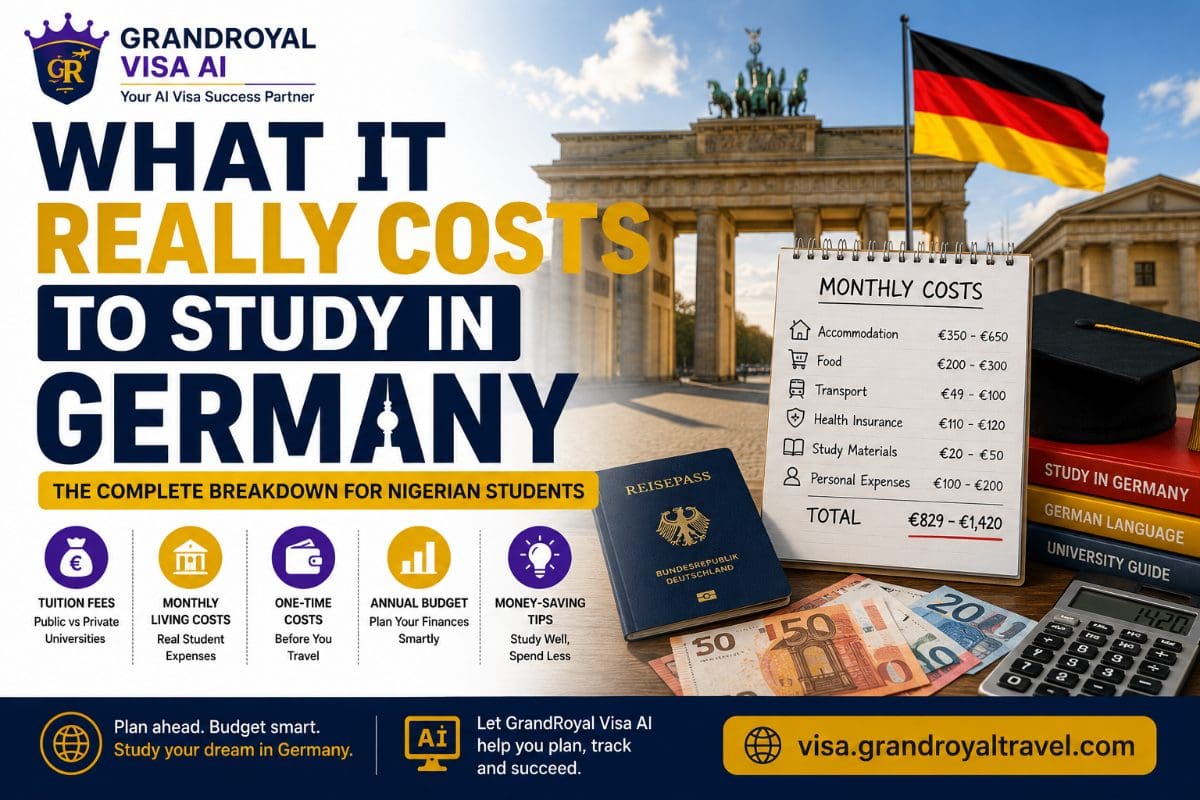
The cost of studying in Germany from Nigeria is the question that decides whether your plan is a dream or a real plan. Germany is marketed as tuition-free, and it is true that most public universities charge no tuition. But tuition-free is not cost-free.
This guide puts real 2026 numbers to the full journey. It covers the money you must prove, the non-refundable cash you spend in Nigeria before you ever board the plane, and what life actually costs once you land. Every figure here is tied to an official 2026 requirement or a current market rate, so you can budget with your eyes open.
All euro figures are set officially in euros and paid in naira at the daily exchange rate, so always confirm the naira amount on the day you pay.
The Real Cost of Studying in Germany From Nigeria at a Glance
There are three separate money buckets, and mixing them up is the most common planning mistake Nigerian students make.
The first bucket is money you must prove but keep. This is mainly the blocked account. The second bucket is money you actually spend before travel and never get back, like the visa fee, uni-assist, and document costs. The third bucket is your monthly living cost once you arrive.
Understanding these three buckets separately is what keeps you from panicking at the size of the blocked account, because that money is still yours.
| Bucket | What it is | 2026 amount (euros) |
|---|---|---|
| Money you prove but keep | Blocked account for one year | 11,904 |
| Cash you spend before travel | Visa, uni-assist, documents, flight | Roughly 800 to 1,650 |
| Monthly living cost after arrival | Rent, food, insurance, transport | 900 to 1,200 per month |
The rest of this guide breaks each bucket down line by line, in the order you will actually pay them.
Tuition Fees: Why Free Is Not Always Free
Most public universities in Germany charge no tuition fees, even for international students. This policy has been in place since 2014 and still holds in 2026. That is the good news, and it is real.
But you still pay a semester contribution at almost every public university. In 2026 this is usually between 100 and 450 euros per semester. It covers student administration, the student union, and in many cities a semester ticket for local public transport. That ticket is now valid nationwide, as we explain in our guide to the Deutschlandticket for students in Germany.
That semester ticket alone can be worth more than the fee, because it often covers your buses and trains across the whole region.
There are two important exceptions for non-EU students like Nigerians. Baden-Wurttemberg charges non-EU students an extra 1,500 euros per semester. In Bavaria, the Technical University of Munich charges international students from outside the EU between 2,000 and 6,000 euros per semester depending on the programme.
Private universities are a different world. They can charge anywhere from 5,000 to 20,000 euros per year. If your budget is tight, a public university outside Baden-Wurttemberg and outside TUM is the smart choice.
| University type | Tuition per year (2026) | Who it suits |
|---|---|---|
| Public, most states | None, only semester contribution | Budget-focused students |
| Public, Baden-Wurttemberg | About 3,000 (1,500 per semester) | Specific programmes only |
| TU Munich (non-EU) | 4,000 to 12,000 | Strong applicants with funding |
| Private universities | 5,000 to 20,000 | English programmes, flexible entry |
For a deeper list of free options, see our guide to English-taught programs in Germany with zero tuition.
The Blocked Account: The Biggest Number You Will See
The blocked account, or Sperrkonto, is the single largest figure in your plan. For 2026 you must show 11,904 euros for one year, which works out to 992 euros per month.
This is not a fee. It is your own money, held in a special account, released to you in monthly portions after you arrive. You spend it on your own rent and food. Think of it as your living budget that the embassy asks you to prove in advance.
You open the blocked account before your visa appointment, because the confirmation is a core visa document. We explain the full process in our guide to the blocked account for Nigerian students.
The providers do charge a small setup and monthly fee, and this is real spent cash. Here is how the main providers compare in 2026.
| Provider | Setup fee | Monthly fee | Note |
|---|---|---|---|
| Fintiba | About 159 euros | About 9.90 euros | Popular, fast, bundles insurance |
| Expatrio | About 89 euros | About 5 euros | Cheaper, bundles insurance |
| Coracle | Paused | Paused | New sign-ups paused since August 2025 |
The setup fee is money you spend, not money you get back. Budget for it as part of your upfront cash, not part of the blocked amount.
Upfront Costs You Spend in Nigeria Before You Travel
This is the bucket that surprises families. These are non-refundable naira payments you make while still at home, long before you see a German campus.
There is one cost you should not budget for, and it catches a lot of families. Nigeria is not on Germany’s APS list, so there is no APS certificate, no APS office and no APS fee for Nigerian qualifications. If an agent quotes you a price for APS processing in Abuja, it is a scam and the money is gone. Your certificates are verified by uni-assist using your WAEC or NECO scratch card, and again by the German Mission at the visa stage. Our full APS certificate Nigeria guide explains why the myth is so widespread.
Next is uni-assist, the service many German universities use to check foreign applications. It charges 75 euros for your first application and 30 euros for each extra university in the same semester. See our uni-assist application guide for the steps.
Then comes the student visa fee itself, which is 75 euros in 2026, paid in naira at the embassy.
On top of these, budget for document costs. These include WAEC and NECO legalisation, passport photographs, translations, courier fees, and travel to Abuja or Lagos for your appointment. Individually they are small, but together they add up.
Finally there is your one-way flight from Lagos or Abuja to Germany, which swings widely with season and booking timing.
| Upfront item | 2026 cost (euros) |
|---|---|
| uni-assist, first university | 75 |
| uni-assist, each extra university | 30 |
| Student visa fee | 75 |
| Blocked account setup | 89 to 159 |
| Documents, photos, translations, travel | 150 to 400 |
| One-way flight | 400 to 800 |
Add these together and most students spend somewhere between 900 and 1,800 euros in real cash before departure, on top of the blocked account.
Monthly Living Costs in Germany for a Nigerian Student
Once you arrive, your blocked account releases about 992 euros per month. Most students spend between 900 and 1,200 euros per month, so that budget is workable if you choose your city well.
Rent is the biggest single cost and the one that varies most. A room in a shared flat or a student dorm is far cheaper than a private studio. Big cities like Munich and Frankfurt are expensive. Smaller cities in eastern Germany and the Ruhr area are much kinder to your budget.
Health insurance is compulsory and roughly 120 to 130 euros per month for students on public insurance. This is not optional, so build it into every budget.
Food, transport, phone, and personal spending fill out the rest. Cooking at home instead of eating out is the single biggest lever a student controls.
| Monthly item | Typical range (euros) |
|---|---|
| Rent, shared flat or dorm | 350 to 600 |
| Health insurance | 120 to 130 |
| Food and groceries | 180 to 250 |
| Transport, often semester ticket | 0 to 40 |
| Phone and internet | 15 to 30 |
| Personal and study materials | 60 to 120 |
Choosing a cheaper city can save you 200 to 400 euros every month, which is the difference between struggling and being comfortable.
Your Full First-Year Budget, Put Together
Here is the honest first-year picture for a Nigerian student at a tuition-free public university outside the two expensive states.
Remember that the blocked account amount is money you spend on your own living, not an extra cost. The true extra cost of the first year is the upfront cash plus your semester contributions.
| Category | First-year amount (euros) |
|---|---|
| Blocked account, your living money | 11,904 |
| Upfront cash before travel | 900 to 1,800 |
| Semester contributions, two semesters | 200 to 900 |
| Buffer for setup and first-month deposits | 500 to 1,000 |
In plain terms, you should plan to have access to roughly 13,500 to 15,500 euros for a safe first year, with the bulk of that being your own living money.
Checklist: Every Cost to Budget For
Use this quick checklist so nothing surprises you.
- Blocked account of 11,904 euros for the year
- Blocked account setup and monthly fees
- WAEC or NECO scratch card, for uni-assist verification
- uni-assist, 75 euros plus 30 per extra university
- Student visa fee of 75 euros
- WAEC and NECO legalisation and translations
- Passport photos, courier, and appointment travel
- One-way flight to Germany
- Health insurance, about 120 to 130 euros per month
- First-month rent and deposit, often two to three months up front
- Semester contribution at enrolment
How to Lower the Cost of Studying in Germany From Nigeria
The total looks big, but several levers bring it down without cutting corners.
Pick a cheaper city. Rent in a small eastern German city can be half the price of Munich, and your semester ticket covers transport either way.
Apply to public universities only, and avoid Baden-Wurttemberg and TU Munich if you want to skip tuition entirely.
Chase scholarships early. Even a partial scholarship can cover your blocked account or your flights. Our guide on how to win a German scholarship from Nigeria shows the realistic routes.
Learn German before you travel. A student job pays more and comes easier when you speak the language, and some blocked-account pressure eases once you can legally work part time. Start with our guide on how to learn German in Nigeria.
Finally, understand the legal ways to prove funds beyond a blocked account, which we cover in our guide to proof of funds for a German student visa.
A Real Example: Chinaza’s First-Year Budget
Chinaza, a 23-year-old from Enugu, got admission to a tuition-free public university in Leipzig for a master’s programme in 2026.
Before travel, she paid 75 euros to uni-assist for one university, the 75 euro visa fee, about 89 euros to set up an Expatrio blocked account, and roughly 300 euros for documents, photos, and travel to Lagos. Her one-way flight cost about 520 euros. Her upfront cash was close to 1,060 euros, not counting the blocked amount. She paid nothing for APS, because it does not apply to Nigerian qualifications.
She funded her 11,904 euro blocked account with family support and a small personal savings. Once in Leipzig, she found a dorm room for 320 euros, paid 122 euros for health insurance, and kept her food bill near 200 euros by cooking at home.
Her actual monthly spend settled around 780 euros, below the 992 euros the blocked account released. That cushion let her save for travel during the holidays. Her lesson was simple. Choosing an affordable city did more for her budget than any other single decision.
Common Mistakes That Blow the Budget
The first mistake is treating the blocked account as a fee. It is your living money. Panicking about it leads students to give up too early.
The second mistake is forgetting the upfront naira cash. Families plan for the blocked account and then get caught out by visa, uni-assist, document, and flight costs stacking up at once.
The third mistake is choosing an expensive city out of familiarity. Munich and Frankfurt sound attractive, but they can cost hundreds more each month than a smaller city.
The fourth mistake is ignoring health insurance in the monthly plan, then being shocked by the compulsory 120 to 130 euro deduction.
The fifth mistake is booking flights late. Prices rise sharply close to the date, so book early once your visa is secure.
Frequently Asked Questions
How much does it really cost to study in Germany from Nigeria in 2026?
Plan for about 13,500 to 15,500 euros for a safe first year, but most of that is the 11,904 euro blocked account, which is your own living money that you spend on rent and food.
Is studying in Germany really free for Nigerian students?
Tuition at most public universities is free, but you still pay a semester contribution of 100 to 450 euros, plus your living costs, insurance, and upfront visa costs.
How much is the blocked account for 2026?
The blocked account is 11,904 euros for one year, which is 992 euros released to you per month.
How much does the student visa cost?
The German student visa fee is 75 euros in 2026, paid in naira at the embassy at the daily rate.
How much does uni-assist charge?
uni-assist charges 75 euros for your first university and 30 euros for each additional university in the same application round.
How much does the APS certificate cost in Nigeria?
Nothing, because it does not exist for Nigerian qualifications. Nigeria is not on Germany’s APS list, so there is no APS office, interview or fee in Nigeria. Anyone charging you for APS processing is defrauding you.
What are the monthly living costs for a student in Germany?
Most students spend 900 to 1,200 euros per month, with rent and health insurance being the biggest items.
How much is student health insurance in Germany?
Public student health insurance is roughly 120 to 130 euros per month in 2026, and it is compulsory.
Which German cities are cheapest for students?
Smaller cities in eastern Germany and the Ruhr area are usually far cheaper than Munich, Frankfurt, and Hamburg. Choosing well can save 200 to 400 euros a month.
Can I work to cover my costs while studying?
Yes. International students can work limited hours, and a student job helps a lot, especially once your German is strong. It does not replace the blocked account for the visa, though.
Do private universities cost more?
Yes. Private universities charge 5,000 to 20,000 euros per year, so public universities are the budget-friendly choice.
Is Bavaria or Baden-Wurttemberg more expensive?
Baden-Wurttemberg charges non-EU students 1,500 euros per semester, and TU Munich charges international fees. Choosing a public university in another state avoids this.
How much upfront cash do I need before I travel?
Budget 800 to 1,650 euros in real spending for visa, uni-assist, documents, blocked account setup, and your flight, separate from the blocked amount. There is no APS fee, because Nigeria is not on Germany’s APS list.
Does the semester fee include transport?
In many cities yes. The semester contribution often includes a semester ticket that covers local buses and trains, which is real value.
Final Word on the Cost of Studying in Germany From Nigeria
The honest cost of studying in Germany from Nigeria in 2026 is large on paper but manageable in practice, because most of the big number is your own living money in the blocked account.
Plan the three buckets separately, spend wisely on a cheaper city, and start early with your German and your scholarship search. Do that, and Germany remains one of the most affordable quality study destinations in the world for a Nigerian student.
For official cost and funding guidance, see the DAAD, and confirm visa fees on the German Missions in Nigeria website. When you are ready to plan your own numbers, the GrandRoyal Visa platform gives you personalised, step by step help.
You can also start with the full route in our pillar guide on the German student visa from Nigeria.
Ready to plan your study budget? Get personalised, step by step help with your German study and visa plans on the GrandRoyal Visa platform.