
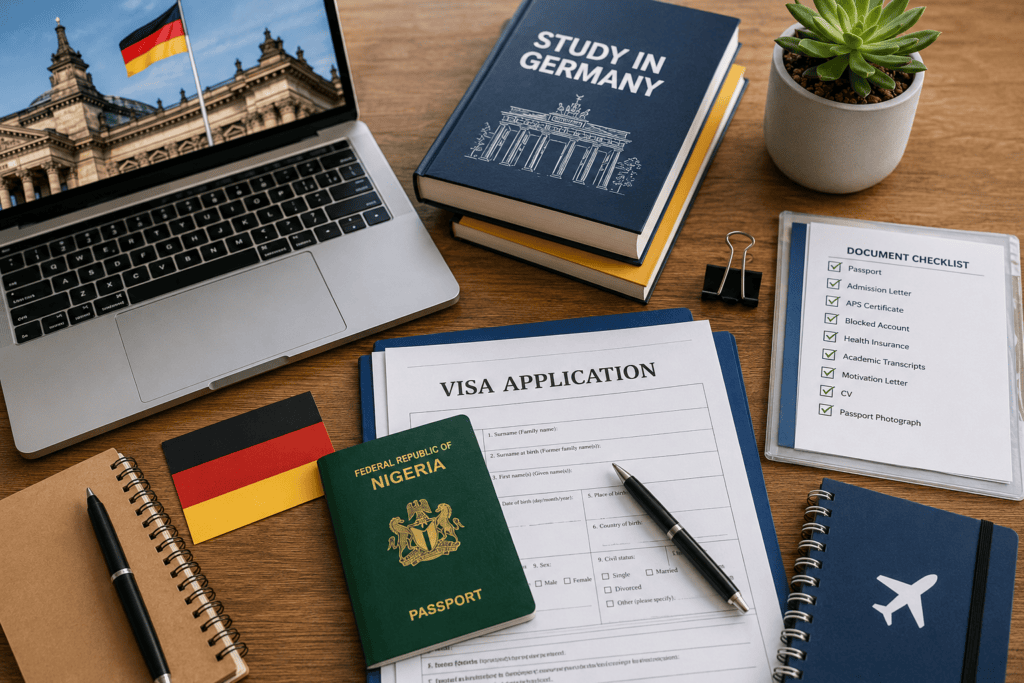
Some years ago I was sitting in my room in Lagos at 2am, staring at the ceiling and asking one question: is Germany actually possible for me? No rich sponsor, no agent, nobody in my family who had done it before. What I had was an admission dream, a tired laptop, and a pile of conflicting information. Today I live in Frankfurt. I went through the queues, the paperwork, and the blocked account panic, and I have spent the years since helping other Nigerians do the same.
This guide is the article I wish someone had handed me back then. It walks you through every step of the 2026 German student visa process from Nigeria, from the blocked account to the new VFS centre in Lekki, in the exact order you should do things. The process has changed since I applied, so every 2026 rule in this guide has been verified against the official sources linked at the bottom. Where something trips people up, I will tell you plainly, because most of it tripped me up first.
Quick answer: the German student visa from Nigeria in one paragraph
You apply for a national visa (type D) for study purposes. You need a university admission letter, a blocked account holding 11,904 euros for your first year, valid health insurance, your legalised WAEC or NECO certificates, proof of language ability, and a few supporting documents. As of 25 March 2026, Nigerian applications are no longer lodged at the consulate directly. You register online, then attend the new VFS Global German Student Visa Centre in Lekki, Lagos, for your documents and biometrics. The visa fee is 75 euros plus a VFS service fee of about 17,500 naira. Start at least three to four months before your course begins, because processing can take several weeks and gets slower in the busy summer season.
German student visa from Nigeria at a glance
| Detail | What to know (2026) |
| Visa type | National visa (type D) for study purposes |
| Where you apply | Online registration, then VFS Global Student Visa Centre, Lekki, Lagos |
| Blocked account | 11,904 euros for the year (about 992 euros per month) |
| Visa fee | 75 euros, paid in naira |
| VFS service fee | Around 17,500 naira, plus optional premium services |
| Language level | Usually B2, or as your programme requires |
| Processing time | Plan for several weeks, longer in peak summer months |
| Health insurance | Mandatory for the visa and after enrolment |
Amounts and rules change. Always confirm the current figures against the German mission in Nigeria and VFS Global before you pay anything.
What is the German student visa (and why it matters)
Germany issues a national visa, often called a type D visa, for anyone who plans to stay longer than 90 days to study. This is different from a Schengen tourist visa. The student visa lets you enter Germany, and once you arrive you convert it into a residence permit for study purposes at your local immigration office.
You need this visa if you are a Nigerian passport holder enrolling in a full degree, a foundation course (Studienkolleg), or a recognised language course that leads to study. If you have not been admitted yet, start with our guide on how to study in Germany for free as a Nigerian student, then come back here once you have your admission letter. If you want a degree taught fully in English, see our guide to English-taught programs in Germany with zero tuition.
The complete document checklist (2026)
Let me be honest about this checklist. None of these documents is hard to get on its own. The trap is the order. Chase them in the wrong sequence and you lose months, because some documents expire while you wait for others. I learned that the slow way, so follow the order below and you will not have to.
Gather these before you book your appointment. Missing or wrong documents are the single biggest cause of delays and rejections. See our full German student visa requirements checklist for the detail on each item.
- Valid Nigerian passport, with at least two blank pages and validity beyond your intended stay.
- Two fully completed and signed national visa application forms.
- Recent biometric passport photographs, 35 by 45 mm, light background, taken within the last six months.
- University admission letter (Zulassungsbescheid), or a conditional or Studienkolleg place where relevant.
- Blocked account confirmation showing 11,904 euros paid in and the monthly release amount.
- Proof of health insurance valid from your date of entry.
- Your academic certificates, including legalised WAEC or NECO results and, for postgraduate applicants, your degree and transcripts.
- Proof of language proficiency, usually B2 German, or English test scores for English-taught programmes.
- Yellow fever vaccination certificate, since Nigeria is a yellow fever region.
- A short CV and a motivation letter explaining your study plan.
Submit two full sets of your documents, the originals plus copies, unless VFS tells you otherwise. For what changed this year, see our guide to the Germany visa changes in 2026.
Step by step: how to apply for the German student visa from Nigeria
Step 1: Secure your university admission
Nothing starts without an admission letter. Apply early, because German universities have firm deadlines and the visa clock only starts once you are admitted. If cost is your concern, public universities charge little or no tuition, and there are funded options in our guide to fully funded scholarships in Germany for African students.
Step 2: Skip the APS, it does not apply to Nigeria
You will read on many sites that Nigerians need an APS certificate. You do not. Nigeria is not on Germany’s APS list. There is no APS office in Nigeria, no APS interview in Abuja and no APS fee for Nigerian qualifications. The APS covers applicants who studied in China, India, Vietnam or Mongolia, and it follows where you studied rather than your passport. Checked 24 August 2026 against the German Mission in Nigeria student visa checklist. Do not pay anyone to process an APS for you here: APS certificate Nigeria, why it does not apply.
Step 3: Open your blocked account
This is where most people get stuck. A blocked account, or Sperrkonto, holds 11,904 euros that proves you can fund your first year. The money is released to you in monthly portions of about 992 euros after you arrive. Open it well before your visa appointment, because the embassy only accepts the official confirmation showing both the total paid in and the monthly amount available. We compare the providers and show you the smoothest route in our blocked account guide for Nigerian students.
Step 4: Get health insurance for the visa
You must show valid health cover from the day you enter Germany. Many applicants use incoming or travel health insurance that meets the visa requirement, then switch to statutory student health insurance once they enrol. Bring the confirmation document to your appointment.
Step 5: Legalise your WAEC and NECO certificates
German authorities do not automatically accept Nigerian academic documents. Your WAEC or NECO certificates usually need to be legalised so the embassy can confirm they are genuine. For undergraduate and foundation applicants this is compulsory, and many universities ask for it too. Start this early, as verification through the examination bodies takes time. Our guide to WAEC legalisation for the German embassy walks through the exact process.
Step 6: Register online through the Consular Services Portal
Nigerian applicants now begin the process online. Create your profile, complete the visa application, and follow the instructions to request an appointment. Keep your details accurate and consistent with your documents.
Step 7: Attend your VFS appointment in Lekki
This is the big 2026 change. From 25 March 2026, the German mission moved Nigerian student visa processing to a dedicated VFS Global German Student Visa Centre in Lekki, Lagos. Your online registration now directs you to VFS, which handles document intake, biometrics, and the secure courier return of your passport. Expect the 75 euro visa fee plus a VFS service fee of around 17,500 naira, with optional extras like SMS alerts and courier return.
Step 8: Attend the interview
Most applicants have a short interview. It is not a trap, it is a check that your plan is genuine and that you can fund and complete your studies. Prepare honest, clear answers, and study our full list of German student visa interview questions beforehand.
Step 9: Wait for the decision, then travel
Processing takes time and is slower in the busy May to September window. Once approved, you receive your visa, travel to Germany, register your address, and convert the visa into a residence permit. Our guide on moving to Germany from Nigeria covers the first weeks after you land. For the arrival day itself, including which passport queue to join and why students are exempt from EES biometrics, read German Airport Arrival for Nigerians: Border Control, EES Biometrics and Customs.
What the German student visa really costs from Nigeria
When I added up my own numbers at the end, the visa fee itself was the smallest line on the list. It is everything around it, the blocked account, the trips to Lagos, the legalisation fees, that quietly stacks up. Here is the full picture so nothing catches you off guard.
| Item | Approximate cost |
| Blocked account (first year funds) | 11,904 euros, released monthly |
| Visa fee | 75 euros, paid in naira |
| VFS service fee | Around 17,500 naira |
| Health insurance | Varies by provider |
| Document certification and translations | Varies, budget ahead |
The blocked account is not a fee, it is your own money that you access monthly after arrival. Everything else is the real cost of applying. For the full picture, including living costs after you arrive, see our report on what it really costs to study in Germany from Nigeria.
Processing time: when to start
The waiting is the part nobody prepares you for. Between submitting documents and holding my passport again, I checked my email more times than I want to admit. Start earlier than feels necessary. Here is the timeline that actually matters.
There is no fixed guaranteed timeline, and it depends on your file and the season. The safest approach is to begin the whole process three to four months before your course starts, and to book your appointment as soon as your documents are ready. Applications submitted in the peak summer months take longer, so earlier is always better.
The visa interview: questions you should prepare for
I still remember rehearsing my answers under my breath the night before my appointment. Here is the truth I only understood afterwards: nobody is trying to trick you. They want to see that your story adds up, that you know your course, your city, your numbers, and your plan for after graduation. Prepare the questions below and walk in calm.
You do not need to memorise scripts. You need honest, specific answers. Expect versions of these:
- Why do you want to study in Germany, and why this university and programme?
- How does this course fit your career plan?
- How are you financing your studies?
- What are your plans after you graduate?
- Do you have ties that matter to your plans?
Answer clearly, keep your story consistent with your documents, and do not exaggerate. Vague or rehearsed answers raise doubts.
Top reasons German student visas get rejected (and how to avoid them)
Every reason on this list is one I have watched somebody go through, either in my own circle in Lagos or among the readers who write to me from this blog. None of them is random. Every single one has a fix, and most of them are avoidable before you ever submit.
- Incomplete or inconsistent documents. Use the checklist above and submit two clean sets.
- Wrong or insufficient financial proof. Your blocked account must show the exact required amount and the monthly release.
- Missing or invalid health insurance. Buy cover that starts on your entry date.
- A weak interview. Prepare genuine answers and know your own study plan.
- Doubts about your intent. Show a clear academic purpose and a realistic plan.
- Starting too late. Late applications get caught in the summer backlog.
If you are refused, you usually have the right to a written explanation and, in many cases, to appeal or reapply with a stronger file. Read the refusal carefully and fix the specific reason before you try again. Our guide on why German student visas get rejected for Nigerians covers this in depth.
After you get the visa: what happens next
The day my visa came through, I celebrated for about an hour and then realised the journey was only half done. Arriving in Germany starts a second checklist, and knowing it in advance made my first weeks in Frankfurt far easier than they could have been. Here is what happens next.
Your visa gets you into Germany, but the process is not over. Within your first weeks you register your address at the local Buergeramt, switch to statutory student health insurance, open a German bank account, and apply for your residence permit for study purposes. You can also begin working part time within the legal student limits. We cover the whole landing checklist in moving to Germany from Nigeria.
Frequently asked questions
How much money do I need for a German student visa from Nigeria in 2026?
You need a blocked account holding 11,904 euros for your first year, released at about 992 euros per month after you arrive. You also pay a 75 euro visa fee and a VFS service fee of around 17,500 naira.
Where do I apply for the German student visa in Nigeria now?
Since 25 March 2026, you register online and then attend the VFS Global German Student Visa Centre in Lekki, Lagos, for document submission and biometrics, rather than the consulate directly.
Do Nigerian students need an APS certificate?
No. Nigeria is not on Germany’s APS list. There is no APS office, interview or fee in Nigeria. The APS applies to applicants who studied in China, India, Vietnam or Mongolia. Checked August 2026.
How long does the German student visa take from Nigeria?
There is no guaranteed time. Plan for several weeks and expect longer during the busy summer months, so apply three to four months ahead.
Can I work on a German student visa?
Yes, students can work part time within the legal limits. Learn the current rules before you rely on a job to fund your stay.
What language level do I need?
Most German-taught programmes require B2. English-taught programmes usually accept IELTS or TOEFL. Always check your specific programme.
Sources and official references
- German mission in Nigeria, visa for students (nigeria.diplo.de)
- VFS Global Germany, Nigeria (visa.vfsglobal.com/nga/en/deu)
- Blocked account standard amount for 2026 (BAfoeG rate)
- Reporting on the move to the VFS Lekki student visa centre from 25 March 2026
Always confirm current amounts, fees, and procedures with the German mission in Nigeria and VFS Global before you apply, since figures and rules change.
Related guide: Boost your visa file and your first year in Germany by learning the language early. See our guide on how to learn German in Nigeria.
Ready to start your application? Get personalised, step by step help with your German visa on the GrandRoyal Visa platform.
Always confirm the latest requirements on the official German Missions in Nigeria website.
Keep reading
Once your visa is approved, the next challenge is the fortnight after you land. Our day by day guide to Arriving in Germany Winter Semester 2026: The 14-Day Setup Plan for Nigerians covers EES biometrics at the border, the Anmeldung deadline, opening a bank account and enrolling in time for lectures.
Join our Telegram channel for the latest Germany study, visa and relocation updates for Nigerians: https://t.me/+I2s3n-gtMIQ0ZjQy
Get GrandRoyal in your Google feed — add us as a preferred source
Free GrandRoyal verified directories
Browse our regularly checked, no-cost directories for studying, training and funding in Germany:
- Study in Germany directory: 81 verified English-taught university programmes
- Scholarships for Germany: 51 verified scholarships with deadlines and official links
- Ausbildung in Germany: paid vocational training, the visa route and verified programmes
- German language courses: courses and recognised exams for your visa or university
Frequently asked questions
What do Nigerians need for a German student visa in 2026?
A university admission letter, a blocked account of €11,904 (or another accepted proof of funds), health insurance, valid passport, and supporting documents, submitted via VFS Global.
How long does the visa take?
Usually 6 to 12 weeks from your appointment, depending on your file and the season.
Where do Nigerians apply?
Through VFS Global in Nigeria; the German mission makes the final decision.