
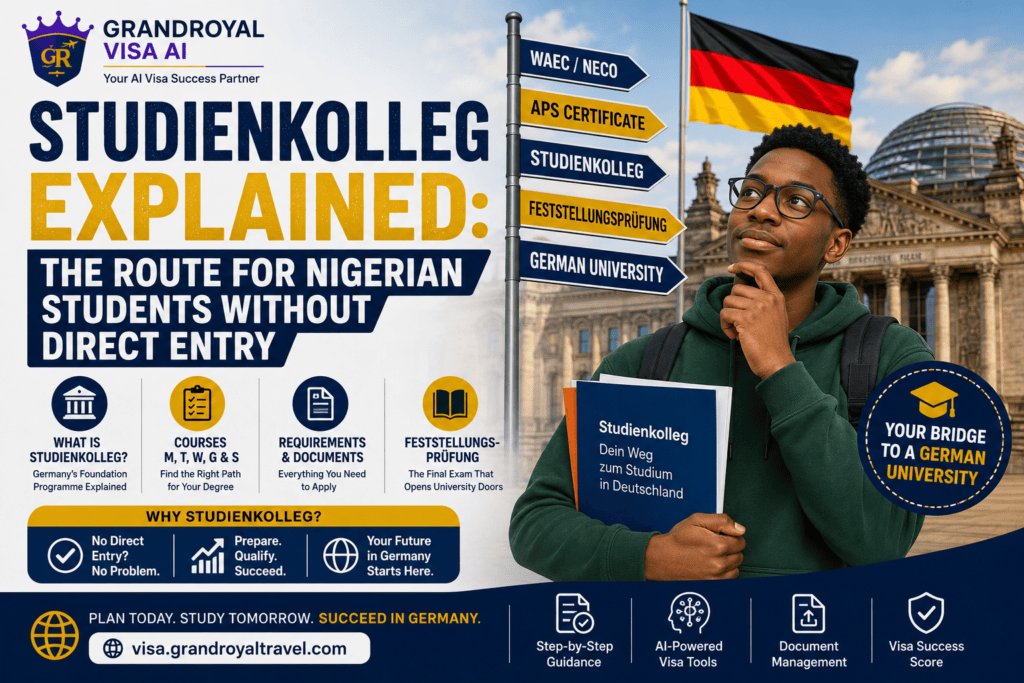
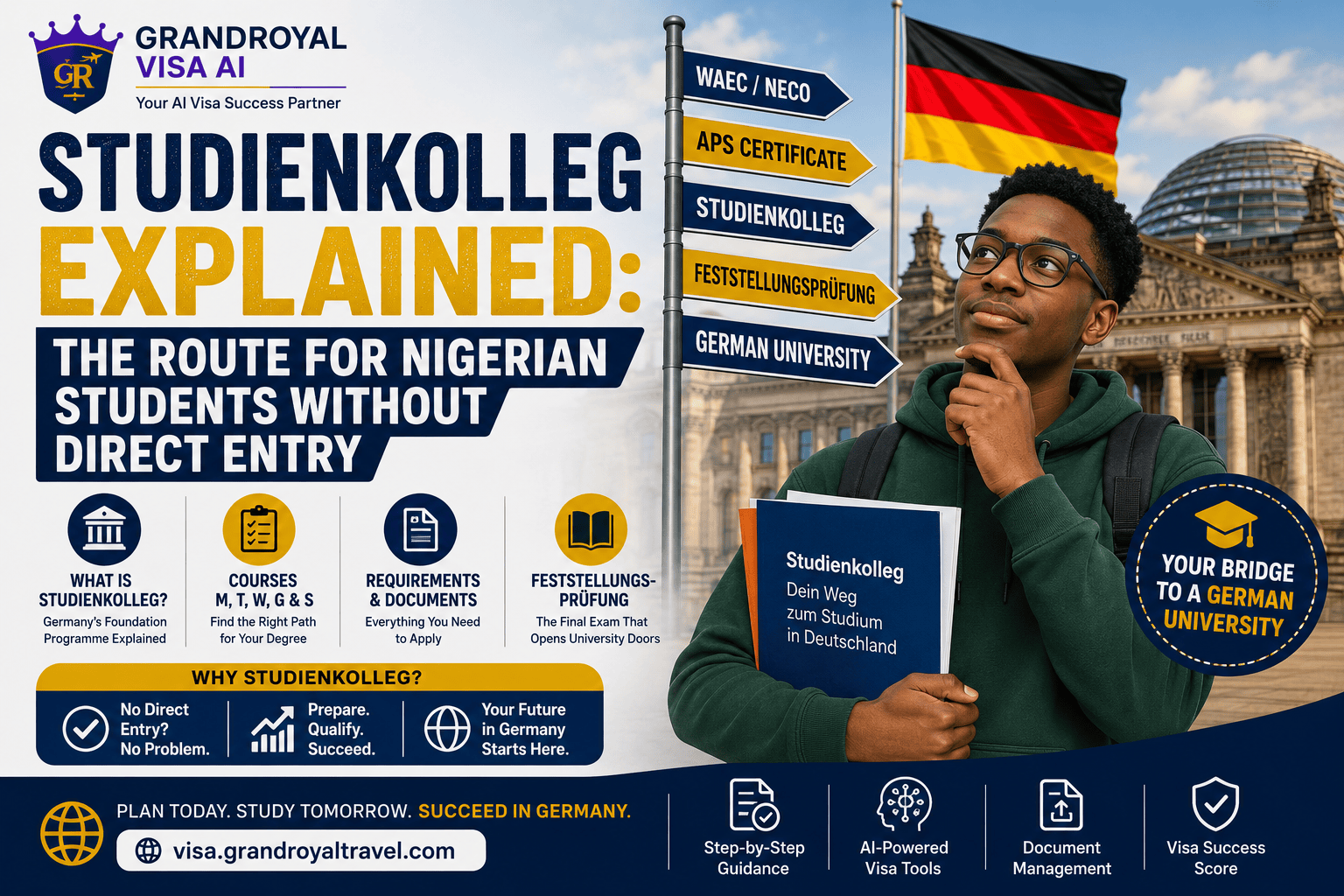
Imagine finishing your WAEC, getting excited about studying in Germany, and then discovering you cannot enter a German university directly. For thousands of Nigerian students, that moment feels like a door slamming shut. But here is the good news that changes everything: Studienkolleg for Nigerian students is not a rejection or a setback. It is a well-worn, respected bridge that carries you from your Nigerian certificate straight into a German degree.
If this is your situation, please do not panic and do not feel that you have failed. The German system simply works differently from ours. Your WAEC or NECO is valuable, but on its own it usually does not match the German school-leaving standard, the Abitur, that universities expect for direct entry. Germany created the Studienkolleg precisely to close that gap for international students like you.
In this complete guide I will explain what Studienkolleg is, why Nigerians often need it, how to check whether you qualify for direct entry instead, the different course types, the entrance exam, the all-important Feststellungsprüfung, the costs, the timeline, and the common mistakes to avoid. By the end, you will have a clear roadmap from your WAEC or NECO all the way to a German university.
Let us turn that closed door into an open pathway.
What Is a Studienkolleg?
A Studienkolleg is a preparatory college, a one-year foundation programme that gets international students ready for a German university. Think of it as a bridge between your secondary school qualification and a German bachelor’s degree. It brings your academic level and your German language up to the standard German universities expect.
The language bar here trips up more applicants than the academic requirements do. German Language Levels for University: A1 to C1 Explained for Nigerians covers why public Studienkollegs expect B2 in practice even when they state B1, and what you need after the Feststellungspruefung.
Here is a simple analogy. If a German bachelor’s degree is a house, the Abitur is the front door key that German students hold. Your WAEC or NECO is a different kind of key that does not quite fit that lock. The Studienkolleg is the workshop that reshapes your key so it opens the door. You spend about two semesters there, and at the end you take a final exam that gives you the qualification to enter university.
Germany created the Studienkolleg because school systems around the world differ. A student from Nigeria, India, or Vietnam may be bright and hardworking, but their secondary school path is not identical to the German one. Rather than shut those students out, Germany built a fair, structured way to prepare them. The Studienkolleg teaches you the specific subjects your future degree needs, sharpens your academic German, and helps you adjust to how German universities actually teach and examine.
So a Studienkolleg is not a punishment or remedial class. It is a genuine academic head start that makes you a stronger, better-prepared university student.
Why Nigerian Students May Need Studienkolleg
To understand why Studienkolleg for Nigerian students exists, you need to see how our education system differs from Germany’s. In Nigeria, you finish secondary school with WAEC or NECO, then usually spend four or more years earning a bachelor’s degree. In Germany, students finish 12 or 13 years of school with the Abitur, which already includes a level of study that overlaps with the first stage of a Nigerian university degree.
That difference is the whole reason. German universities compare your qualification to the Abitur. On its own, WAEC or NECO is usually judged to be below that direct-entry standard, so it does not by itself grant a place at a German bachelor’s programme. This is not about the quality of Nigerian students. It is about matching two different systems fairly.
Your documents are assessed against official German guidelines, handled by the Central Office for Foreign Education, known as the ZAB. If your WAEC or NECO meets the conditions, it qualifies you for a Studienkolleg rather than direct university entry. You do not need an APS certificate for any of this. Nigeria is not on Germany’s APS list, so there is no APS office, no APS interview and no APS fee for Nigerian qualifications. uni-assist verifies your WAEC or NECO results directly, using your scratch card number and PIN. Our APS Certificate Nigeria guide explains why that myth persists, and our WAEC and NECO legalization guide covers preparing your school certificates.
There is also the Anabin database, Germany’s official system for recognising foreign qualifications. It classifies how Nigerian certificates are viewed and whether they lead to direct entry or Studienkolleg. We will cover how to use it shortly.
The short version is this. For most Nigerian students entering with WAEC or NECO, Studienkolleg is the standard and expected route. It is normal, it is respected, and it works.
Studienkolleg for Nigerian Students: Do You Need It?
Not every Nigerian student needs Studienkolleg. Whether you do depends mainly on what you studied after secondary school. Here is a clear guide to the most common situations.
| Your Background | Studienkolleg Usually Needed? | Notes |
|---|---|---|
| WAEC or NECO only | Yes | The standard route for most school-leavers |
| WAEC plus A Levels | Often no | Strong A Levels can grant direct entry, subject to checks |
| One or two years of a Nigerian university | Often no for related field | Completed study can qualify you for direct admission |
| Completed Nigerian bachelor’s degree | No for bachelor’s, use it for a master’s | A full degree can grant direct or master’s entry |
| Transfer student mid-degree | Depends | Credits and field are assessed individually |
| International Baccalaureate (IB) | Often no | A recognised IB can grant direct entry |
| Cambridge or other A Level qualifications | Often no | Depends on subjects and grades |
As a rule of thumb, if you are applying with just WAEC or NECO, plan for Studienkolleg. If you have completed one or two years of relevant university study in Nigeria, you may qualify for direct admission to a bachelor’s programme in a related field. And if you already hold a full Nigerian bachelor’s degree, you generally aim for a master’s rather than a Studienkolleg.
Because every case is slightly different, it is worth checking your specific situation rather than guessing. You can check whether you need Studienkolleg using GrandRoyal Visa AI, which reviews your qualifications and points you to the right pathway.
How to Check If You Qualify for Direct Entry
Before committing to Studienkolleg, confirm whether you might qualify for direct entry. Here is how to check, step by step.
- Use the Anabin database. Anabin is Germany’s official recognition system. Search for your Nigerian qualification and your intended German programme to see how your certificate is classified and whether it leads to direct entry or Studienkolleg.
- Use the DAAD admission database. The DAAD, Germany’s academic exchange service, offers tools that show admission requirements for international students by country. It is a reliable, official reference.
- Check the university’s own requirements. Each university and programme lists its exact entry conditions. Two universities can treat the same qualification slightly differently, so always read the specific programme page.
- Confirm through uni-assist. uni-assist assesses your WAEC or NECO against ZAB guidelines and, where a university asks for one, issues a VPD stating exactly what your certificates qualify you for. That assessment, not an APS certificate, decides direct entry or Studienkolleg.
If these checks show you qualify for direct entry, wonderful, you can skip Studienkolleg. If they point to Studienkolleg, you now know your route with certainty rather than assumption. Either way, the next steps in your journey, the blocked account and the visa, are covered in our German student visa guide.
Types of Studienkolleg Courses
Studienkolleg is not one-size-fits-all. You choose a course, called a Kurs, based on the degree you eventually want. Each course prepares you for a specific family of university programmes. Here are the five main types.
T-Kurs (Technical and Science)
Subjects studied: German, Mathematics, Physics, Chemistry or Computer Science, and technical drawing in some colleges. Who should apply: Students aiming for engineering, computer science, physics, mathematics, architecture, and other technical fields. Afterward: You can apply to engineering, IT, physics, maths, and architecture degrees.
M-Kurs (Medicine and Biology)
Subjects studied: German, Biology, Chemistry, Physics, and Mathematics. Who should apply: Students aiming for medicine, dentistry, pharmacy, biology, and health sciences. Afterward: You can apply to medicine, dentistry, pharmacy, biology, and related life-science degrees. Note that medicine itself is highly competitive.
W-Kurs (Business and Economics)
Subjects studied: German, Mathematics, Economics, and Business or Social Studies. Who should apply: Students aiming for business, economics, management, finance, and marketing. Afterward: You can apply to business administration, economics, management, finance, and marketing degrees.
G-Kurs (Humanities)
Subjects studied: German, History, Literature, and German Studies or Social Sciences. Who should apply: Students aiming for humanities, languages, arts, history, and related fields. Afterward: You can apply to humanities, arts, history, philosophy, and language-based degrees.
S-Kurs (Languages and Social Sciences)
Subjects studied: German, a second language, History, and Social Sciences. Who should apply: Students aiming for languages, social sciences, translation, and education. Afterward: You can apply to language, social science, translation, and education degrees.
[Suggested diagram: a simple chart mapping each Kurs (T, M, W, G, S) to the university degrees it unlocks.]
Choosing the right course matters enormously, because your Kurs determines which degrees you can enter afterward. Pick the one that matches your true career goal, not just the one that looks easiest.
Public vs Private Studienkolleg
One of the biggest decisions you will make is whether to attend a public or a private Studienkolleg. Here is an honest comparison.
| Factor | Public Studienkolleg | Private Studienkolleg |
|---|---|---|
| Tuition | Essentially free, only a semester fee | Paid, often several thousand euros |
| Admission | Competitive, via entrance exam | Easier, sometimes no entrance exam |
| Difficulty | Rigorous and demanding | Varies, sometimes gentler |
| Recognition | Widely recognised by all universities | Recognition can vary, always verify |
| Class size | Larger classes | Often smaller classes |
| Quality | Consistently high standard | Depends on the specific college |
| Pros | Free, respected, strong preparation | Easier entry, flexible start dates |
| Cons | Hard to get a place, entrance exam | Expensive, recognition must be checked |
My honest recommendation for most Nigerian students is to aim for a public Studienkolleg first. It is essentially free apart from a small semester fee, its Feststellungsprüfung is recognised everywhere, and its academic preparation is excellent. A private Studienkolleg can be a sensible backup if you cannot secure a public place, but always confirm that its qualification is accepted by the universities you are targeting before you pay.
Admission Requirements
To apply for a Studienkolleg, you will need to prepare a complete set of documents. Here is the full checklist with a note on each.
- International passport. Valid, with your name spelled consistently across all documents.
- WAEC certificate. Your original secondary school result, verifiable and genuine.
- NECO certificate. If you sat NECO, include it too. Many students submit both.
- Academic transcripts. Any university transcripts if you have some tertiary study.
- WAEC or NECO scratch card. The card number and PIN, so uni-assist can verify your results directly with the examination board. This replaces the APS certificate that Nigerian applicants are often wrongly told to get.
- Translations. Certified or sworn translations only for documents not in English or German.
- German language certificate. Proof of your German level, usually B2, from a recognised provider.
- Application form. The Studienkolleg’s own form, or the uni-assist application where required.
- Motivation letter. A short, clear letter explaining your goals and course choice.
- CV. A simple, honest curriculum vitae.
Get these ready early, because gathering originals, translations, and language certificates takes time. You can generate a personalised Studienkolleg document checklist with GrandRoyal Visa AI so nothing is missed.
German Language Requirements
German is the heart of Studienkolleg, and it is where many students underestimate the challenge. Most public Studienkollegs require at least B2 German to sit the entrance exam, and some accept B1 with the expectation that you will keep improving. By the time you take the Feststellungsprüfung at the end, your German should be around C1, which is also the level German universities expect for direct study.
So the realistic path is this. Enter your Studienkolleg at B2, and leave it at roughly C1. This is completely achievable with focused preparation, but it means you should start learning German early, ideally long before you apply.
For recognised proof of your level, prepare with a reputable provider. The most widely accepted options are the Goethe-Institut, telc, and TestDaF certificates. A Goethe or telc B2 certificate is a common way to meet the entry requirement, while TestDaF is often used at the university stage. Begin German lessons as soon as you decide on Germany, because language is the single biggest factor in Studienkolleg success.
The Studienkolleg Entrance Exam (Aufnahmeprüfung)
The entrance exam, called the Aufnahmeprüfung, is how public Studienkollegs decide who gets a place. This is one of the most important stages, so let me explain it fully.
Its purpose is simple. Because public places are limited and free, the Studienkolleg needs to select students who are ready to cope with the programme. The exam checks that your German and your foundational subject knowledge are strong enough to succeed.
The exam almost always tests two areas. First, German language, through reading comprehension, grammar, and sometimes writing, to confirm you can follow lessons taught in German. Second, mathematics, and depending on your chosen Kurs, sometimes a subject element, to confirm your academic base. For technical and medical courses especially, maths is central.
The difficulty is real but fair. It is pitched at a level a well-prepared secondary school graduate can reach with focused revision. The passing score varies by college and course, and because places are competitive, aiming comfortably above the minimum is wise. Missing a place often comes down to weak German rather than weak maths, so prioritise your language.
Here is how to prepare well. Build your German steadily to a strong B2 or beyond. Revise core secondary maths thoroughly, including algebra, functions, and geometry. Practise past entrance papers where your target college provides them. And simulate exam conditions so the real day feels familiar.
A few sample-style questions to show the flavour:
- German: Read a short passage and answer comprehension questions, then complete sentences with the correct grammatical form.
- Mathematics: Solve a quadratic equation, simplify an algebraic expression, or calculate the area of a described shape.
- Technical (T-Kurs): A basic physics or applied maths problem, such as calculating speed, force, or a simple circuit value.
Prepare seriously, and the entrance exam becomes a hurdle you clear with confidence rather than a wall that stops you.
Feststellungsprüfung Explained
The Feststellungsprüfung, often shortened to FSP, is the final exam at the end of your Studienkolleg, and it is the qualification that actually opens the university door. Everything in your Studienkolleg year builds toward it.
It is what it sounds like: an assessment examination that confirms you are ready for German university study in your chosen field. It usually happens at the end of your two semesters, after roughly a year of preparation.
The subjects tested match your Kurs. A T-Kurs student is examined in German, mathematics, and sciences like physics or chemistry. An M-Kurs student faces biology, chemistry, and related sciences. A W-Kurs student is tested in economics and maths, and so on. German is always part of it, because you must prove you can study at university level in German.
The grading produces a final grade that functions like your German-equivalent school-leaving result. Universities use this Feststellungsprüfung grade, together with any subject requirements, to decide admission. A strong FSP grade widens your choice of universities and programmes, especially for competitive fields, so it genuinely pays to aim high.
If you fail, it is not necessarily the end. Many students are allowed to retake the Feststellungsprüfung, usually once, depending on the college’s rules. But retaking costs time, so the goal is always to pass well on the first attempt through consistent effort across the year.
In short, the entrance exam gets you into Studienkolleg, and the Feststellungsprüfung gets you into university. Respect both, and prepare for both.
The Full Timeline
Seeing the whole journey laid out removes a huge amount of anxiety. Here is the typical path from finishing secondary school to starting your German degree.
Finish secondary school (WAEC / NECO)
        |
        v
Start learning German  (aim for B2, then C1)
        |
        v
Apply to Studienkolleg  (documents + application)
        |
        v
Sit the entrance exam (Aufnahmeprüfung)
        |
        v
Attend Studienkolleg  (about two semesters)
        |
        v
Pass the Feststellungsprüfung (FSP)
        |
        v
Apply to a German university  (using your FSP grade)
        |
        v
Receive admission, then apply for your student visa
Notice how early German learning sits in the journey. It is the single thing Nigerian students most often start too late. Begin it as soon as you decide on Germany, and the rest of the timeline flows smoothly.
Costs
A major advantage of the public Studienkolleg route is affordability. Here is a realistic picture of what to budget for.
| Expense | Estimated Cost |
|---|---|
| Public Studienkolleg tuition | Free, apart from a small semester fee |
| Semester fee | Around €100 to €350 per semester |
| Accommodation | Around €300 to €500 per month |
| Health insurance | Around €120 to €130 per month |
| Food and groceries | Around €200 to €250 per month |
| Transport | Often covered by the semester ticket |
| Books and materials | A modest monthly amount |
| Blocked account (visa requirement) | €11,904 for the year |
The tuition itself is essentially free at a public Studienkolleg, which is why this route is so attractive. Your biggest cost is simply living in Germany, and that is exactly what the blocked account is designed to cover. To understand how that works, read our German blocked account guide. Roughly speaking, you should plan for around €11,904 for the year in your blocked account, plus your travel and setup costs.
Best Studienkollegs in Germany
There are respected public Studienkollegs across Germany, attached to universities or run by regional states. Rather than chase a single ranking, focus on colleges that offer your Kurs, are publicly funded, and are recognised nationwide. Well-known public Studienkollegs are found in cities and regions such as Berlin, Hamburg, Munich, Karlsruhe, Hannover, Darmstadt, Marburg (Mittelhessen), Konstanz, and Nordhausen, among others.
When choosing, check a few things for each option. Confirm which courses (T, M, W, G, or S) it offers, since not every college runs every Kurs. Check its exact entrance requirements and German level. Read its application process and deadlines carefully, as some apply directly and others through uni-assist. And verify its location and living costs, since these vary widely across Germany.
Always apply to more than one Studienkolleg where possible, because public places are competitive. Treat the official college website as your source of truth for requirements and dates, and apply early within the stated window.
Common Mistakes Nigerian Students Make
Avoid these frequent errors and you will move ahead of most applicants.
Applying too late. Missing the application window is heartbreaking and avoidable. Fix: note the deadlines early and apply within the stated period.
Ignoring German language requirements. Underestimating German is the number one reason students struggle. Fix: start German early and reach a strong B2 before the entrance exam.
Choosing the wrong course. Picking the wrong Kurs can block your target degree. Fix: choose the Kurs that matches your intended university programme.
Poor entrance-exam preparation. Walking in unprepared wastes a rare opportunity. Fix: revise German and maths seriously and practise past papers.
Paying for APS. Nigeria is not on Germany’s APS list, but agents still charge Nigerian students for APS processing and appointments. Fix: do not pay for it and do not hand over original certificates. Our APS certificate guide explains what is actually checked instead.
A weak motivation letter. A vague letter weakens your application. Fix: write a clear, specific letter about your goals and course choice.
Incorrect translations. Uncertified or wrong translations cause rejections. Fix: use certified or sworn translations only where actually required.
Avoid these and your Studienkolleg application becomes far stronger and smoother.
Related: thinking about medicine? Read How to Study Medicine in Germany From Nigeria With WAEC Only.
Frequently Asked Questions
1. What is a Studienkolleg in simple terms? It is a one-year preparatory college that bridges your Nigerian qualification and a German university degree.
2. Do all Nigerian students need Studienkolleg? Most who apply with only WAEC or NECO do. Those with completed university study or strong A Levels may qualify for direct entry.
3. Can I study in English at Studienkolleg? Public Studienkollegs are taught in German, so you need German. Some private options differ, but the standard route is German.
4. Can I skip Studienkolleg? Only if you qualify for direct entry, for example with completed university study, a recognised degree, or certain qualifications. Otherwise it is required.
5. How long does Studienkolleg take? Usually two semesters, about one year, ending with the Feststellungsprüfung.
6. What German level do I need? Usually B2 to enter and sit the entrance exam, rising to around C1 by the Feststellungsprüfung.
7. Is public Studienkolleg free? Tuition is essentially free apart from a small semester fee. Private Studienkollegs charge tuition.
8. What is the Feststellungsprüfung? It is the final exam that qualifies you to enter a German university in your chosen field.
9. What is the Aufnahmeprüfung? It is the entrance exam that decides admission into a public Studienkolleg, testing German and maths.
10. Which Kurs should I choose? Choose based on your target degree: T-Kurs for engineering and science, M-Kurs for medicine and biology, W-Kurs for business, G-Kurs for humanities, S-Kurs for languages and social sciences.
11. Can I work during Studienkolleg? Students can usually work limited hours within the visa rules, but Studienkolleg is demanding, so prioritise your studies.
12. Can I change my course afterward? Your Kurs and Feststellungsprüfung shape which degrees you can enter, so changing to an unrelated field can be difficult. Choose carefully from the start.
13. Can I transfer universities after Studienkolleg? Your Feststellungsprüfung is recognised nationwide, so you can apply to different universities that accept your grade and Kurs.
14. What happens if I fail the Feststellungsprüfung? You can often retake it once, depending on the college, but aim to pass first time through steady preparation.
15. Can scholarship students attend Studienkolleg? Yes. A scholarship helps with funding, but you still follow the same academic and language requirements.
16. Do I still need APS for Studienkolleg? No. Nigeria is not on Germany’s APS list. Your WAEC or NECO results are verified by uni-assist using your scratch card number and PIN.
17. Do I need a blocked account for the Studienkolleg visa? Yes. You apply for a student visa and typically need the required blocked account amount.
18. How competitive are public Studienkollegs? Quite competitive, because they are free and respected. Apply to more than one and prepare well for the entrance exam.
19. Can I do Studienkolleg online? The standard public route is in person in Germany. Some private preparation is online, but verify recognition carefully.
20. Is Studienkolleg the same as a foundation year? Yes, it is Germany’s version of an international foundation programme.
21. Which is harder, the entrance exam or the Feststellungsprüfung? Both matter. The entrance exam gets you in; the Feststellungsprüfung gets you into university and carries more weight for admission.
22. Can I apply to Studienkolleg from Nigeria? Yes. You apply from Nigeria, often through the college directly or uni-assist, then travel after admission and visa approval.
23. Do I need NECO as well as WAEC? Not always, but many students submit both to strengthen their results. Genuine, verifiable certificates matter most.
24. Will Studienkolleg guarantee a university place? Passing the Feststellungsprüfung qualifies you to apply, but each university still makes its own admission decision.
25. How early should I start preparing? As early as possible. Begin German long before the application window opens, and get your WAEC or NECO scratch card ready for uni-assist.
26. Can I choose any university after Studienkolleg? You can apply to universities that accept your Kurs and Feststellungsprüfung grade, subject to their requirements.
27. What if my German is only B1? Some colleges accept B1 to start, but you must reach a higher level for the Feststellungsprüfung, so keep improving.
28. Is medicine possible through Studienkolleg? Yes, via the M-Kurs, but medicine is highly competitive and needs strong grades.
29. Do I need translations of my WAEC? WAEC is in English, so translation is often unnecessary. Translate only documents not in English or German.
30. How do I know if I truly need Studienkolleg? Check Anabin, the DAAD tools, the university requirements, and your uni-assist assessment, or get a personalised review.
How GrandRoyal Visa AI Helps
The Studienkolleg pathway has many moving parts, from checking eligibility to German, uni-assist, applications, and the visa. Trying to juggle all of it alone is exactly where students get overwhelmed and make costly mistakes. This is where GrandRoyal Visa AI becomes your guide.
It starts by helping you check your eligibility, so you know whether you need Studienkolleg or qualify for direct entry before you waste time on the wrong path. You can organise your documents, upload your WAEC and NECO, and generate a personalised document checklist tailored to the Studienkolleg route. It helps you improve your Visa Success Score so you know how strong your overall application is, prepare a clear motivation letter, and practise interview questions for your visa stage.
Beyond that, it helps you discover scholarships you may qualify for and track your entire application, from your first uni-assist submission all the way to university admission, so nothing slips through the cracks. Think of it as an admissions consultant that keeps your whole Germany journey organised and on schedule.
If you want to move from confusion to a clear plan, check your eligibility and build your Studienkolleg roadmap with GrandRoyal Visa AI today.
Conclusion
If you take one thing from this guide, let it be this: Studienkolleg for Nigerian students is an opportunity, not a setback. Discovering that your WAEC or NECO does not grant direct entry can feel discouraging, but as you now understand, Germany simply built a fair, respected bridge for students from different school systems. Thousands of Nigerians have crossed that bridge into excellent German degrees, and you can too.
You now know what a Studienkolleg is, why Nigerians usually need it, how to check whether you qualify for direct entry, the different course types, the entrance exam, the Feststellungsprüfung, the costs, and the timeline. That is a complete roadmap from your certificate to a German university.
So begin early, and begin with the two things that matter most: improving your German toward B2 and beyond, and getting your WAEC or NECO verification ready. Organise your documents carefully, choose the right Kurs for your goals, and prepare seriously for both exams. And to keep every step organised, from eligibility to admission, let GrandRoyal Visa AI guide your Studienkolleg journey. Your German degree is closer than it feels right now. Take the first step today, and keep walking.
Read more on the official DAAD website.
Keep reading
Keep reading
Never miss a deadline. Join the GrandRoyal Travel newsletter for weekly intake dates, scholarship openings and visa rule changes for Nigerians heading to Germany.
Join our Telegram channel for the latest Germany study, visa and relocation updates for Nigerians: https://t.me/+I2s3n-gtMIQ0ZjQy
Get GrandRoyal in your Google feed — add us as a preferred source
Frequently asked questions
Do Nigerian students need a Studienkolleg?
Often yes for a bachelor's, unless your qualifications already meet direct-entry rules. Check your specific eligibility first.
How can I skip Studienkolleg?
Typically with completed university study in Nigeria or qualifications recognised as equivalent to the German Abitur.
How long does it take?
About one year, ending with the Feststellungsprüfung (FSP) exam.