
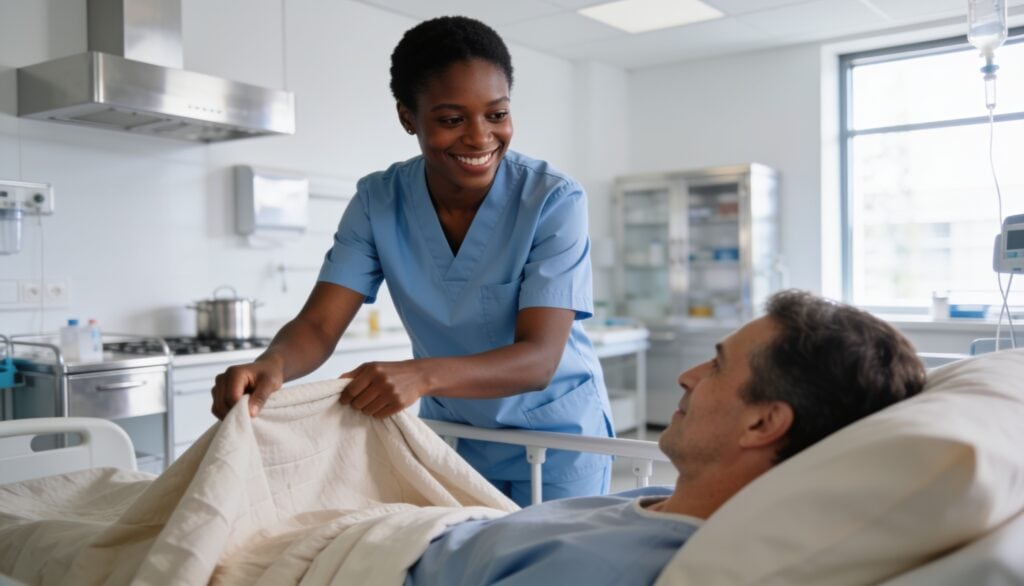

If you are a trained nurse in Nigeria and you dream of a stable, well-paid career abroad, then nursing in Germany from Nigeria is one of the strongest and most realistic routes available in 2026. Germany has a deep and growing shortage of nurses, salaries are solid, the job is secure, and the pathway leads to permanent residence and eventually citizenship. But the process is not a shortcut.
You need German at B2 level, you need your Nigerian qualification recognised through a process called Anerkennung, and you need to understand a few important rules, including where Nigeria stands on international recruitment guidance. This guide explains the entire journey in plain, warm English, with real 2026 figures, the exact steps, the costs, the salary you can expect, the common mistakes, and a full checklist you can start using today.
Nursing is one of the most reliably sponsored professions for Nigerians, but the same employer side rules apply across every field. See Visa Sponsorship Jobs in Germany for Nigerians: How to Actually Find Them for how German sponsorship actually works.
Get Free Germany Scholarship and Visa Updates
Join students across Africa receiving the latest scholarship deadlines, visa tips, and application guides straight to their inbox.
Why Germany needs nurses (and why this is good news for you)
Germany is one of the fastest-ageing countries in the world. Its population needs more care every year, while the number of German nurses entering the workforce cannot keep up. Estimates point to hundreds of thousands of unfilled nursing roles across hospitals, clinics, and elderly care homes over the coming years. That shortage is exactly why Germany has built clear legal routes for qualified foreign nurses to come, get recognised, and work. For a Nigerian nurse with real training and the discipline to learn German, this is a genuine open door, not a lottery.
Nursing also sits inside a larger relocation picture. If your goal is to build a permanent life in Europe, read our pillar guide on how to move to Europe from Nigeria to see how nursing compares with the other legal routes such as Ausbildung, the skilled worker visa, and the Opportunity Card. You can also check the official overview on Make it in Germany.
Nursing in Germany from Nigeria: the honest overview
Let us be clear and honest from the start, because this matters. Nigeria appears on the World Health Organization’s 2023 health workforce support and safeguards list. That list flags countries with severe health worker shortages and asks wealthy countries to avoid aggressive, organised recruitment from them. Germany respects this guidance, which is why Nigeria is not part of Germany’s official government-to-government recruitment programme, Triple Win. Triple Win recruits from countries like the Philippines, Indonesia, India, Tunisia, and Bosnia and Herzegovina, not Nigeria.
Here is the key point that many people misunderstand. The WHO safeguards list discourages active, mass recruitment. It does not ban individual nurses from applying on their own initiative. You, as an individual Nigerian nurse, can still apply directly to German employers, get your qualification recognised, and receive a visa. You simply do it through the individual pathway rather than through a Triple Win agency. That distinction is the difference between confusion and a working plan, so keep it in mind throughout this guide.
The two ways your nursing route can look
Depending on how your Nigerian qualification compares to the German standard, your journey will follow one of two shapes.
- Full recognition: If the German authority decides your qualification is equivalent to the German nursing qualification (Pflegefachfrau or Pflegefachmann), you are recognised as a full nurse (Pflegefachkraft) once you also pass the German language requirements. You then work and earn on the full scale.
- Partial recognition: More commonly, the authority finds differences between your training and the German standard. You then complete an adaptation period (Anpassungslehrgang) or a knowledge test in Germany to close the gap. For this, you use the recognition visa under Section 16d of the Residence Act, which can be granted for up to 24 months. After you finish, you gain full recognition and full pay.
Neither outcome is a failure. Partial recognition is completely normal for third-country nurses and simply means a few extra months of guided training inside Germany, usually while you already earn a support salary.
Language: the B2 German requirement you cannot skip
This is the single most important requirement, so treat it seriously. To be recognised and work as a nurse in Germany, you normally need German at B2 level on the Common European Framework. On top of general B2, most states also require you to pass a specialist language exam for healthcare, the Fachsprachprüfung Pflege, which tests the medical and nursing German you will actually use with patients and colleagues.
Do not underestimate this. B2 is a real, intermediate-to-strong level of German, and reaching it from zero usually takes many months of consistent study. Start early at the Goethe-Institut Lagos or another recognised school. Your certificate should come from a recognised provider such as Goethe-Institut, telc, ÖSD, or TestDaF. For a structured plan to get there, read our guide on how to learn German in Nigeria. You can confirm the official recognition rules on anerkennung-in-deutschland.de.
What you earn: real nurse salaries in Germany for 2026
Money matters, so here are realistic 2026 figures. Salaries in public hospitals follow the TVöD-P collective pay scale, which increased by 2.8 percent on 1 May 2026, with the nursing allowance rising to about €141.82 per month. Your exact pay depends on your recognition status, experience, and employer.
Ready to start your application? Get personalised, step by step help with your German visa on the GrandRoyal Visa platform.
| Stage | Typical gross monthly pay (2026) |
|---|---|
| Nursing assistant / pre-recognition (around B1) | €2,907 – €3,629 |
| Newly recognised nurse (Pflegefachkraft, TVöD-P entry) | €2,930 – €3,415 |
| Fully recognised nurse with experience (P7–P8) | €3,510 – €4,489 |
Remember these are gross figures. After German income tax and social contributions, nurses typically take home around 60 to 65 percent of the gross amount. Even so, a recognised nurse in Germany earns a stable, middle-class income with strong job security, paid leave, pension contributions, and clear routes to promotion. Compared with nursing pay in Nigeria, the difference is life-changing, and it comes with legal residence and a future for your family.
What it costs to get there
Budget honestly so there are no surprises. The main costs are the recognition process, the language training, translations, and travel.
| Item | Typical cost (2026) |
|---|---|
| Recognition (Anerkennung) fee, standard | €200 – €600 |
| Accelerated recognition (about 2 months) | around €411 |
| National visa fee (Nigeria) | €75 |
| Certified translations of documents | varies, budget for several documents |
| German language courses to B2 + Fachsprachprüfung | your largest ongoing cost |
| Blocked account if required (2026 benchmark) | €11,904 / year (€992 per month) |
Whether you need a blocked account depends on your route. If you enter with a work or recognition arrangement that pays you a support salary that covers your living costs, that income can serve as proof of funds. If not, you must show a blocked account at the 2026 benchmark. If you need one, providers such as Fintiba let you open a blocked account online from Nigeria before your visa appointment. Read our full blocked account guide for Germany before you fund anything.
Step by step: the full nursing pathway from Nigeria
Step 1: Confirm your Nigerian nursing qualification and gather documents
You need proof that you are a trained, registered nurse in Nigeria. Collect your nursing diploma or degree, your Nursing and Midwifery Council of Nigeria (NMCN) licence, your transcripts, your certificate of good standing, your CV, and your international passport. Keep everything organised, because the recognition authority will ask for certified copies and certified German translations.
Step 2: Start learning German immediately
Do not wait for anything else. Begin German now and push toward B2, then prepare for the Fachsprachprüfung Pflege. This is the slowest part of the journey, so starting early is the single best decision you can make.
Step 3: Apply for recognition (Anerkennung)
Submit your qualification to the competent recognition authority in the German state where you plan to work. They compare your training against the German nursing standard. You can start this while still living in Nigeria. Processing usually takes about three to four months for a complete application, sometimes faster with accelerated processing.
Step 4: Receive your recognition decision
You will get either full recognition or, more often, partial recognition with a required adaptation period or knowledge test. Both are workable. Partial recognition simply routes you through Section 16d.
Step 5: Secure a German employer or training placement
Apply to hospitals, clinics, and care homes. Many employers help arrange your adaptation period and support your relocation because they genuinely need staff. A signed job offer or placement is central to your visa.
Step 6: Apply for the correct visa in Nigeria
Depending on your case, you apply for a recognition visa (Section 16d) to complete your adaptation, or a skilled worker visa once fully recognised. Apply at the German Embassy in Lagos or Abuja based on your state of residence. The national visa fee is €75, paid in naira. Bring every document in A4 format, one copy each, unstapled, with originals presented separately. Note that Germany does not accept the Apostille for Nigerian documents, so some certificates may require embassy verification, which can take up to twelve weeks.
Step 7: Travel, complete recognition, and start work
Once in Germany, register your address (Anmeldung), collect your residence permit, complete any adaptation period, pass your final requirements, and step into full recognition as a Pflegefachkraft on the full pay scale.
Documents checklist for nursing in Germany
- Valid Nigerian international passport (6+ months validity)
- Nursing diploma or degree and academic transcripts
- NMCN licence and certificate of good standing
- Certified German translations of all key documents
- German language certificate at B2 level
- Proof of Fachsprachprüfung Pflege where already taken
- Recognition (Anerkennung) application and decision letter
- Job offer or adaptation placement from a German employer
- Proof of funds: support salary evidence and/or blocked account (€11,904/year)
- Health insurance confirmation for entry
- Completed national visa application form (signed)
- Visa fee €75 (paid in naira)
- Documents needing verification submitted early (up to 12 weeks)
Pro tips from people who made it
Language first, everything else second. Nurses who reach B2 early move fast. Nurses who delay German get stuck for years. Treat your German course like your most important job.
Choose your state wisely. Recognition rules, adaptation options, and processing speed differ slightly between German states. Pick a state and employer that make the adaptation period smooth.
Get an employer who supports recognition. The best German employers guide you through the paperwork, arrange your adaptation, and sometimes support relocation costs. Prioritise those.
Keep certified translations ready. Missing or uncertified translations are a common cause of delay. Prepare them properly the first time.
Apply as an individual, not through shady agents. Because of the WHO safeguards guidance, avoid anyone promising mass, fast-track recruitment from Nigeria. Direct, individual applications are the clean and legal way.
Common mistakes to avoid
Ignoring the B2 requirement. No B2, no recognition, no job. This is the number one reason nurses stall.
Expecting instant recognition. Partial recognition is normal. Plan for an adaptation period rather than being surprised by it.
Falling for “Triple Win Nigeria” scams. Nigeria is not a Triple Win partner country. Anyone selling you a Triple Win Nigeria slot is misleading you. Use the individual route.
Poor document preparation. Uncertified translations, missing licences, or messy files cause long delays. Get it right from the start.
Underestimating funds. If your route does not provide a covering salary, you need a blocked account at the €992 per month benchmark. Do not book your appointment without sorting this.
A real example: how it can look
Consider Chidi, a 29-year-old registered nurse from Enugu with four years of hospital experience and an NMCN licence. He decided in early 2025 that Germany was his goal. He enrolled in German classes and spent about fourteen months reaching B2 while preparing for the Fachsprachprüfung Pflege. In parallel, he gathered his diploma, transcripts, and licence, had them certified and translated, and submitted his recognition application to a German state authority. The decision came back as partial recognition, requiring a short adaptation period.
A German clinic that needed nurses offered him a placement and helped with the paperwork. He applied for the Section 16d recognition visa at the German Embassy in Abuja, paid the €75 fee, and submitted a complete file. He completed his adaptation period in Germany, passed his final assessment, and is now a fully recognised Pflegefachkraft earning on the TVöD-P scale, with a residence permit and a path to permanent residence. His journey took roughly two years from zero German to full recognition, which is typical.
Done step by step, it worked. See German visa requirements for Nigerians.
The adaptation period (Anpassungslehrgang) explained simply
Because partial recognition is the most common outcome for third-country nurses, it helps to understand exactly what the adaptation period involves, so it does not sound scary. When the German authority finds gaps between your Nigerian training and the German standard, it offers you two ways to close them. The first is an adaptation course (Anpassungslehrgang), where you work in a German hospital or care home under supervision for a set number of months while completing specific learning modules that cover the missing areas.
The second is a knowledge test (Kenntnisprüfung), a practical and theoretical exam that proves you meet the German standard.
Most Nigerian nurses choose the adaptation course, because you are inside a real German workplace, you often receive a support salary while you learn, and you build local experience and contacts at the same time. The length depends on how big the gaps are, but it commonly runs for several months up to around a year. At the end, you are assessed, and once you pass you receive full recognition as a Pflegefachkraft and move onto the full pay scale. In short, the adaptation period is not a punishment.
It is a guided, paid bridge from your Nigerian qualification to full German recognition.
The nursing assistant route: a faster way in
If reaching B2 and full recognition feels far away, there is a stepping-stone many Nigerians use. With B1 German and the right arrangement, you can sometimes enter Germany and start working as a nursing assistant (Pflegehilfskraft) while you continue toward full recognition. As shown in the salary table, assistants already earn a meaningful income, roughly €2,907 to €3,629 gross per month. This route lets you begin earning and gaining German experience earlier, then upgrade to full Pflegefachkraft status once your language and recognition are complete.
It is not the only path, and it depends on the employer and state, but it is worth discussing with any hospital that offers to support you. Think of it as a legal on-ramp rather than the final destination.
Which German state should you target?
Germany has sixteen states, and each one has its own competent authority for nurse recognition. The core requirements are similar everywhere, but the processing speed, the availability of adaptation places, and the local demand for nurses can differ. Big city regions and industrial states tend to have many hospitals and care homes actively hiring, which can make it easier to find an employer who will support your recognition and adaptation. Rather than fixing on a state first, it is often smarter to let the employer decide your state.
Find a hospital or care provider that wants you and supports your paperwork, then apply for recognition in that state. This keeps your journey aligned with a real job offer instead of guessing. Wherever you land, the pay follows the same national TVöD-P framework, so you are not sacrificing salary by being flexible on location.
Nursing compared with the nursing Ausbildung route
Some Nigerians ask whether they should come as an already-trained nurse seeking recognition, or start fresh with a nursing Ausbildung. Here is the simple difference. If you are already a trained, registered nurse in Nigeria, the recognition route in this guide is usually faster, because you build on qualifications you already hold. If you are not yet a nurse, or your training does not translate well, a nursing Ausbildung lets you qualify from the beginning inside Germany while earning a training allowance.
Both routes end in the same place: a recognised German nurse with a secure job and a path to permanent residence. Choose recognition if you already have the credentials, and choose Ausbildung if you are starting your nursing career from scratch. See Ausbildung in Germany for Nigerians.
How long does the whole journey take?
Be realistic. From starting German at zero to full recognition and full pay usually takes about 18 to 30 months. The biggest variable is your language speed. Recognition itself often takes three to four months once your file is complete, and an adaptation period adds several more months. If you already have some German, the whole timeline shrinks significantly. The nurses who move fastest are the ones who start their language training the very day they decide to go.
After recognition: residence, family, and citizenship
Once you are a recognised nurse working in Germany, your future opens up. You hold a residence permit tied to skilled work, you earn a stable salary, and after the required period of legal residence and integration you become eligible for permanent residence, and later German citizenship. You can also bring your family through family reunion once you meet the income and housing conditions, which is realistic on a nurse’s salary. In other words, nursing is not just a job abroad. It is a complete, legal pathway from Nigeria to a permanent, secure life in Germany.
It is also worth remembering that nursing is one of the most respected and future-proof professions in Germany. The demand is not a short-term trend but a long-term reality driven by an ageing population, which means your skills will stay valuable for decades. Once you are established, you can specialise in areas like intensive care, anaesthesia, or elderly care, each of which brings higher pay and more responsibility. Many Nigerian nurses who arrived a few years ago are now senior staff, homeowners, and German citizens.
That same door is open to you if you start the journey properly and stay consistent.
Frequently asked questions
Can a Nigerian nurse work in Germany in 2026?
Yes. A trained, registered Nigerian nurse can work in Germany after getting their qualification recognised and reaching B2 German. Nurses apply as individuals rather than through the Triple Win programme, which does not cover Nigeria.
Is Nigeria part of Germany’s Triple Win nursing programme?
No. Triple Win recruits from countries such as the Philippines, Indonesia, India, Tunisia, and Bosnia and Herzegovina. Nigerian nurses use the individual application route instead, which is fully legal.
Does the WHO safeguards list ban Nigerian nurses from Germany?
No. The WHO list discourages active mass recruitment from countries with severe shortages, but it does not stop individual nurses from applying directly to German employers on their own initiative.
What German level do I need for nursing in Germany?
You normally need B2 German, plus a specialist healthcare language exam called the Fachsprachprüfung Pflege in most states.
How much does a nurse earn in Germany in 2026?
A newly recognised nurse typically earns between €2,930 and €3,415 gross per month, rising to €3,510 to €4,489 with experience on the TVöD-P scale. Assistants at B1 level earn roughly €2,907 to €3,629.
How much does recognition (Anerkennung) cost?
Standard recognition costs about €200 to €600, and accelerated processing is around €411. Add translation and course costs to your budget.
How long does nurse recognition take?
Recognition usually takes about three to four months for a complete application, sometimes faster with accelerated processing. An adaptation period, if required, adds several more months.
What is the Section 16d visa?
It is the recognition visa for people whose foreign qualification is only partially recognised. It lets you complete an adaptation period or knowledge test in Germany and can be granted for up to 24 months.
Do I need a blocked account as a nurse?
It depends on your route. If your placement pays a covering support salary, that can count as proof of funds. If not, you need a blocked account at the 2026 benchmark of €11,904 for the year, or €992 per month.
How much is the visa fee from Nigeria?
The national visa fee is €75, payable in naira at the consulate’s exchange rate.
Can I bring my family as a nurse in Germany?
Yes, through family reunion, once you meet the income and housing conditions. A recognised nurse’s salary usually makes this realistic.
How long is the whole journey from Nigeria?
From zero German to full recognition, the journey usually takes about 18 to 30 months, with language learning being the biggest factor in how fast you move.
Conclusion: your realistic next step
Nursing in Germany from Nigeria is a demanding but genuinely achievable path in 2026. Germany needs nurses, the salary is strong, the job is secure, and the route leads all the way to permanent residence and citizenship. Your plan is clear: start German today and push to B2 with the Fachsprachprüfung Pflege, gather and translate your documents, apply for recognition, secure a supportive German employer, and apply for the right visa at the embassy in Lagos or Abuja.
Apply as an individual, avoid the Triple Win Nigeria myth, and prepare a clean file. Do these things step by step and you move from wishing to going. Start with the AI-powered visa support platform and take your first concrete step today.
Keep reading
Join our Telegram channel for the latest Germany study, visa and relocation updates for Nigerians: https://t.me/+I2s3n-gtMIQ0ZjQy
Stay Ahead of Every Scholarship Deadline
Get free updates on fully funded scholarships, visa requirements, and relocation guides for Germany. No spam, just what you need.
Get GrandRoyal in your Google feed — add us as a preferred source
Frequently asked questions
Can Nigerian nurses work in Germany?
Yes, demand is high, but you must get your qualification recognised and reach B2 German.
What German level do nurses need?
B2 is the standard requirement for patient-facing nursing work, and it cannot be skipped.
What are the steps?
Qualification recognition (Anerkennung), B2 German, a job offer, then the work visa.