
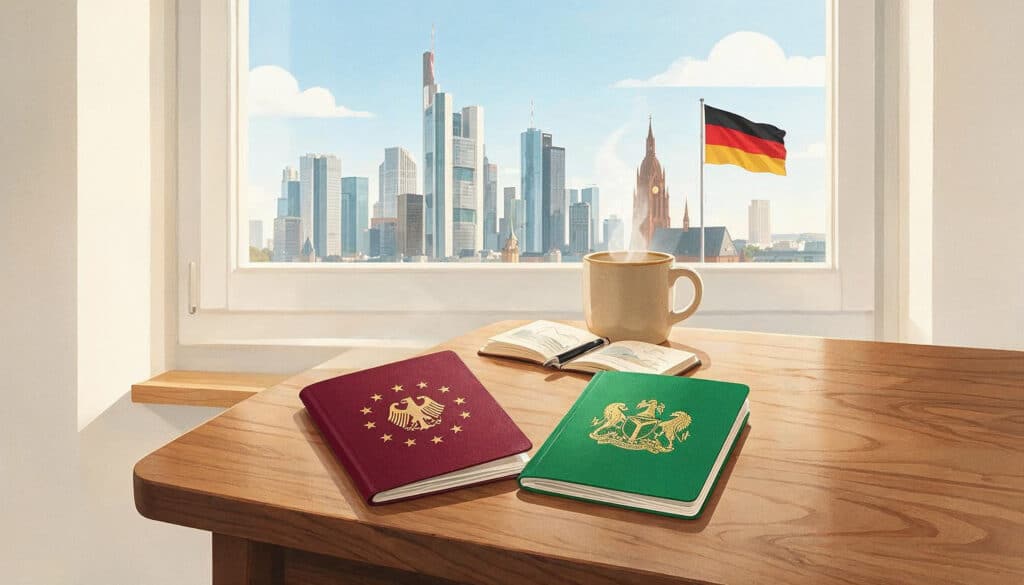

If you are a Nigerian living in Germany, or planning to, one question keeps coming up in WhatsApp groups and forums: can you actually become German and still keep your Nigerian passport? The answer in 2026 is yes, and the path is shorter than most people think. German citizenship for Nigerians is now realistic within five years of legal residence, thanks to the citizenship reform that came into force on 27 June 2024. This guide walks you through the exact rules, the costs, the tests, the timeline, and the common mistakes that get Nigerian applications delayed or rejected. Everything here reflects the law as it stands in 2026, including the changes that took effect in late 2025.
We keep this simple and practical. No legal jargon dumped on you, no vague promises. Just the real requirements, the real numbers, and a clear checklist you can follow. If you are still at the study or work stage, start with our pillar guide on how to move to Europe from Nigeria, then come back here when residence and citizenship are on your radar.
What changed: the 2024 reform and the 2025 correction
Germany overhauled its nationality law with the Staatsangehörigkeitsmodernisierungsgesetz, which took effect on 27 June 2024. Two things changed that matter enormously for Nigerians. First, the standard residence requirement dropped from eight years to five years. Second, and this is the big one, Germany now allows dual citizenship for almost everyone. Before June 2024, most people had to give up their old passport to become German. That rule is gone.
Get Free Germany Scholarship and Visa Updates
Join students across Africa receiving the latest scholarship deadlines, visa tips, and application guides straight to their inbox.
There was also a short-lived fast track. The 2024 law introduced a three-year route for people with exceptional integration, meaning very strong German (C1), outstanding achievements, and full financial independence. That three-year fast track was scrapped. Since 30 October 2025, a uniform minimum of five years applies to the standard route. So if you read older articles promising German citizenship in three years through “special integration,” ignore them. That door is closed. The three-year route for spouses of German citizens is a separate rule and still exists, which we cover below.
Can Nigerians hold dual citizenship with Germany?
Yes, and this is where Nigeria’s own law works in your favour. Under Section 28 of the Nigerian Constitution, a Nigerian citizen by birth does not lose citizenship by acquiring another nationality. So if you were born Nigerian, you can become German and keep your Nigerian passport legally. Both countries now permit it. This is a real change. For years, Nigerians in Germany hesitated because they did not want to renounce Nigeria. That barrier is gone from both sides.
One caution. Nigerians who became Nigerian by registration or naturalisation, rather than by birth, face tighter rules under Nigerian law and may be required to renounce a second nationality within a set period unless they hold that other nationality by birth. The vast majority of Nigerian students, workers, and professionals in Germany are Nigerian by birth, so this rarely bites. But if your Nigerian citizenship itself came through registration, get specific advice before you apply.
German citizenship for Nigerians: the core requirements in 2026
To naturalise through the standard route, you generally need to meet all of the following. Think of these as boxes that must all be ticked, not a menu you pick from.
| Requirement | What it means for you |
|---|---|
| Five years legal residence | Continuous lawful stay in Germany. Time on a student residence permit counts, and time in language study can count too, as long as your stay was legal. |
| Settled residence status | You hold a valid residence permit, an EU Blue Card, a settlement permit, or free movement right at the time you apply. |
| B1 German (spoken and written) | Certificate at B1 level or higher, or proof through a German school or university qualification. |
| Einbürgerungstest passed | The 33-question civics test on life, law, and society in Germany. |
| Financial self-sufficiency | You support yourself and any dependants without ongoing Bürgergeld or social welfare, apart from limited exceptions. |
| Clean criminal record | No significant criminal convictions. Minor issues may be overlooked, serious ones are disqualifying. |
| Commitment to the free democratic order | You sign a declaration of loyalty to Germany’s constitution and confirm you reject extremism and antisemitism. |
The financial requirement deserves attention because it trips up the most people. You do not need to be rich. You need to show that you and your household are not dependent on state welfare. If you have been working steadily, paying into the system, and covering your own rent and insurance, you are in good shape. If you have been on Bürgergeld for reasons within your control, that is a problem. Time spent building a stable income before you apply is time well spent.
The Einbürgerungstest: what it is and how to pass
The naturalisation test, or Einbürgerungstest, is a multiple-choice civics test. You get 33 questions, 60 minutes, and four answer options per question. You need at least 17 correct to pass. The questions cover German history, the legal system, basic rights, how elections work, and some questions specific to the federal state where you live. The test costs 25 euros to sit.
Here is the good news. The full pool of possible questions is public. There are 300 general questions plus 10 state-specific ones, and every test is drawn from that pool. Nobody should fail this test if they prepare. Free practice apps and the official BAMF question catalogue let you drill until you are consistently scoring above 30 out of 33. Most Nigerians who take it seriously pass on the first attempt. You are exempt from the test if you hold a German school leaving certificate or a relevant German qualification.
The B1 German requirement and how to reach it from Nigeria
B1 is the language standard for standard naturalisation. B1 means you can handle everyday conversations, understand the main points of clear standard speech, and write simple connected text on familiar topics. It is not fluency, but it is real, usable German. If you already studied or worked in Germany for five years, you may well be at or above B1 already. If you are not, you have time to get there.
If you are still in Nigeria and thinking long term, building German early pays off at every stage, from your visa to your job to your citizenship. Our detailed guide on how to learn German in Nigeria shows the fastest route from zero to B1, including the Goethe-Institut path and cheaper alternatives. Higher levels help too. If you want to work in a skilled role while building toward citizenship, see our guide to the Germany Opportunity Card for Nigerians, where German language points can make or break your application.
Does time as a student in Germany count toward citizenship?
Yes. This is one of the most common questions from Nigerian students, and the answer is encouraging. Lawful residence as a student counts toward the five-year requirement. So the years you spend on a student residence permit are not wasted from a citizenship point of view, they are building your clock. The same applies if you move from studying to working, for example after graduation on a residence permit for job search or through the Germany skilled worker visa route.
What matters is that your residence was continuous and lawful, and that when you apply you hold a settled status and can support yourself. A student who arrives, graduates, gets a job, and stays employed can realistically reach citizenship eligibility in around five to six years from arrival. Plan the whole journey, not just the first visa. If you are just starting, our guide on the German student visa requirements for Nigerians is the right first read.
Faster routes: spouses, children, and special cases
The standard route is five years, but a few situations are different.
- Married to a German citizen. If you are married to a German national, you can generally apply after three years of legal residence, provided the marriage has lasted at least two years. This route survived the 2025 changes.
- Children born in Germany. A child born in Germany to Nigerian parents automatically acquires German citizenship at birth if at least one parent has been legally resident in Germany for more than five years and holds a settled residence status. This is birthright by residence, not by blood.
- Minor children in your application. Your children can often be naturalised together with you, and the fee for a child included in a parent’s application is lower than the adult fee.
These routes matter for families. A Nigerian couple who move together, have a child in Germany, and stay lawfully can find that the child is German at birth while the parents naturalise a couple of years later. If family relocation is your goal, our guide on the family reunion visa from Nigeria explains how to bring a spouse and children in the first place.
What German citizenship gives a Nigerian
It is worth being clear about the prize, because the effort is real. A German passport is one of the strongest in the world for visa-free travel. As a German citizen you get the full right to live and work anywhere in the European Union, the right to vote in German elections, unrestricted access to the job market with no permit conditions, and permanent security of status that no residence permit can match. You stop worrying about renewals, blocked accounts, and Ausländerbehörde appointments. And because you keep your Nigerian passport, you keep your roots, your property rights in Nigeria, and your family ties intact.
Costs: what you actually pay
| Item | Cost in 2026 |
|---|---|
| Naturalisation fee (adult) | 255 euros per person |
| Naturalisation fee (minor child in parent’s application) | 51 euros per child |
| Einbürgerungstest | 25 euros |
| B1 language exam (if not already certified) | Roughly 150 to 250 euros depending on provider |
| Document translations and certifications | Varies, budget 100 to 300 euros |
So the core government cost for a single adult is modest, around 280 euros for the fee plus the test. The extra costs come from language certification and document handling. Compared with what you likely spent on your studies, the citizenship stage is cheap. The real currency here is time and paperwork, not money.
The step-by-step process
- Check your clock. Confirm you have five years of continuous lawful residence, or three if married to a German.
- Secure your German certificate. Get your B1 certificate if you do not already have proof of German at that level.
- Pass the Einbürgerungstest. Book it at a licensed test centre, prepare with the public question pool, and sit it.
- Gather documents. Passport, residence permits, proof of income, tax records, pension contributions, rental contract, marriage or birth certificates as relevant, and your language and test certificates.
- Submit your application. Apply at your local naturalisation authority, which is usually the Einbürgerungsbehörde or the city’s citizens office. Many cities now offer online pre-applications.
- Wait for processing. This is the slow part. Big cities have backlogs of 12 to 18 months. Smaller towns are often faster.
- Attend your ceremony. Once approved, you receive your naturalisation certificate, often at a short ceremony, and you are German.
Your citizenship readiness checklist
- Five years lawful residence (or three if married to a German for at least two years)
- Valid, settled residence status at the time of application
- B1 German certificate or equivalent qualification
- Einbürgerungstest passed with at least 17 of 33
- Proof you support yourself without ongoing welfare
- Clean criminal record certificate
- Signed declaration of loyalty to the constitution
- Full document set, translated and certified where needed
- Confirmation your Nigerian citizenship is by birth, so dual nationality is secure
Common mistakes that delay or sink applications
Most rejections and long delays are avoidable. Here are the patterns we see most often among Nigerian applicants.
- Applying while dependent on welfare. If you are on Bürgergeld without a qualifying exception, the application is likely to fail. Fix your income situation first.
- Gaps in lawful residence. A period where your permit lapsed can reset or interrupt your clock. Keep every renewal on time.
- Assuming the three-year fast track still exists. It does not, except for spouses of Germans. Do not build your timeline around it.
- Weak German preparation. Turning up to a B1 exam underprepared wastes money and time. Study properly.
- Incomplete documents. Missing tax records or an uncertified translation can send your file to the back of a long queue.
- Not confirming the dual citizenship position. If your Nigerian citizenship is by registration, check the rules before you assume you can keep both.
A real example: how the timeline works
Take Chidi, a Nigerian who arrived in Frankfurt in 2020 on a student visa. He studied for two years, reached B1 during his studies, and after graduating in 2022 moved onto a work permit as an IT specialist. He kept every residence permit valid, paid into the pension and tax system, and never touched welfare.
By mid 2025 he had crossed the five-year mark of continuous lawful residence. He booked the Einbürgerungstest, scored 31 out of 33, gathered his payslips, tax statements, and B1 certificate, and submitted his application to the city naturalisation office. Because he lives in a large city, processing took just over a year.
In 2026 he attended his ceremony, received his certificate, and now holds both his German and his Nigerian passports. Nothing about his path was exotic. He simply planned the whole journey and kept his status clean.
Where citizenship fits in your bigger plan
Citizenship is the last step of a long relocation journey, not the first. Most Nigerians reach it through study or skilled work. If you are at the very start, get the foundation right. Understand your proof of funds options, plan your studies, and read our full pillar on how to move to Europe from Nigeria. When you land, our first week in Germany checklist helps you register your address and open a bank account, both of which build the paper trail you will need years later at the citizenship stage. Every clean step now makes the finish line easier.
Citizenship versus permanent residence: which should you aim for?
Many Nigerians confuse permanent residence with citizenship, so let us clear it up. Permanent residence, the Niederlassungserlaubnis, gives you the right to stay in Germany indefinitely with an open work permit. It is excellent, and you can often get it faster than citizenship, sometimes after 21 to 33 months on a Blue Card with the right German level, or after five years on other permits. But it is still a residence permit. It can, in rare cases, be lost, and it does not give you a passport, the right to vote, or free movement across the European Union as a citizen.
Citizenship is the final, unshakeable status. Once you are German, you cannot be deported, your status never expires, and you carry one of the world’s most powerful passports. For most Nigerians the smart play is to get permanent residence when you qualify, then convert to citizenship once you hit the five-year mark and meet the language and civics requirements. The two are steps on the same ladder, not competing choices. Permanent residence protects you along the way, citizenship crowns the journey.
| Feature | Permanent residence | German citizenship |
|---|---|---|
| Right to stay | Indefinite, but a permit | Permanent and irrevocable |
| Passport | No, you keep your Nigerian one only | Yes, German passport plus your Nigerian one |
| Right to vote | No national vote | Full voting rights |
| EU free movement | Limited | Full right to live and work EU-wide |
| Typical timeline | From about 21 months on a Blue Card | Five years standard |
What counts as continuous lawful residence
The five-year clock rewards continuity, so protect it. Continuous lawful residence means your residence permits stayed valid without a gap where you were in Germany illegally or outside the country for long stretches. Short trips home to Nigeria for holidays or family do not break your residence. Long absences can. Letting a permit expire before you renew it is the classic own goal, because a lapse can interrupt or reset your count. Renew early, keep copies of every permit, and never let a deadline slip.
Time spent as an asylum seeker or on a tolerated stay is treated differently and may not count the same way as time on a student or work permit. If your history is complicated, a short consultation with a migration adviser before you apply can save you months. For most Nigerian students and professionals with a clean permit history, though, the count is straightforward: add up your years from the day your first long-stay permit began.
Pro tips to make your application smooth
- Start collecting documents a year early. Tax statements, pension records, and payslips going back five years take time to assemble. Build the folder before you need it.
- Aim higher than B1. If you can reach B2, do it. It makes the language proof effortless and helps at work too.
- Sit the Einbürgerungstest before you apply. Having the certificate in hand speeds your file and removes one variable.
- Keep your Anmeldung current. Your registered address history is part of the paper trail that proves continuous residence.
- Apply in a smaller municipality if you can. If you live near a smaller town’s jurisdiction, processing can be far faster than a big city backlog.
- Never fall onto welfare in the run-up. The financial independence check looks at your recent situation, so stay employed and self-supporting.
Frequently asked questions
Can Nigerians get German citizenship without giving up their Nigerian passport?
Yes. Since 27 June 2024 Germany allows dual citizenship for almost everyone, and Nigeria lets citizens by birth keep their Nigerian nationality when they acquire another. So a Nigerian by birth can become German and keep both passports legally.
How many years do I need to live in Germany to apply?
Five years of continuous lawful residence for the standard route. Three years if you are married to a German citizen and the marriage has lasted at least two years.
Is the three-year fast track still available?
No. The special three-year fast track for exceptional integration was abolished on 30 October 2025. A uniform five-year minimum now applies to the standard route. The three-year route for spouses of Germans is separate and still exists.
Does my time as a student count toward the five years?
Yes. Lawful residence on a student permit counts toward the five-year requirement, as does time later spent working, as long as your residence stayed continuous and legal.
What level of German do I need?
B1 in both spoken and written German for the standard route. You can prove it with a recognised B1 certificate or an equivalent German school or university qualification.
What is the Einbürgerungstest and how hard is it?
It is a 33-question multiple-choice civics test. You need 17 correct in 60 minutes. The full question pool is public, so with proper practice it is very passable. It costs 25 euros.
How much does German citizenship cost for a Nigerian?
The naturalisation fee is 255 euros per adult and 51 euros per minor child included in a parent’s application. Add 25 euros for the test, plus language certification and translation costs.
Can I apply if I am on Bürgergeld or welfare?
Usually no. You must generally support yourself and your household without ongoing social welfare, apart from limited exceptions. Build a stable income before you apply.
How long does the application take to process?
It varies by city. Large cities such as Berlin and Hamburg have backlogs of roughly 12 to 18 months. Smaller towns are often quicker.
Will my child born in Germany be German?
A child born in Germany to Nigerian parents becomes German at birth if at least one parent has lived lawfully in Germany for more than five years and holds a settled residence status.
Do I need a clean criminal record?
Yes. Serious criminal convictions are disqualifying. Very minor matters may be overlooked, but a clean record is strongly expected.
What if my Nigerian citizenship is by registration, not birth?
Nigerian citizens by registration or naturalisation face stricter dual nationality rules and may need to renounce a second nationality within a set period. Most Nigerians in Germany are citizens by birth, but if yours is by registration, get specific advice first.
Where do I actually submit my citizenship application?
At your local naturalisation authority, usually the Einbürgerungsbehörde or your city’s citizens office. Many cities now let you start with an online pre-application before submitting documents.
Final word
German citizenship for Nigerians is no longer a distant dream reserved for a lucky few. With the five-year route and universal dual citizenship now in force in 2026, a Nigerian who studies or works in Germany, keeps their status clean, learns the language, and supports themselves can realistically hold a German passport within five to six years, without ever surrendering their Nigerian one. The rules are clear, the costs are modest, and the biggest requirement is simply patience and clean paperwork over time. Start where you are, plan the full journey, and keep every step lawful.
Official sources worth bookmarking: the German Federal Office for Migration and Refugees (BAMF) for naturalisation details and the Einbürgerungstest, and the German Federal Foreign Office for the current nationality law.
Want the relocation and citizenship roadmap sent to you? Join the GrandRoyal Travel newsletter and get our step-by-step guides on studying, working, and settling in Germany from Nigeria, straight to your inbox. Sign up for the free newsletter here.
Never miss a deadline. Join the GrandRoyal Travel newsletter for weekly intake dates, scholarship openings and visa rule changes for Nigerians heading to Germany.
Join our Telegram channel for the latest Germany study, visa and relocation updates for Nigerians: https://t.me/+I2s3n-gtMIQ0ZjQy
One practical note: renunciation of Nigerian citizenship is currently suspended at the Berlin embassy. The full service list and fees are in Nigerian Embassy in Berlin: Every Service They Actually Provide.
Stay Ahead of Every Scholarship Deadline
Get free updates on fully funded scholarships, visa requirements, and relocation guides for Germany. No spam, just what you need.
Get GrandRoyal in your Google feed — add us as a preferred source
Frequently asked questions
Can Nigerians hold dual citizenship with Germany?
Yes — since the 2024 reform, Germany allows dual citizenship, so you can naturalise without renouncing your Nigerian passport.
How long until I can apply?
Usually about 5 years of legal residence, or less in exceptional integration cases.
What are the main requirements?
German language, passing the citizenship test (Einbürgerungstest), and being able to support yourself.