
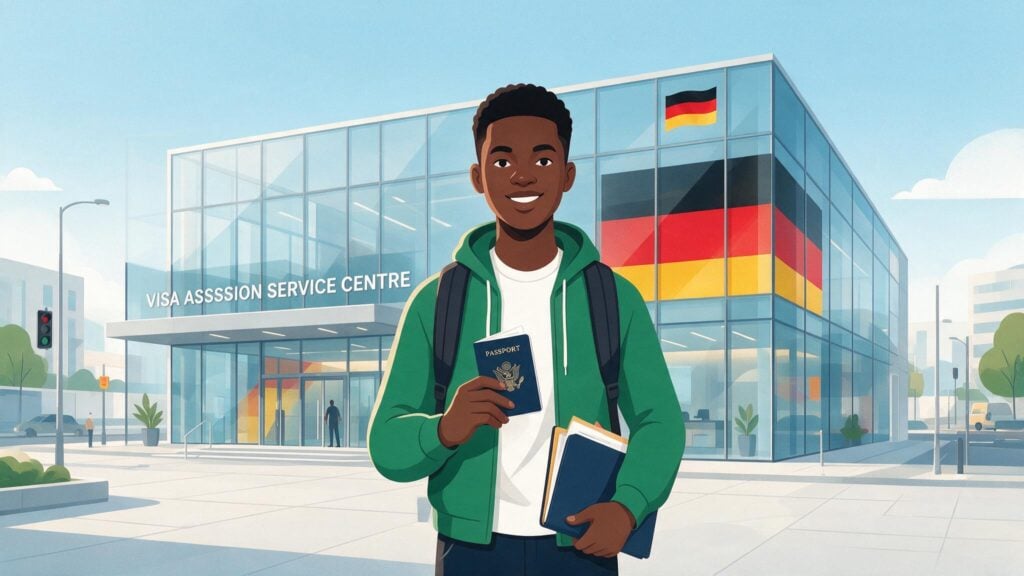
On the morning of my student visa interview at the German consulate in Lagos, I realised I had forgotten to print one document. I had to use the photocopy services at the visa location, and I paid 10,000 naira for each print and 3,000 naira for each extra photocopy, in 2018. The same service cost about 20 naira per copy outside. That mistake is why I now write every German student visa document checklist 2027 with one rule at the top: print and copy everything before the day, not on the day.
This checklist is built from two things. First, what I actually carried into the interview in 2018, including the papers that turned out to be useless. Second, what the current rules say in 2026, checked in October 2026. I will keep those two clearly apart, because the process has changed since I applied, and mixing old and new rules is how people end up with a wrong list.
What changed in 2026: you now apply through VFS Lekki
Since 25 March 2026, student visa applications from Nigeria are handled through a dedicated VFS Global centre in Lekki, Lagos. You register online, get an appointment at VFS, and submit your documents and biometrics there. The consulate still makes the decision. When I applied in 2018 you went straight to the consulate, so some of what you read from older students no longer matches (checked October 2026, source: TheCable).
Get Free Germany Scholarship and Visa Updates
Join students across Africa receiving the latest scholarship deadlines, visa tips, and application guides straight to their inbox.
For the full booking steps, read our guide to the VFS Lekki German student visa process. This page is only about the documents.
The German student visa document checklist 2027, in one table
The core list below follows the German foreign mission’s student visa leaflet (January 2025 edition) and the Nigeria-specific points on our main requirements guide. Your own case may need extras, so always compare it with the current list on the German mission in Nigeria website and the VFS page before you book.
| Document | What to bring | My note |
|---|---|---|
| International passport | Original, plus copies of the data page | Valid well beyond your stay, with blank pages |
| Visa application form | Completed and signed | Fill it in on a computer, do not rush it at the centre |
| Passport photo | Recent biometric photo | Take two, one always goes missing |
| University admission letter | Original and copy | It must state the language of instruction |
| School and university certificates | Originals and copies | WAEC or NECO, degree, and graduation certificate if you have one |
| Transcript | Original and copy | Stamped and signed by your university |
| Language proof | Certificate matching your course language | The leaflet asks for B2 in the language of instruction unless a preparatory course is included. I used PTE Academic in 2018 |
| Proof of funds | Blocked account confirmation (EUR 11,904) or another accepted proof | Open it before the visa appointment |
| Health insurance | Valid policy, minimum EUR 30,000 cover | Required today, see the section below |
| CV and motivation letter | Signed, in the language of your course | Keep both consistent with your admission documents |
The blocked account figure is EUR 11,904, which is 12 months at EUR 992 per month, checked October 2026. If you are still choosing a provider, our blocked account guide for Nigerian students compares the options, and the proof of funds guide covers the other accepted routes.
What I submitted in 2018, and what turned out to be unnecessary
I started gathering documents earlier in 2018, when I was applying to a university in Poland. Luckily, almost all of those papers also worked for the German application. Here is what I took to the interview for my place at SRH in Dresden:
- The signed visa application and my passport with the data page.
- My transcript from Godfrey Okoye University in Enugu and the original graduation certificate from 2015.
- My WAEC certificate, my original NYSC certificate and my birth certificate.
- My PTE Academic result as proof of English.
- My admission letter from SRH in Dresden.
- A sponsorship letter from my German sponsor, who registered it at her local authority near Hamburg.
- A court affidavit, because my age and graduation year did not match across some of my documents.
I also took things nobody asked me for: my local government state of origin letter, a copy of my ID card front and back, a private health insurance policy and a flight insurance. None of them were needed at that interview. That is the lesson of an over-packed folder. It did not hurt me, but it cost time, money and stress.
One warning. Health insurance was not asked for at my interview in 2018, but it is on the list today. The current leaflet asks for proof of cover with at least EUR 30,000 until your statutory insurance starts (checked October 2026). So do not copy my 2018 experience on that point. Our health insurance guide for students explains what to buy and when.
The three documents that caused me real work
1. The mismatch affidavit. My age and my graduation year did not line up across my documents, so I got a court affidavit to explain it. If any of your papers disagree with each other, fix it or explain it before the appointment. A consular officer will notice a mismatch in seconds, and an unexplained one is the kind of thing that leads to questions. If your visa was refused, read what to do next in our German student visa rejection guide.
2. The sponsorship letter. My German sponsor went to her local authority and arranged the formal sponsorship document, which I carried to the interview. If someone is sponsoring you, the paperwork has to be done on their side in Germany first. Our Verpflichtungserklarung guide explains how that document works.
3. Certified copies. In 2018 I booked a separate consulate appointment for the certification of copies for university applications. The booking email told me what to bring, and I still remember how strict it was. These were the 2018 rules:
- Up to five application sets per appointment, not stapled.
- Each set in the same order: the original application form, then copies of the academic documents in the same order as the originals, then a copy of the passport.
- Originals presented in the same order, along with the original passport. Soft copies on a phone were not accepted.
- Documents printed on both sides, such as a WAEC certificate, copied on both sides.
- Certification for university applications was free of charge.
These are 2018 rules from my own booking email, so treat them as an example of how strict the process can be, not as today’s official list. Check the current requirements before you go. If your certificates also need legalisation, read our WAEC legalisation guide.
Print and copy before the day: the 2018 price shock
Here is the practical lesson again, because it matters. I forgot to print one document on the day. The shops near the consulate charged 10,000 naira per print and 3,000 naira per photocopy, and I was told to make an extra set. The embassy itself is not running that business. The shops around it are, and they know you have no choice. Those were 2018 prices, so today’s will differ, but the pattern will not.
How I would pack it today, based on that mistake: print three copies of every document before you leave home, keep each document set in the order your appointment email asks for, do not staple anything, and carry the appointment confirmation printed on paper. A phone screen is not a printout.
Common mistakes that waste an appointment
- Going with documents that still need printing or copying.
- Stapling sets. The 2018 consulate email warned about it, and the current leaflet repeats it.
- Carrying the wrong checklist. A visa checklist for artists, language students or tourists has a different list from the student visa list. Always use the one for your visa type.
- Mixing old advice with new rules, especially on health insurance and where you lodge the application.
- Arriving without a clear story. Your documents should tell one consistent story, which is also what the German student visa interview questions test.
What happened after my interview: the wait nobody warns you about
My interview was on 29 August 2018. On 24 September the consulate replied to my first status email and said the usual processing time for a student visa was six weeks, and that this had not passed in my case. On 17 October, in the seventh week, I wrote again. On 29 November a federal office told me my file had been forwarded to the city of Dresden on 10 September 2018 and was still in the working process there. In January 2019 I was writing again, now past four months, with no news. In February 2019, the consulate finally asked me to send in my passport and a travel health insurance valid for three months from the travel date.
That is almost six months from interview to that request. It is not a typical timeline today, and I do not want to scare you, but it is the reason I tell people to apply early and keep every email. Read our German student visa processing time guide for the realistic range now. If your school starts before your visa is ready, tell your university early. I also wrote to a welcome centre at a Dresden university, but it only handles PhD candidates and could only point me to the city’s immigration office, so find the right department from the start.
Frequently asked questions
Do I need originals and copies for the German student visa from Nigeria?
Yes, bring both. Bring originals for checking and printed copies for submission, and follow the exact order and copy count in your appointment confirmation.
How much money do I need to show for a German student visa in 2027?
The current figure is EUR 11,904, which is 12 months at EUR 992 per month, checked October 2026. Always confirm the figure on the official mission page before you pay in, because it is reviewed regularly.
Do I need health insurance before the visa appointment?
Yes, today the leaflet lists proof of health insurance with at least EUR 30,000 cover until statutory insurance starts (checked October 2026). In 2018 it was not asked for at my interview, so older advice may be wrong.
Can I submit my application at the consulate in Lagos?
Not for student visas. Since 25 March 2026 these applications are lodged through the VFS Global centre in Lekki, Lagos, and the consulate decides.
What if my documents have different dates or ages?
Fix the mismatch before your appointment or bring a clear legal explanation. In my case I got a court affidavit to explain a difference between my age and graduation year.
Should I bring extra documents just in case?
Bring what is on the current checklist, correctly ordered. Extra papers like my state of origin letter were not needed and only added weight. If something is genuinely relevant to your case, such as a sponsor’s formal letter, include it.
Is this checklist official?
No. It combines my own experience with published guidance. The final authority is always the German mission in Nigeria and the VFS Global page for your appointment.
Want your documents checked before you book? Use the GrandRoyal visa platform, and read our complete German student visa guide for Nigerians for the full route from admission to arrival. For the leaflet this checklist follows, see the German mission student visa leaflet, and for general visa guidance see DAAD.
Join our Telegram channel for the latest Germany study, visa and relocation updates for Nigerians: https://t.me/+I2s3n-gtMIQ0ZjQy
Stay Ahead of Every Scholarship Deadline
Get free updates on fully funded scholarships, visa requirements, and relocation guides for Germany. No spam, just what you need.
Get GrandRoyal in your Google feed — add us as a preferred source