
My own flight from Lagos landed at Frankfurt just after six in the morning, and the thing nobody had prepared me for was how little actually happened at the border. A staffed booth. Three questions. Ninety seconds. All the fear had been in the weeks before the flight, and none of it was needed at the desk. This guide covers the Germany airport arrival Nigerian passport holders actually experience in 2026, not the version written for tourists.
I mention that because of what has changed since. The EU Entry/Exit System went fully live in April 2026, and almost every guide written for Nigerians since then tells you to expect a biometric kiosk, fingerprints, a facial scan and a queue running past two hours. If you are flying in on a student, Ausbildung or work visa, that advice is wrong, and acting on it costs you real money. It sends you into the wrong line and, if you booked a tight onward train or connection on the strength of it, straight past the one you paid for.
So here is what a Germany airport arrival Nigerian passport holders make on a long stay visa actually looks like in 2026. Most of the advice online is written for tourists. You are not a tourist. Below is the border in order, the real customs limits, and the clock that starts the moment you step outside the terminal.
Get Free Germany Scholarship and Visa Updates
Join students across Africa receiving the latest scholarship deadlines, visa tips, and application guides straight to their inbox.
The one rule most guides get wrong
The EU Entry/Exit System, EES, has been fully operational at every external Schengen border since 10 April 2026. It replaces passport stamping with a digital record and it captures fingerprints and a facial image.
But EES covers short stays only, meaning up to 90 days in any 180 day period. Third country nationals who hold a long stay national visa, the type D visa, or a residence permit issued by a country operating EES are not registered in the system at all. Their border check stays as it always was: show the passport and the long stay visa at a staffed booth. No fingerprints, no face scan.
So if you are flying into Germany on a German student visa, an Ausbildung visa, a Chancenkarte or a work visa, you are outside EES for as long as that document is valid. Checked August 2026 against the European Commission’s own guidance.
| Your document on arrival | EES biometrics? | Which queue |
|---|---|---|
| German national D visa (student, Ausbildung, work, Chancenkarte) | No | Staffed passport booth, all passports |
| German residence permit card already issued | No | Staffed passport booth |
| Schengen C visa (short visit, conference, family) | Yes, first entry enrols you | EES kiosk, then booth |
| No visa, transiting airside only | No, you never cross the border | Transit corridor |
Two exceptions worth knowing. Long stay visas and residence permits issued by Cyprus or Ireland are still registered in EES, because those countries sit outside the full Schengen border area. And a renewal receipt or a pending application is not a residence permit. Carry the original valid document, not a photocopy and not a screenshot.
Germany airport arrival Nigerian passport guide, step by step
This is the sequence at Frankfurt and it is close to identical at Munich, Düsseldorf and Berlin.
- Leave the aircraft and follow “Ankunft / Arrivals”. If you connected through Istanbul, Addis Ababa, Casablanca or Doha, your border check happens in Germany, not at the connection point, as long as you stayed airside.
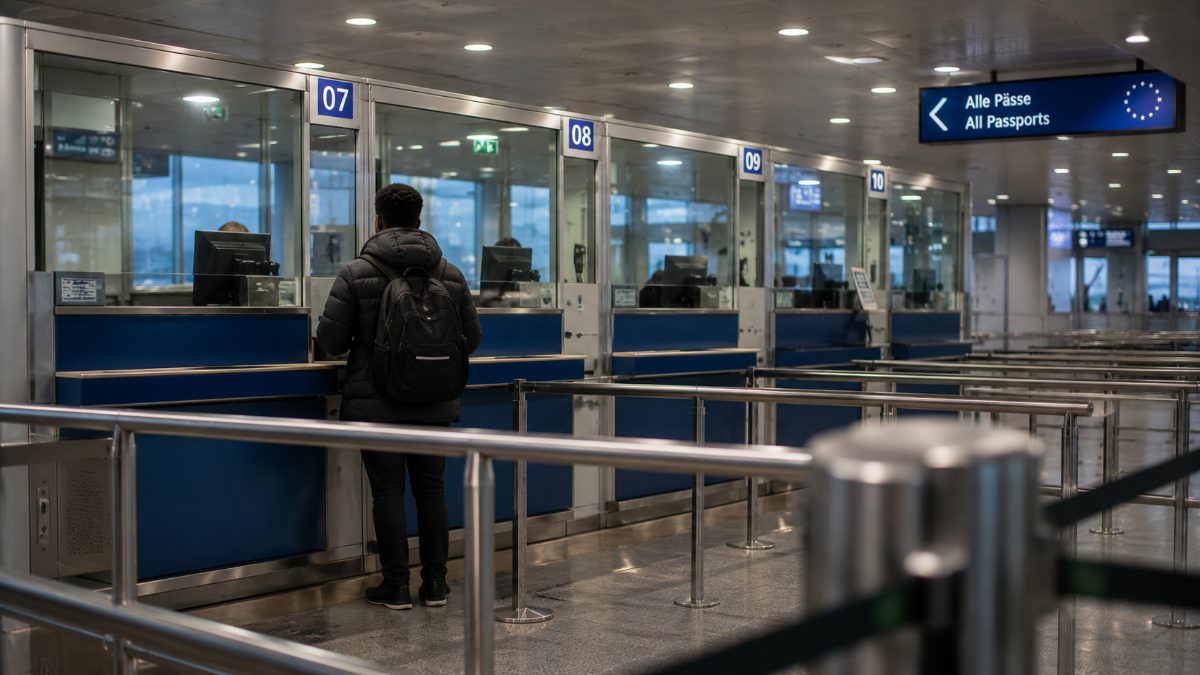
- Choose the correct passport line. Ignore the automated eGates. Those are for EU, EEA and Swiss citizens and for registered users. Look for the staffed booths marked for all passports or non-EU.
- Hand over your passport open at the visa page. Do not hand over a folder of documents. Give the passport, then produce anything else only if you are asked.
- Answer two or three short questions. Almost always: why are you here, how long, where will you live. Answer in one sentence each. This is not an interview and treating it like one makes it longer.
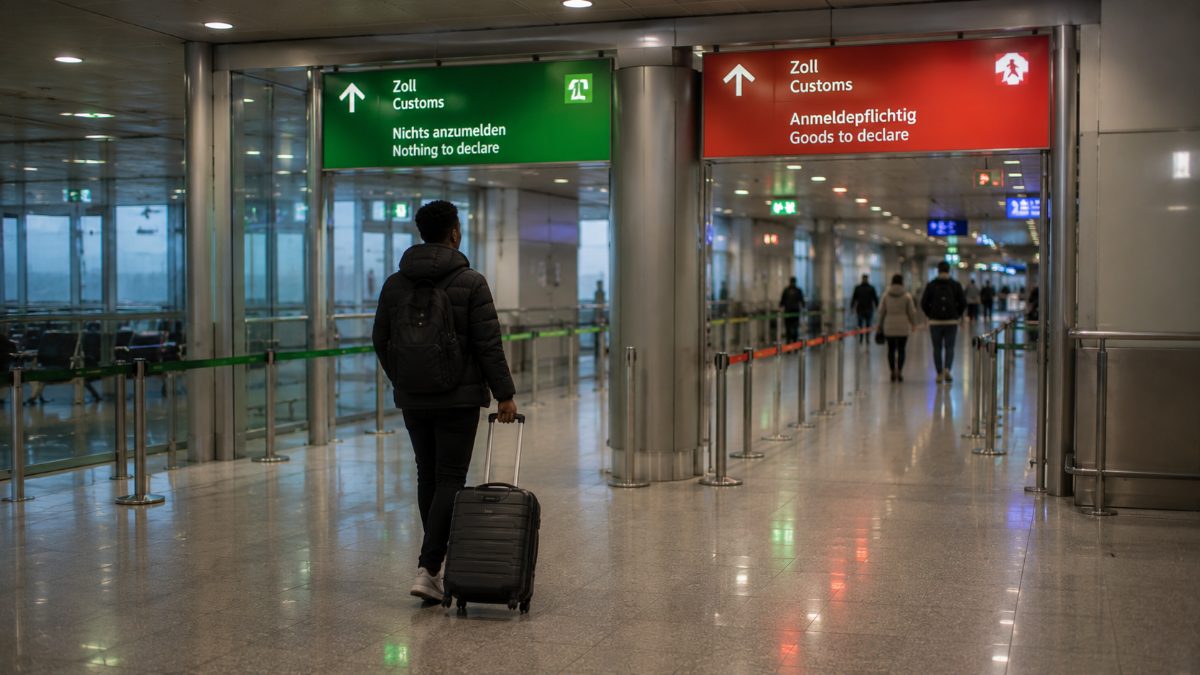
- Collect your bags, then choose green or red at customs. More on that below, because this is where the actual money risk sits.
Total time on a normal morning at Frankfurt Terminal 1: fifteen to forty minutes from aircraft door to baggage hall. The long EES queues you have read about in the news are the short stay tourist lines. You are not standing in them.
What the officer can ask for, and what to keep within reach
The visa is the decision. It was already made at the German mission in Abuja or Lagos. The officer at the border is confirming that nothing has changed since then. In practice they rarely ask for more than the passport, but they are entitled to, and the cost of not having a document is being taken aside for twenty minutes while you dig through a checked bag you no longer have access to.
Keep these five in your hand luggage, in one clear folder, in this order:
| Document | Why it can be asked for |
|---|---|
| Passport with the valid D visa | The check itself |
| University admission letter, printed | Confirms the purpose of the visa still holds |
| Blocked account confirmation | Proof you can fund yourself. The 2026 requirement is 11,904 euros in total, released at 992 euros a month, checked August 2026 |
| Health insurance certificate | Public student cover runs roughly 141 to 155 euros a month in 2026, TK around 141 |
| Address for your first weeks, printed | The “where will you live” question, answered in one line |
If you are still assembling this file before you fly, our German student visa requirements for Nigeria guide lists the full set, and the blocked account guide for Nigerian students explains the monthly release rule that trips people up in month one.
Customs: the green channel decision is the real risk
Nobody gets sent home at the passport booth for a paperwork mistake. People do get fined at customs, and it is almost always avoidable.
After baggage claim you pick a channel. Green means nothing to declare. Red means you are over an allowance or carrying something restricted. Walking green while over the limit is a punishable offence, not a misunderstanding.
Your duty free allowances arriving by air from Nigeria
| Category | Allowance per adult traveller |
|---|---|
| General goods, gifts, electronics, clothing | 430 euros total value |
| Cigarettes | 200, or 100 cigarillos, or 50 cigars, or 250g tobacco |
| Spirits above 22 percent | 1 litre |
| Fortified or sparkling wine under 22 percent | 2 litres |
| Still wine | 4 litres |
| Beer | 16 litres |
Figures checked August 2026 on the German customs site. The goods must be carried by you and be for your own use, your household or as gifts. A new laptop bought in Lagos still counts toward the 430 euros if it is boxed and clearly not your personal used item.
Cash: 10,000 euros is a declaration duty, not a limit
You may carry any amount. What you may not do is carry 10,000 euros or more, in cash or equivalent means of payment, without declaring it. That threshold counts everything together, so naira, dollars, euros, travellers cheques and bearer instruments are added up at the exchange rate on the day. Declaring costs you nothing. Not declaring can cost you the money.
The food rule that catches almost every Nigerian traveller
This is the one. Bringing meat, milk and any product made from them into the EU from a non-EU country is prohibited. Not restricted, prohibited. That means the suya, the kilishi, the dried meat your mother packed, the pepper soup and suya spice mixes that contain dried meat or meat extract, and yes, the cheese. Read the label on seasoning cubes, because many contain meat extract.
Small exceptions exist for infant food, foods required for medical reasons, and other animal products such as honey up to 2 kg per person, and fishery products such as stockfish, dried fish and crayfish up to 20 kg per person. Dried egusi, ogbono, garri, dried beans, plantain flour and packaged spices without animal content are generally fine, though plant products have their own rules and quantity limits.
My honest advice after doing this trip and watching friends do it: leave the meat. A confiscation at Frankfurt at seven in the morning, on no sleep, is a miserable way to start. Our guide on what to pack from Nigeria to Germany goes through the suitcase itself, item by item.
A worked example: Chidinma lands at 6:05
Chidinma flies Lagos to Frankfurt on a German student visa for a winter semester start. Her file is in a clear folder in her backpack.
- 06:05 Aircraft door opens. She follows Arrivals.
- 06:20 She reaches passport control, walks past the eGates, and joins the staffed all-passports line. Because she holds a D visa she is not enrolled in EES, so she is not in the biometric queue.
- 06:38 At the booth. Passport open at the visa page. Three questions: purpose, duration, address. Three short answers. Ninety seconds.
- 06:55 Baggage hall. Two suitcases. She carries 3,000 euros in cash, well under the declaration threshold, one new laptop worth about 700 euros, and no meat because she checked first.
- 07:10 The laptop puts her over the 430 euro goods allowance, so she takes the red channel, declares it, pays the duty and VAT owed, and keeps the receipt. Fifteen minutes and no fine.
- 07:30 Landside. She buys a Deutschlandticket for 63 euros a month rather than a single long distance ticket, and heads to her temporary room.
- Day 3 She books her Anmeldung appointment. The 14 day clock started when she moved into that room.
Notice what she did not do. She did not argue about the laptop, she did not hide it, and she did not spend the night before her flight worrying about the border interview that was never going to happen.
Common mistakes, ranked by how much they cost
- Carrying meat or dairy. Confiscation, possible fine, and a bad first hour. Most common by far.
- Going green with a new laptop, phone or gift electronics over 430 euros. If you get checked, the penalty is worse than the duty would have been.
- Standing in the EES biometric queue on a D visa. Costs you twenty to forty minutes, and the onward train or connection you booked on the strength of bad advice.
- Putting the admission letter and blocked account proof in the checked bag. Once your bag is in the hold you cannot reach it at the booth.
- Treating the border check like the visa interview. Long, unprompted explanations invite follow up questions. Answer what was asked.
- Ignoring the 14 day Anmeldung clock because you are “still settling in”. See below.
The clock that starts when you leave the terminal
Arrival is not the end of the process. Two deadlines start immediately.
Anmeldung, 14 days. Under Section 17 of the Bundesmeldegesetz you must register your address within 14 days of moving into a residence. Late, missing or incorrect registration is an administrative offence under Section 54 BMG and can be fined up to 1,000 euros. In practice a first late registration is rarely fined if you booked the earliest appointment you could get and can show the confirmation, which matters in cities where appointments run four to twelve weeks out. Book the appointment on day one, even for a temporary address, and keep the email.
If you are landing for a winter semester start specifically, our guide on arriving in Germany for the winter semester covers the first fortnight week by week.
Residence permit. Your D visa is a bridge, usually valid three to six months. The Ausländerbehörde appointment that converts it into a residence permit needs your Anmeldung certificate first, so the two are linked. Start it in your first fortnight, not in your last. The full sequence, documents, fees and timeline is in Residence Permit in Germany for Students After Arrival.
For the wider sequence from Nigeria to a settled life in Germany, our pillar guide on how to move to Europe from Nigeria maps the whole route, and the German student visa from Nigeria 2026 guide covers everything that happens before you board.
Your arrival day checklist
- Passport with valid D visa, in hand luggage, not in a bag pocket
- Printed admission letter, blocked account confirmation, insurance certificate, first address
- Under 10,000 euros total in cash, or ready to declare it
- Goods under 430 euros, or ready to take the red channel
- No meat, no dairy, no meat based seasoning cubes or spice mixes
- Screenshot of your onward train or transfer, and the address written out
- Anmeldung appointment booked within 48 hours of getting a room
If you want the document side checked before you fly, our visa platform walks through your file and flags what is missing: visa.grandroyaltravel.com.
Primary sources worth reading yourself rather than trusting any blog, including this one: the German customs allowances page, the Federal Foreign Office on the obligation to declare cash, and Make it in Germany for post arrival registration steps.
Get the next guide first. We send one email a week on Germany study, visa and relocation for Nigerians, with the figures updated as they change. Sign up on any page of the site.
Join our Telegram channel for the latest Germany study, visa and relocation updates for Nigerians: https://t.me/+I2s3n-gtMIQ0ZjQy
Frequently asked questions
Do Nigerians give fingerprints at the German border in 2026?
Not if you arrive on a German long stay national visa or a residence permit. EES has been fully operational since 10 April 2026, but it registers short stay travellers only. Holders of long stay visas and residence permits issued by an EES country are not enrolled. If you enter Europe on a short stay Schengen C visa, you are enrolled on first entry.
Will my passport still be stamped when I arrive in Germany?
Your check is done at a staffed booth rather than a biometric kiosk, and long stay visa holders are handled the traditional way rather than through the digital EES record. Keep your boarding pass until your residence permit is issued, as it is useful proof of your entry date.
How much cash can I bring from Nigeria to Germany?
There is no limit. There is a declaration duty. Cash and equivalent means of payment totalling 10,000 euros or more must be declared to customs on entry and exit. Everything is counted together and converted at the day’s rate. Declaring is free.
Can I bring suya, kilishi or dried meat into Germany?
No. Meat, milk and products derived from them cannot be brought into the EU from a non-EU country. Spice mixes and seasoning cubes containing meat or meat extract fall under the same ban. Fishery products are different: stockfish, dried fish and crayfish are allowed up to 20 kg per person. Honey and similar animal products are allowed up to 2 kg per person, and there are narrow exceptions for infant food and medically required foods.
What will the German border officer ask a Nigerian student?
Usually why you are coming, how long you are staying and where you will live. Answer each in one sentence. Have your admission letter, blocked account confirmation and insurance certificate in your hand luggage in case they are requested, but do not offer the whole folder unprompted.
How long does it take to clear Frankfurt airport on a student visa?
Fifteen to forty minutes from aircraft door to baggage hall on a normal morning, plus baggage and customs. You are not in the EES queues that cause the long waits reported in the news, because those are for short stay travellers.
What must I do in my first two weeks in Germany?
Register your address. Section 17 BMG gives you 14 days from moving in, and Section 54 BMG allows a fine of up to 1,000 euros for late or missing registration. Book the appointment immediately, keep the confirmation email, and use the Anmeldung certificate to start your residence permit application at the Ausländerbehörde.
Border control only works if the booklet in your hand is still valid. If yours is running down, Nigerian Passport Renewal in Germany: Embassy Process, Cost and Timeline walks through the embassy process, the real 2026 fees and the six to eight week wait.
Stay Ahead of Every Scholarship Deadline
Get free updates on fully funded scholarships, visa requirements, and relocation guides for Germany. No spam, just what you need.
Get GrandRoyal in your Google feed — add us as a preferred source
Frequently asked questions
What happens at the German airport with a Nigerian passport?
You clear passport control (now with EES biometrics), may be asked about your stay, and pass through customs. Keep key documents in your hand luggage.
What documents should I carry on arrival?
Passport with visa, admission letter, proof of funds and health insurance, all in your hand luggage.
Which customs channel do I use?
The green channel only if you have nothing to declare; otherwise the red channel.