

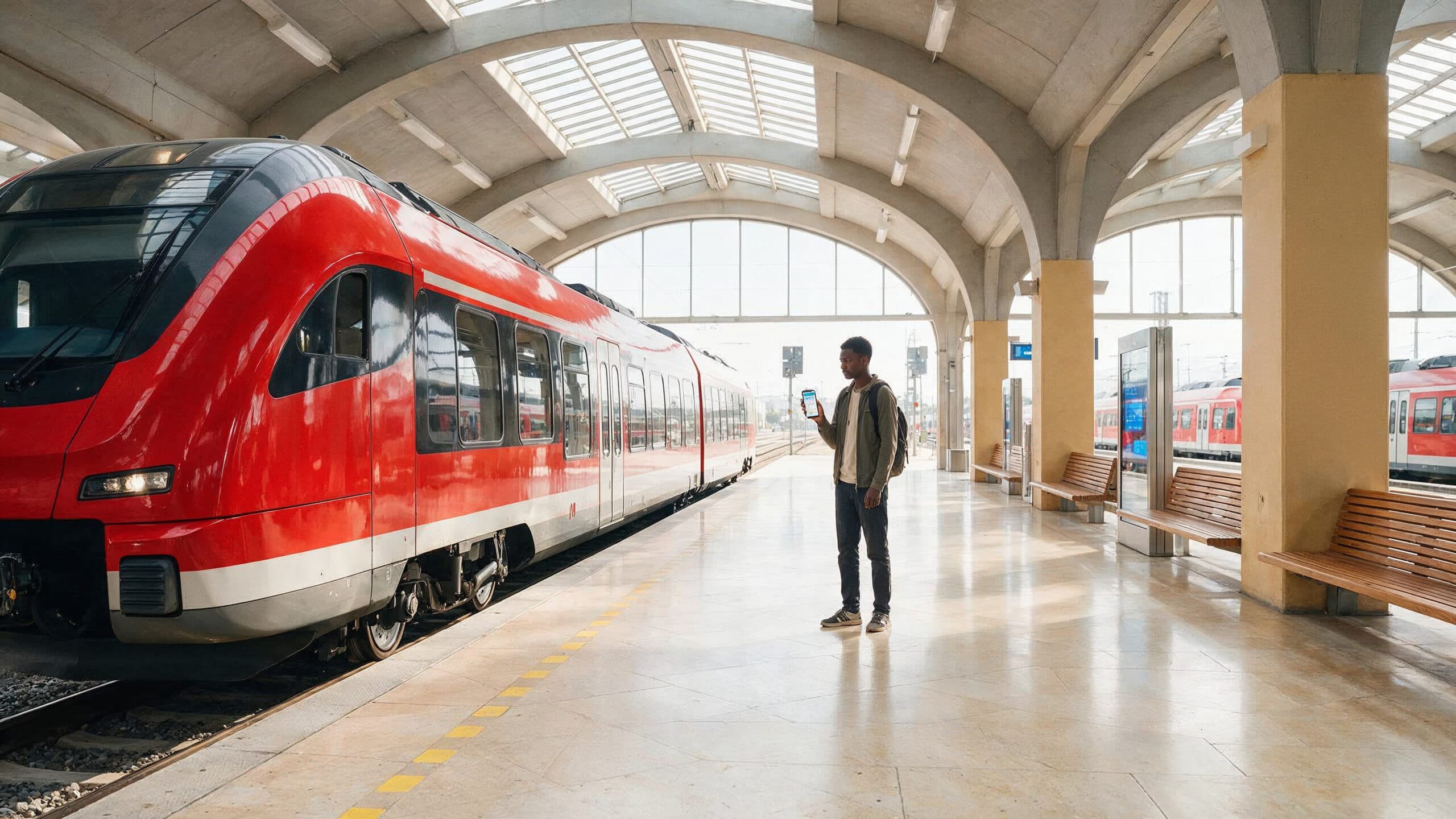
The Deutschlandticket for students is the single best deal in German student life, and most Nigerians arriving in Germany do not understand it until they have already wasted money. For one flat monthly price you get unlimited travel on every bus, tram, U-Bahn, S-Bahn and regional train in the entire country. Not your city. The entire country. Hamburg to Munich, Frankfurt to Dresden, Cologne to the Baltic coast, all on one ticket that costs less than a single long distance train fare.
In 2026 the standard price is €63 per month. Students pay far less through the Deutschlandsemesterticket, which is capped by law at 60 percent of the standard price. This guide explains exactly what you pay, how you get it, what it covers, what it does not cover, and the specific traps that catch international students in their first semester. I have been using this ticket from Frankfurt since it launched, and I have watched plenty of people pay fines they did not need to pay.
What the Deutschlandticket Actually Is
Germany used to have a mess of regional transport zones. Every city and region had its own operator, its own zones, its own pricing, and travelling between them meant buying separate tickets and hoping you had read the map correctly. It was expensive and genuinely confusing even for Germans.
Get Free Germany Scholarship and Visa Updates
Join students across Africa receiving the latest scholarship deadlines, visa tips, and application guides straight to their inbox.
The Deutschlandticket, launched in May 2023, replaced all of that with one nationwide subscription. It is a digital monthly ticket, valid on all local and regional public transport across Germany, from the first day of a calendar month to the last.
Winter is when this ticket earns its keep, because cycling stops being realistic by about mid November. For the wider picture on getting through the cold months, read Surviving Your First Winter in Germany: A Nigerian’s Guide.
The price has climbed steadily. It started at €49 per month, rose to €58 in 2025, and increased again to €63 per month from 1 January 2026 after a funding dispute between the federal government and the states. From 2027 a price index tied to staff and energy costs is expected to govern future increases.
Even at €63 it remains extraordinary value. A single one way ticket from Frankfurt to Hamburg on a regional connection would cost more than that on its own.
Deutschlandticket for Students: What You Pay in 2026
Here is where students win. German law caps the student version, called the Deutschlandsemesterticket, at 60 percent of the standard price.
| Ticket type | Price per month (2026) | Price per semester | Who gets it |
|---|---|---|---|
| Standard Deutschlandticket | €63 | Not applicable, monthly subscription | Anyone |
| Deutschlandsemesterticket, summer semester 2026 | €34.80 | €208.80 | Enrolled students at participating universities |
| Deutschlandsemesterticket, winter semester 2026/27 | €37.80 | €226.80 | Enrolled students at participating universities |
Read that table again, because the saving is enormous. As an enrolled student in winter semester 2026/27 you pay €37.80 per month for nationwide travel, against €63 for everyone else. That is a saving of €25.20 every month, or €302.40 across a full year.
The price rise from €34.80 to €37.80 happens at the start of winter semester 2026/27, not in January. That is because the semester ticket price is recalculated for each new semester, so the January 2026 increase in the standard price only feeds through to students from the winter semester.
How You Get It as an International Student
This is the part that confuses new arrivals most, because you usually do not buy the Deutschlandticket for students separately at all.
At most German universities the Deutschlandsemesterticket is bundled into your Semesterbeitrag, the semester contribution you pay when you enrol or re-enrol. It works on a solidarity model. Every student at the university pays it, which is why the price is so low. You do not opt in, and in most cases you cannot opt out.
The practical sequence looks like this:
- You accept your university place and receive your enrolment instructions.
- You pay the semester contribution, typically somewhere between €150 and €400 depending on the university. The transport ticket is a line item inside that total.
- Once payment clears and enrolment completes, the university or the regional transport operator activates your ticket.
- You download it, usually as a digital ticket in the university app, the operator’s app, or as a chip card or QR code depending on your region.
- You travel from the first day of the semester period covered.
Because it is included in the semester fee, the ticket is one of the reasons German public universities remain such good value overall. Our full breakdown of the cost of studying in Germany from Nigeria puts the semester contribution in context against rent, food and insurance.
A Few Universities Offer Opt Out or Upgrade Models
A small number of institutions still run older arrangements. Some offer a limited opt out procedure, usually with a strict and early application deadline and narrow grounds such as long term illness, a semester abroad, or severe disability. Others still use an upgrade model, where your basic regional semester ticket can be upgraded to full nationwide coverage by paying only the difference.
Check your own university’s student union page before you assume anything. The AStA or Studierendenwerk website is the authoritative source for your institution, and the rules genuinely differ from one university to the next.
What the Ticket Covers, and What It Does Not
This distinction has cost more international students money than anything else on this page. Learn it properly.
| Covered | Not covered |
|---|---|
| Regional trains marked RB, RE, IRE and R | ICE high speed trains |
| S-Bahn commuter rail in all cities | IC and EC intercity trains |
| U-Bahn underground networks | FlixTrain and other private long distance operators |
| Trams and Straßenbahn | EuroCity, Railjet, TGV, Eurostar |
| City and regional buses | First class on any train |
| Some ferries operating as local transport | Long distance coaches such as FlixBus |
| Travel anywhere in Germany, all regions | Any travel outside Germany |
| Second class seating only | Seat reservations and night trains |
The rule to memorise is simple. If the train is fast and expensive, your ticket does not cover it. ICE and IC trains are excluded, with no exceptions and no partial credit. If a conductor finds you on an ICE with only a Deutschlandticket, you are travelling without a valid ticket and the penalty fare is €60 plus the cost of the journey.
The ticket also stops at the German border. It does not work in Austria, the Netherlands, Poland, France, Belgium, Switzerland or Denmark. There are a handful of quirky cross border exceptions on specific regional lines that dip briefly into a neighbouring country, but do not plan a trip around them without checking the specific route first.
Travelling Germany Slowly, and Cheaply
Here is what nobody tells you. You can cross the whole of Germany on regional trains alone. It takes longer, but it costs nothing extra once you hold the ticket.
Frankfurt to Cologne on regional trains takes around three hours instead of one hour on the ICE. Frankfurt to Munich takes roughly six hours with two or three changes. Berlin to Hamburg is about three hours. On a Saturday with a book and headphones, that is not a hardship. It is a free day out.
| Route | Regional journey time | Typical ICE fare you avoid |
|---|---|---|
| Frankfurt to Cologne | About 3 hours | €40 to €80 |
| Frankfurt to Heidelberg | About 1 hour 30 | €25 to €40 |
| Berlin to Hamburg | About 3 hours | €40 to €90 |
| Munich to Nuremberg | About 2 hours | €30 to €60 |
| Cologne to Düsseldorf | About 30 minutes | €10 to €20 |
| Frankfurt to Munich | About 6 hours | €60 to €130 |
Two or three weekend trips a semester and the ticket has paid for itself several times over. For students on a tight budget, this is how you actually see Germany rather than just seeing your university town.
When you are ready to go further and cross into the rest of Europe, that is where flights and long distance rail come in, and you can compare routes and prices on our GrandRoyal Travel booking platform.
If You Are Not Yet an Enrolled Degree Student
This is a real gap, and it catches a lot of Nigerians in their first year in Germany.
The Deutschlandsemesterticket is tied to enrolment at a participating higher education institution. If you are attending a private German language school, you are usually not enrolled in that sense and will not get the student rate. You pay the full €63 per month like everyone else.
Studienkolleg students are a mixed case. Where the Studienkolleg is attached to a university and you are formally enrolled through it, you normally receive the ticket with your semester contribution. Where it is a private or standalone provider, you usually do not. Ask the administration directly and get the answer in writing before you budget for the year.
If you are still at the application stage and working out which route into Germany makes sense, our guides to English taught programmes in Germany with no tuition fees and the full German student visa requirements for Nigerians cover the decisions that come before this one.
How to Buy the Standard Ticket if You Do Not Qualify
- Pick a provider. Deutsche Bahn, your local transport operator, or the official Deutschlandticket portal all sell it at the same €63 price. Choose based on which app you find easiest.
- Register with a German address and a German bank account. Most providers require SEPA direct debit. Our guide to opening a German bank account as an international student covers the accounts that accept new arrivals quickly.
- Subscribe. It is sold as a rolling monthly subscription, not as a one off purchase.
- Download the digital ticket. There is no paper version. It lives in an app or on a chip card.
- Carry photo ID every time. The ticket is personal and non transferable. Without ID, an inspector can treat it as invalid.
Cancelling Correctly
The subscription renews automatically. To cancel, you must give notice by the 10th day of the month for the cancellation to take effect at the end of that month. Miss the 10th and you are charged for another full month.
Set a calendar reminder for the 8th of the month you intend to stop. This one detail costs people €63 every single year.
Common Mistakes That Cost Students Money
- Boarding an ICE by accident. The most expensive mistake. Always filter for regional connections in the DB Navigator app before you travel. The penalty is €60 plus the fare.
- Travelling without photo ID. Your ticket is personal. Carry your residence permit or passport, always.
- Forgetting to cancel by the 10th. A full extra month charged for nothing.
- Assuming it works abroad. It stops at the German border. A trip to Amsterdam or Vienna needs a separate ticket.
- Sitting in first class. The ticket is second class only, even on a half empty regional train.
- Letting a friend borrow it. Non transferable. Both of you face consequences if caught.
- Buying a separate city ticket you already have. Plenty of new students buy monthly local passes for weeks before realising their semester fee already included nationwide coverage.
- Assuming the semester ticket covers the summer gap. Check the exact validity dates of your semester period. They usually run 1 April to 30 September and 1 October to 31 March, but confirm with your university.
- Letting the phone battery die. A digital ticket on a dead phone is no ticket at all. Screenshots are generally not accepted because inspectors scan a live code.
A Real Example: Amara’s First Year
Amara moved from Enugu to study computer science in Darmstadt. She arrived in September, three weeks before her semester started, to attend a short language course.
For those first weeks she was not yet enrolled, so she bought the standard Deutschlandticket at €63. Worth it, because she used it to travel to Frankfurt for her Anmeldung, to Mainz to view a room, and to Heidelberg on a free Sunday.
When she enrolled in October, her semester contribution of €293 included the Deutschlandsemesterticket. She then made the classic mistake of forgetting to cancel her personal subscription, so she paid €63 twice for a ticket she already had through the university. She caught it in November and cancelled before the 10th.
Over that academic year she used it for eleven weekend trips, including Cologne, Trier, Würzburg, Nuremberg and the Rhine valley. She estimates she would have spent well over €700 on those journeys at normal fares. Her total transport cost for the year, excluding the two duplicated months, was the €37.80 monthly equivalent inside a semester fee she had to pay anyway.
Her advice to new arrivals is blunt. Find out what your semester fee already includes before you buy anything.
Pro Tips
- Use DB Navigator and filter out ICE and IC. There is a setting for local transport only. Turn it on once and stop worrying.
- Travel early on weekends. Regional trains fill up fast on Saturday mornings, especially on scenic routes.
- Screenshot your ticket’s validity dates. Not as a replacement ticket, but so you know exactly when your semester coverage starts and ends.
- Keep the phone charged and carry a power bank. Cheaper than a penalty fare.
- Combine it with cheap regional accommodation. Free transport plus a €30 hostel makes a weekend in another German city genuinely affordable on a student budget.
- Check for a social discount. Several cities offer a reduced Deutschlandticket for people on low incomes or receiving certain benefits. If you are struggling financially, ask at the local Sozialamt.
- Use it for job interviews. If you are applying for working student roles across the region, free travel widens your search radius enormously.
- Plan family visits around it. If relatives come over on a German tourist visa from Nigeria, they will need their own tickets, but you can meet them anywhere in the country at no extra cost to you.
How It Fits Into Your Wider Budget
Transport is one of the four big monthly costs for a student in Germany, alongside rent, health insurance and food. The Deutschlandsemesterticket effectively removes transport from your monthly worries, which is a bigger deal than it sounds when you are budgeting against a fixed amount in a blocked account.
Speaking of which, the blocked account for 2026 requires €11,904 for the year, which works out at €992 per month released to you. Knowing that your transport is already paid through the semester fee frees up a meaningful slice of that €992 for rent and food. Our guide to the German blocked account for Nigerian students explains the current amount and how the monthly release works.
For official, government backed information on living and studying in Germany, including transport and cost of living guidance, the Make it in Germany portal is the authoritative source and is worth bookmarking alongside this guide.
And if you are still mapping out the whole journey from Nigeria to Germany, from visa to arrival to settling in, start with our master guide on how to move to Europe from Nigeria.
Deutschlandticket Versus the Alternatives
New arrivals often ask whether they should also buy a BahnCard, a city monthly pass, or rely on long distance buses. Here is the honest comparison.
| Option | Typical cost | What it gets you | Worth it alongside the student ticket? |
|---|---|---|---|
| Deutschlandsemesterticket | €37.80 per month from WS 2026/27 | All local and regional transport, nationwide | You already have it, it is the foundation |
| City monthly pass | €60 to €100 per month | One city or region only | No. Completely redundant, never buy this |
| BahnCard 25 or 50 | Around €62 to €250 per year, reduced student rates available | 25 or 50 percent off ICE and IC fares | Only if you take long distance trains several times a year |
| FlixBus | €10 to €40 per long journey | Long distance coach travel | Rarely. Regional trains are free for you and often faster |
| Budget flights within Germany | €40 to €120 | Speed on the longest routes only | Only for Munich to Hamburg style distances when time matters |
The clear answer for most students is that the semester ticket plus occasional patience replaces almost everything else. The one genuine add on worth considering is a discounted BahnCard 25 if you travel home to family or across the country regularly and cannot spare six hours on regional connections. Deutsche Bahn offers reduced BahnCard pricing for people under 27, which is worth checking before you pay the full rate.
How to Actually Plan a Regional Trip
Knowing you have free nationwide travel is one thing. Using it well is another, and the apps make a real difference.
- DB Navigator is the main app. Open the connection search, go into the transport options, and deselect ICE, IC and EC. Every route it then shows you is covered by your ticket. This single setting prevents almost every expensive mistake.
- Your regional operator’s app, such as RMV in the Frankfurt area, VRR in the Rhine-Ruhr, MVV in Munich or VBB in Berlin, is usually better for local buses and trams and for live disruption updates.
- Google Maps works well for door to door planning but does not reliably filter out long distance trains, so always cross check the train type before boarding.
- Check for Schienenersatzverkehr. German regional rail runs a lot of weekend engineering work, replaced by buses. Your ticket covers the replacement bus, but the journey takes considerably longer, so look for the abbreviation SEV before you commit to a plan.
A practical planning rule is to allow one and a half to two times the ICE journey time when travelling regionally, and to build in a buffer for one missed connection. Regional services are frequent, so a missed change usually costs you thirty to sixty minutes rather than the whole day.
If you are still deciding whether Germany is the right destination and want independent, official information on student life and costs, the German Academic Exchange Service publishes detailed guidance at daad.de, which pairs well with the practical detail in this guide.
Frequently Asked Questions
How much is the Deutschlandticket for students in 2026?
The Deutschlandsemesterticket costs €34.80 per month in summer semester 2026 and rises to €37.80 per month from winter semester 2026/27, which is €226.80 per semester. It is capped by law at 60 percent of the standard €63 price.
Why did the price go up to €63?
The transport ministers of the federal states agreed the increase from 1 January 2026 following an unresolved funding dispute between the federal government and the states. The ticket had already risen from €49 to €58 a year earlier.
Do I have to buy the student ticket separately?
Usually not. At most German universities it is bundled into your semester contribution automatically under a solidarity model. You pay it as part of enrolment and receive the ticket once payment clears.
Can I opt out if I do not want it?
In most cases no, because the low price depends on everyone participating. A small number of universities allow opt out on narrow grounds such as long term illness or a semester abroad, with early deadlines. Check with your student union.
Does it work on ICE trains?
No. ICE, IC, EC, FlixTrain and all other long distance services are excluded. Only regional trains marked RB, RE, IRE and R, plus S-Bahn, U-Bahn, trams and buses, are covered. Boarding an ICE with only this ticket means a €60 penalty plus the fare.
Can I use it outside Germany?
No. Coverage ends at the German border. A few regional lines cross briefly into neighbouring countries, but do not rely on it without checking that specific route.
Is it valid in first class?
No, second class only, on every service including regional trains.
Can my friend borrow my ticket?
No. It is personal and non transferable, and you must carry photo identification with it. Lending it out risks penalties for both of you.
What if I am only doing a language course?
You will usually not qualify for the student rate, because private language schools do not count as enrolment at a higher education institution. You would buy the standard ticket at €63 per month instead.
Do Studienkolleg students get it?
It depends. If your Studienkolleg is attached to a university and you are enrolled through it, you normally do. If it is a private standalone provider, you normally do not. Ask the administration and get the answer in writing.
How do I cancel the standard subscription?
Give notice by the 10th of the month and it ends at the end of that same month. Miss the 10th and you are billed for another full month.
Is there a paper version?
No. It is digital only, held in an app or on a chip card. Keep your phone charged, because a dead battery leaves you without a valid ticket.
Is a discounted version available for people on low incomes?
Several cities and regions offer a reduced social version for residents receiving certain benefits. Availability and price vary by city, so ask at your local Sozialamt or transport operator.
Does it cover airport transfers?
Usually yes, where the airport is served by S-Bahn or regional rail, as at Frankfurt, Munich, Düsseldorf and Berlin. Dedicated express airport services operated as long distance trains are not covered.
Final Thoughts
The Deutschlandticket for students is the closest thing to free money that German student life offers. At €37.80 per month from winter semester 2026/27, bundled into a semester fee you are paying anyway, you get unlimited access to every bus, tram, U-Bahn, S-Bahn and regional train in a country the size of Germany.
Three things will keep you out of trouble. Never board an ICE or IC with it. Always carry photo ID. And find out exactly what your semester contribution already includes before you buy any other transport pass, because paying twice for the same ticket is the most common and most avoidable mistake international students make in their first months.
Then use it. Do not sit in your university town for three years. Pick a direction on a Saturday morning, get on a regional train, and go somewhere you have never been. It costs you nothing extra, and it is the reason so many of us who moved here for a degree ended up staying for the life.
Planning trips beyond Germany? Compare flights, trains and stays for your next European adventure on our booking platform: booking.grandroyaltravel.com
Join our Telegram channel for the latest Germany study, visa and relocation updates for Nigerians: https://t.me/+I2s3n-gtMIQ0ZjQy
Stay Ahead of Every Scholarship Deadline
Get free updates on fully funded scholarships, visa requirements, and relocation guides for Germany. No spam, just what you need.
Get GrandRoyal in your Google feed — add us as a preferred source
Frequently asked questions
How much is the Deutschlandticket for students in 2026?
Students often pay a discounted rate of around €37.80 per month via the semester-ticket scheme, versus the standard price.
What does it cover?
Unlimited local and regional transport nationwide — buses, trams, U-Bahn, S-Bahn and regional trains, but not ICE/IC.
How do I get it?
Through your university's semester-ticket scheme or the standard subscription.