

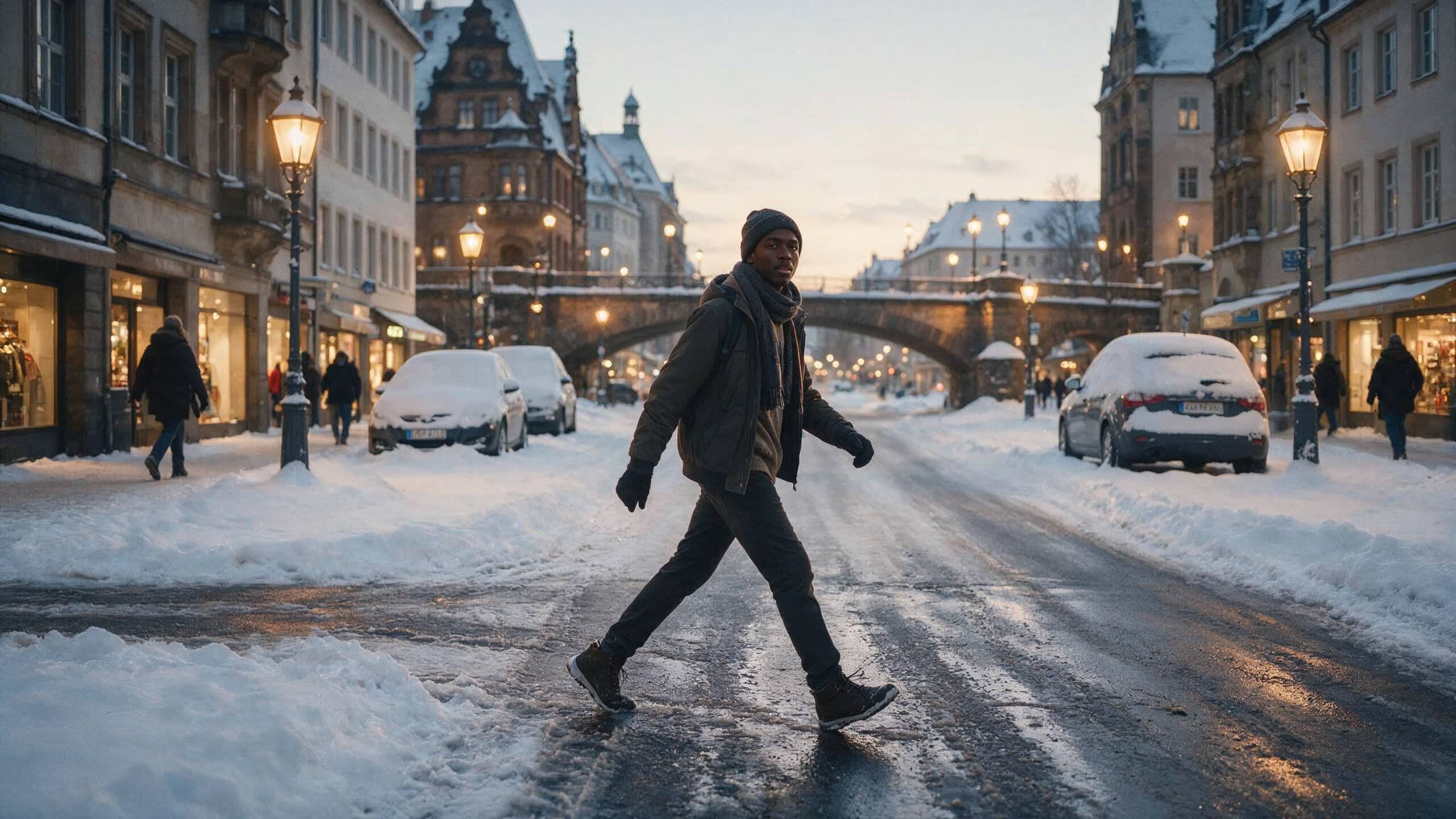
Your first winter in germany nigerian is not really a fight against cold. It is a fight against darkness, damp, and a set of small habits nobody explains to you before you land. Most Nigerians arriving in Germany expect snow and thick jackets, and they prepare for exactly that. Then December arrives, the sun sets at half past four, the sky stays grey for eleven straight days, the heating bill lands in spring like an ambush, and they realise they were braced for the wrong thing entirely.
If you plan to drive through the winter, check your paperwork before you check the tyres. Your Nigerian licence is only valid for six months after you register your address, and swapping it for a German one is not a formality. See Nigerian Drivers Licence Germany: Complete 2026 Conversion Guide for the full process.
This guide is written for the person who has never lived through a real winter. Not a general weather article, but the practical, money and health specific version: what to buy, what it costs, what German landlords expect of you, why your radiator has numbers instead of degrees, how to keep your mood intact through the darkest weeks, and which mistakes cost the most. If you are still at the planning stage, pair this with our full walkthrough on how to move to Europe from Nigeria, which covers the route into the country before you get to the business of surviving it.
Get Free Germany Scholarship and Visa Updates
Join students across Africa receiving the latest scholarship deadlines, visa tips, and application guides straight to their inbox.
What a German winter actually feels like for someone from Nigeria
Nigeria sits between roughly 4 and 14 degrees north of the equator. Germany sits between 47 and 55 degrees north. That gap is the whole story, and it explains almost everything that surprises people.
Near the equator, day length barely changes across the year. You get roughly twelve hours of daylight in January and roughly twelve in July. Your body has never had to negotiate with the seasons. In Germany, December daylight collapses to around seven or eight hours. In the far north of the country it is less. The sun rises late, sits low and weak in the sky all day, and disappears in the afternoon while you are still at your desk.
Temperature averages tell you less than you would think. Most German cities sit around 2C to 5C in the day through the coldest months, dipping below freezing overnight. Munich, Dresden and Leipzig run colder. Cologne, Duesseldorf and Hamburg are milder but wetter. The number on your phone is not what you feel, though. Wind and humidity are what actually cut through you. A dry -2C in Berlin on a still day is more comfortable than +4C in Hamburg with wind and drizzle, and every newcomer learns this the hard way in about week two.
The other thing nobody warns you about is how warm the indoors is. German buildings are heavily insulated and centrally heated. You will walk from 1C outside into a 22C lecture hall wearing four layers and start sweating within three minutes. This is why layering, not one enormous coat, is the correct strategy. You need to be able to shed and rebuild your insulation many times a day.
The timeline of a first German winter
Knowing the shape of the season helps enormously, because each phase catches you differently.
- October. The clocks go back on the last Sunday, and the evening suddenly arrives an hour earlier. Temperatures are still manageable, around 8C to 14C. This is the month to buy your gear, before the good sizes sell out and before you are already cold.
- November. The genuinely hardest month for most newcomers, and the one people underestimate. It is not cold enough to be dramatic, but it is grey, wet, and dark, with no Christmas atmosphere to soften it. Mood dips here more than in January.
- December. Cold sets in properly, but Christmas markets, lights, and the end of semester break give you something to hold onto. Offices close from around 23 December to 2 January, so finish any paperwork before this.
- January and February. The coldest weeks, and exam season at most universities. The combination of low mood, low light and high academic pressure is why this is the period to be most deliberate about routine and daylight.
- March. Light returns noticeably. By late March the clocks go forward and you get evenings back. You will feel the change in your body within days.
Your complete first winter in Germany Nigerian clothing list, with real prices
This is the section people want first, so here it is with honest numbers. The guiding principle is simple: buy your winter clothing in Germany, not in Nigeria. Winter outerwear sold in Lagos or Abuja is fashion, not insulation. It is designed to look the part in a market that does not need real thermal performance, and it is often expensive relative to what it delivers. Bring one warm jacket and a hoodie for the airport and your first two days, then buy properly once you arrive.
Preparing for that first cold season starts before you leave Nigeria. Our guide to What to Pack From Nigeria to Germany: The Only List You Need explains why buying a winter coat in Lagos is usually a mistake, and Arriving in Germany Winter Semester 2026: The 14-Day Setup Plan for Nigerians maps out the fortnight after you land so you are settled before the dark months arrive.
| Item | Why it matters | Realistic price in Germany | Where to buy |
|---|---|---|---|
| Waterproof winter jacket (-10C rated, hooded) | The one item you cannot improvise. Blocks wind and rain, which is what actually makes you cold | 80 to 150 euros | Decathlon, TK Maxx, Zalando sales |
| Thermal base layer top and bottom | Traps warm air against your skin. Lets you wear a thinner outer layer | 20 to 40 euros per set | Decathlon, Lidl and Aldi winter weeks |
| Wool or synthetic blend socks (5 pairs) | Cotton holds sweat and freezes. Wool keeps warmth even when damp | 20 to 35 euros | Decathlon, C&A, Aldi |
| Waterproof boots with deep rubber soles | Prevents falls on ice and keeps feet dry through slush | 50 to 100 euros | Deichmann, Decathlon |
| Beanie or wool hat | Significant heat is lost from an uncovered head and ears in wind | 8 to 20 euros | Anywhere, including supermarkets |
| Windproof gloves | Knitted gloves alone do nothing against German wind | 10 to 25 euros | Decathlon, dm |
| Scarf or neck gaiter | Seals the gap at your collar where cold air enters | 8 to 20 euros | Anywhere |
| Moisturiser and lip balm | Indoor heating plus cold air cracks skin and lips badly, especially darker skin which shows ashiness fast | 10 to 20 euros | dm, Rossmann |
| Vitamin D supplement | Your skin cannot make it from October to March at German latitude | 5 to 15 euros for several months | dm, Rossmann, any Apotheke |
| Total realistic first winter kit | Around 250 to 400 euros new, 120 to 200 euros mixing sales and second hand |
Two timing tricks save serious money. First, German retailers run heavy end of season sales in January and February, cutting winter stock by 40 to 70 percent. If you arrive for the winter semester in October, buy the essential jacket and boots immediately, then fill in the rest during the January sales. Second, Aldi and Lidl run themed weeks where thermal wear, socks and gloves appear cheaply in the middle aisle for a few days. They are basic but perfectly functional, and a 4 euro pair of thermal socks from Lidl outperforms a 15 euro pair of cotton ones.
Second hand is entirely normal in Germany and carries no stigma. Kleiderkreisel and Vinted, plus charity shops and the Sozialkaufhaus in most cities, will get you a serviceable jacket for 25 to 50 euros. Many university towns also run a Kleidertauschboerse, a clothing swap, at the start of the cold season.
The layering system that actually works
Forget the idea of one heroic coat. Three layers, each doing a different job:
- Base layer. Thermal top and leggings worn against the skin. Its job is to trap warm air and move sweat away from you. Must not be cotton.
- Mid layer. A fleece, hoodie, or wool jumper. Its job is bulk insulation, and this is the layer you remove indoors.
- Outer layer. The waterproof, windproof jacket. Its job is not warmth. Its job is to stop wind and water from stealing the warmth the other two layers made.
The single most common newcomer mistake is wearing a thick cotton hoodie under a fashion jacket, sweating on the U-Bahn, then stepping outside with damp cotton against the skin. That is how people end up genuinely cold and, often enough, genuinely ill. Cotton is the enemy. Wool and synthetics are your friends.
Heating your room without destroying your budget
Here is the mechanism that catches nearly every international student in their first year. Your rent is quoted as Kaltmiete, the cold rent, plus Nebenkosten, the additional costs. Together they make Warmmiete. The Nebenkosten you pay monthly is an estimate, typically based on the previous tenant’s usage. Once a year the meters are read and the real figure is calculated. If you used less than estimated, you get a refund. If you used more, you receive a Nachzahlung, a back payment, due quickly.
Students who kept a radiator on setting 5 through a cold winter routinely receive bills of 300 to 900 euros in spring. It arrives at exactly the moment when your funds are thinnest, and it is not negotiable. Central heating in a typical apartment runs to roughly 2.50 euros per square metre per month over the heating season, so a 20 square metre room is costing something in the region of 50 euros a month to heat properly, and considerably more if you overheat it.
| Radiator setting | Approximate room temperature | Sensible use |
|---|---|---|
| * (snowflake) | Around 6C | Frost protection only. Use when travelling home for Christmas, never as a daily setting |
| 1 | Around 12C | Too cold to live in. Raises mould risk badly |
| 2 | Around 16C | Bedroom at night, if you sleep under a warm duvet |
| 3 | Around 20C | The sweet spot for a living room or study desk |
| 4 | Around 24C | Warmer than most Germans keep a room. Expensive |
| 5 | Around 28C | Almost never justified. This is how students get 800 euro back payments |
The practical advice: keep living space at setting 3, bedroom at 2 to 3 overnight with a good duvet, and never use 5 as a way to warm a cold room quickly. Radiators do not work that way. Setting 5 does not heat faster, it simply heats to a higher final temperature, so you overshoot and waste money. Turn the heating down but not off when you go out for the day, because reheating a fully cold room costs more than maintaining a cool one.
If money is the pressure point, it is worth mapping your full cost picture rather than economising blindly on heat, which carries health and mould consequences. Our detailed breakdown of the cost of studying in Germany from Nigeria shows where winter expenses sit against everything else, and the guide to the blocked account for Germany for Nigerian students explains the monthly release schedule you are actually living on. For 2026 the blocked account requirement is 11,904 euros, releasing 992 euros per month, and a 600 euro heating back payment against a 992 euro month is a serious event. Plan for it in November.
Lueften: the ventilation rule that protects your deposit
This one feels absurd when you first hear it. In the middle of winter, you are expected to open your windows wide.
The reason is condensation. A heated, sealed German room fills with moisture from your breathing, cooking, showering and drying clothes. That moisture condenses on the coldest surfaces, usually window frames and the wall behind a wardrobe, and mould follows within weeks. Mould disputes are among the most expensive and most stressful problems international students face, and they can consume your entire deposit.
The correct technique is called Stosslueften, or shock ventilation:
- Turn the radiator down first.
- Open the window fully, not tilted, for five to ten minutes.
- Ideally open windows on opposite sides of the flat to create a cross draught, which is Querlueften.
- Close, turn the radiator back up.
- Do this two to four times a day, including after showering and cooking.
Leaving a window permanently tilted, which feels like the sensible compromise, is the worst option. It cools the wall around the frame continuously without properly exchanging the air, which creates exactly the cold damp surface mould wants. Never dry laundry on a rack in a closed unventilated room. Buy a cheap hygrometer for around 10 euros and keep indoor humidity between 40 and 60 percent. If a dispute ever arises, a simple written log of when you heated and ventilated is genuinely useful evidence.
Your health through the dark months
Vitamin D is not optional advice
Between roughly October and March, the sun in Germany never climbs high enough for UVB radiation to reach the surface in the amount your skin needs. This is not about how long you stay outside. On a bright, cloudless January noon in Frankfurt your skin will still produce essentially no vitamin D, because the required wavelengths are being filtered out by the atmosphere at that angle.
This affects everyone in Germany, but it lands harder on people arriving from tropical latitudes. Melanin is effective natural sun protection, which is a benefit in Nigeria and a disadvantage at 50 degrees north, because it slows vitamin D synthesis from already scarce UVB. Many Nigerians arrive with reserves built under a Lagos sun, run them down over autumn, and are low by January without ever knowing it. Symptoms are vague and easy to mistake for something else: fatigue, low mood, aching muscles, frequent minor illness.
Supplements are cheap, unregulated in the sense that you do not need a prescription for standard doses, and available in every dm, Rossmann and Apotheke for around 5 to 15 euros for several months. Speak to a doctor about the right dose for you, and ask for a blood test if you are feeling persistently tired. Diet helps a little, through oily fish, eggs and fortified products, but through a German winter it will not carry you alone.
Seasonal low mood, and taking it seriously
Seasonal affective disorder is a recognised form of depression driven by reduced daylight, and it is common enough in northern Europe that Germans have an entire vocabulary for winter gloom. For someone who has lived their whole life with equatorial daylight, the first exposure can be sharp.
Normal is feeling flat for a few grey days. Worth acting on is two weeks or more of persistent low mood, sleeping far more than usual, withdrawing from friends, losing interest in what you used to enjoy, or struggling to get out of bed. That is not weakness and it is not a character failure. It is a physiological response to light deprivation, and it responds well to treatment.
What genuinely helps:
- Get outside in actual daylight every single day, ideally before 13:00, even for fifteen minutes and even when it is grey. Overcast daylight is still many times brighter than indoor lighting.
- Consider a daylight lamp. A 10,000 lux SAD lamp costs 40 to 80 euros, and twenty to thirty minutes in the morning is a well evidenced intervention.
- Keep a fixed sleep schedule. Darkness destroys routine, and drifting sleep makes everything worse.
- Move your body. Most universities have a Hochschulsport programme costing 20 to 40 euros a semester for unlimited classes. It is the cheapest gym you will ever find and it puts you around people.
- Protect your social contact deliberately. The instinct in winter is to stay in your room. That instinct is wrong and it compounds.
- Use the free counselling. Every German university and every Studentenwerk offers free psychological counselling, often with English speaking staff. Using it is completely routine here.
One more specific point for Nigerians: the loneliness is often sharper than expected because winter coincides with Christmas, when German friends disappear to their families for two weeks and campus empties. Plan for that fortnight in advance. Find the other international students who are also staying, because there are always many, and make a plan rather than discovering the emptiness on 24 December.
Skin, hair and the things nobody mentions
Cold outdoor air holds little moisture and indoor heating strips out what remains. The effect on darker skin is immediate and visible, and on afro textured hair it is significant.
Switch to a heavier, oil based moisturiser than you used in Nigeria and apply it to damp skin straight after showering. Shea butter works well and is widely available in African shops in every German city. Use lip balm constantly, because cracked lips in the wind are miserable. For hair, expect increased dryness and breakage. Deep condition more often, protect your hair under a hat, and consider satin lined headwear because wool draws moisture straight out of your hair. Every mid sized German city has African hair shops and salons, so you are not stranded, but it is worth locating yours before you urgently need it.
Also expect more colds than you are used to, particularly in your first year while your immune system meets an unfamiliar set of circulating viruses in poorly ventilated winter rooms. Know how your health insurance in Germany for students works, and register with a Hausarzt, a general practitioner, before you actually need one. Finding a doctor while ill and feverish in a foreign system is not an experience worth having.
Getting around safely when everything is dark and icy
Falls are the most common winter injury among new arrivals, and a broken wrist in your first semester is a genuinely serious setback. Black ice, Blitzeis, is the specific danger, because it is transparent and looks like wet pavement. Assume bridges, shaded stretches, and the strip beside parked cars are icy even when you cannot see it.
Walk with short steps, keep your weight over your front foot rather than striding, keep your hands out of your pockets so you can balance and catch yourself, and buy boots with deep soft rubber soles. Hard smooth soles are treacherous. Property owners have a legal duty to clear and grit paths, the Raeum und Streupflicht, and this is genuinely enforced, but it does not help you crossing a courtyard at six in the morning.
Public transport gets less reliable in snow and freezing rain, with delays and occasional cancellations. Leave earlier than you think necessary, especially for exams and appointments. The Deutschlandticket for students makes winter travel far less painful than cycling in sleet, and most students who cycle from October simply stop by mid November. If you do cycle, lights are legally required and the police do check.
Daylight running out at 16:00 also means you will be walking home in darkness constantly. German cities are generally safe, but the ordinary sense of an evening being late is distorted. It feels like 21:00 at 17:00, and people misjudge their energy accordingly.
A real example: Chinedu’s first winter in Frankfurt
Chinedu arrived from Enugu in late September 2025 for a winter semester master’s programme. He landed with two hoodies, a leather jacket bought in Lagos, and a plan to buy more later.
October was fine and confirmed his sense that people had exaggerated. By early November the leather jacket had stopped working, because it blocked nothing and held rain. He spent two damp weeks perpetually cold before buying a proper jacket, thermal layers, boots, socks and gloves in a single trip to Decathlon for 310 euros, which he had not budgeted for and which came out of his monthly 992 euro release.
He kept his radiator on 5 through December, because his room felt cold when he came in from outside and turning it up felt like the fix. He also kept his window tilted permanently, reasoning that fresh air was healthy. In February his landlord flagged mould behind the wardrobe, and in April the Heizkostenabrechnung arrived with a 640 euro back payment.
The mood problem crept up more quietly. He stopped going out in November because it was dark and wet, missed the Christmas period entirely when campus emptied, slept ten or eleven hours a night, and went into his February exams underprepared and flat. He passed, but two grades below what he had been achieving.
What he did in his second winter: bought gear in the January sales at half price, kept the radiator at 3, did Stosslueften three times a day with the window fully open for seven minutes, started vitamin D in October, joined Hochschulsport badminton because it forced him out twice a week, and made a plan for the Christmas fortnight with three other international students. His heating settlement that year came back as a 40 euro refund. His grades recovered. Nothing he changed was expensive. It was all information he did not have the first time.
Common mistakes in a first German winter
- Buying winter clothing in Nigeria. Fashion outerwear, tropical pricing, no real insulation. Bring one jacket for the airport and buy properly on arrival.
- Wearing cotton next to the skin. It absorbs sweat, stops insulating, and turns cold against you. Thermal base layers exist for a reason.
- Running the radiator on 5. It does not heat faster, only hotter, and it produces spring back payments in the hundreds of euros.
- Leaving windows permanently tilted instead of doing proper Stosslueften. Cools the walls, does not exchange air properly, invites mould, threatens your deposit.
- Drying laundry indoors in a closed room. One of the fastest routes to a humidity and mould problem.
- Skipping vitamin D. Cheap to fix, genuinely consequential to ignore.
- Treating low mood as weakness. It is a light deprivation response and there is free, normal, confidential help on every campus.
- Hibernating socially from November. The instinct to stay in is the thing that turns a hard season into a bad one.
- Scheduling paperwork for late December. German offices shut down around Christmas and nothing moves until January.
- Smooth soled shoes on ice. The most avoidable injury of the season.
- Underestimating November. Everyone braces for January and gets blindsided by grey, wet, festive free November.
- Not budgeting for the heating settlement. Set aside 40 to 60 euros a month from October and the spring bill becomes a non event.
Your first winter checklist
Work through this in order. It maps to the timeline above.
- Buy the waterproof windproof jacket before the end of October.
- Buy thermal base layers, wool blend socks, hat, windproof gloves, scarf.
- Buy boots with deep rubber soles. Test the grip before you need it.
- Start a vitamin D supplement in October and speak to a doctor about dosage.
- Register with a Hausarzt while you are still healthy.
- Find your nearest Apotheke, dm or Rossmann, and African food and hair shop.
- Learn what the numbers on your radiator valve mean and set living space to 3.
- Set phone reminders for Stosslueften, morning and evening, until it becomes habit.
- Buy a 10 euro hygrometer and keep humidity between 40 and 60 percent.
- Start setting aside 40 to 60 euros a month for the heating settlement.
- Switch to a heavier moisturiser and get lip balm now, not in January.
- Sign up for one Hochschulsport class that forces you outdoors weekly.
- Block a daily fifteen minute daylight walk into your calendar before 13:00.
- Finish any Auslaenderbehoerde, bank or university paperwork before 20 December.
- Make an actual plan for the Christmas fortnight with people who are staying.
- Save the number of your university’s psychological counselling service now.
- Diarise the January sales to buy the rest of your gear at half price.
Pro tips most guides will not tell you
- The middle aisle at Lidl and Aldi is a legitimate winter gear strategy. Thermal socks, base layers and gloves appear cheaply for a few days at a time from October. Basic, functional, a fraction of sportswear prices.
- Warm your bed, not your room. A 15 euro hot water bottle and a proper duvet lets you sleep at radiator setting 2 comfortably, which is a meaningful saving across a season.
- Cook more. Hot food, an oven that warms the kitchen, and cheaper meals than eating out. Winter is when Nigerian students who cook pull ahead financially.
- Vitamin D plus a daylight lamp on your desk beats either alone for most people in the January to February stretch.
- Christmas markets are the cheapest social life in December. Entry is free, a Gluehwein is a few euros, and it is the one time of year when German public space is warm and social.
- Take the daylight when it appears. When a rare bright winter day arrives, drop what you are doing and go outside for an hour. Everyone in Germany does this and it is not procrastination.
- Buy next winter’s jacket in February. End of season clearance is when the good stuff is 60 percent off.
- Keep the receipts and the log. Written notes of your heating and ventilation habits are real protection in a mould dispute.
Winter and your studies: do not lose the semester
The academic calendar is unkind here. The winter semester runs from October, teaching ends in early February, and exams fall in February and March, precisely when motivation is at its lowest and daylight at its scarcest. Students who drift through November and December find themselves trying to recover in the worst possible conditions.
Practical countermeasures: study in the library rather than your room, because it is bright, warm, heated at someone else’s expense, and full of other people doing the same thing. Form a study group in October before you need one. Treat your daylight walk as non negotiable rather than the first thing you cut. If you are on an English taught programme, this is also a good stretch to make progress on German, since you will be indoors anyway.
Our overview of English taught programs in Germany that are free covers how the language question fits into your degree, and if you are still in the application phase, the German student visa from Nigeria in 2026 guide and the German student visa requirements for Nigeria breakdown will keep your paperwork on track through the season when offices slow down.
Also worth knowing: whether you arrive for the winter or summer intake changes your first cold season entirely. Arriving in October means winter hits you while you are still finding your feet. Arriving in April gives you six months to settle before your first one. Our comparison of the winter or summer intake in Germany goes into the trade offs, and the first week in Germany checklist covers the administrative sprint that lands on top of everything else.
For official guidance on living and working conditions, the German government’s own portal at Make it in Germany is a reliable reference, and the Federal Foreign Office publishes current entry and residence information that is worth checking directly rather than through third parties.
Frequently asked questions
How cold does it actually get during your first winter in Germany?
In most German cities the coldest stretch runs from late December to mid February, with daytime highs around 2C to 5C and night lows between -1C and -5C. Southern and eastern cities such as Munich, Dresden and Leipzig go colder than Cologne or Hamburg. Numbers alone do not tell the story. Wind and damp make 3C in Frankfurt feel far harsher than dry cold, which is why layering matters more than any single thick coat.
Is snow the hardest part of winter for Nigerians?
No. Almost every Nigerian expects snow and is pleasantly surprised by it. The two things that actually catch people off guard are the darkness and the damp. In December the sun can set before 16:30 and you may go days without seeing direct sunlight. That, plus constant grey drizzle, affects mood far more than temperature does.
What is the single most important item of winter clothing to buy?
A proper waterproof and windproof winter jacket rated for around -10C, with a hood. Everything else can be layered or bought cheaply, but a weak jacket cannot be compensated for. Budget 80 to 150 euros for a decent one from Decathlon, TK Maxx or a end of season sale.
Should I buy my winter clothes in Nigeria or in Germany?
Buy in Germany. Winter clothing sold in Lagos or Abuja is usually fashion outerwear, not thermal gear, and it is priced for a market that does not need real insulation. Bring one warm jacket and a hoodie for the airport and first two days, then buy properly once you arrive. German end of season sales in January and February cut prices by 40 to 70 percent.
How much should I budget for winter clothing in total?
Plan 250 to 400 euros for a full first winter kit if you buy new, or 120 to 200 euros if you mix second hand shops, Kleiderkreisel, and sales. This is a one time cost. The gear lasts several winters if you buy quality once instead of cheap repeatedly.
What is Heizkostenabrechnung and why do students fear it?
It is the annual heating and utility settlement. You pay a fixed monthly estimate as part of your Nebenkosten, then once a year the meters are read and you either get money back or receive a Nachzahlung, a back payment. Students who heated heavily through winter commonly face bills of 300 to 900 euros arriving in spring. Budget for it rather than being ambushed by it.
Is it true I must ventilate my room even in freezing weather?
Yes, and it is not optional in practice. German rental culture expects Stosslueften, which means opening windows fully for five to ten minutes several times a day rather than leaving them tilted. Failing to do this causes condensation and mould, and mould disputes with landlords are among the most common and most expensive problems international students face.
Do I really need vitamin D supplements?
For most people arriving from Nigeria, yes, and it is worth discussing with a doctor. Between October and March the sun sits too low in Germany for your skin to produce meaningful vitamin D, regardless of how much time you spend outside. Darker skin produces vitamin D more slowly from limited UVB, so people coming from tropical latitudes often start a German winter already low. Supplements are cheap and available in any Apotheke or dm.
What is winter depression and how do I know if I have it?
Seasonal affective disorder is a real, recognised form of depression tied to reduced daylight. Warning signs are persistent low mood, sleeping much more than usual, withdrawing from friends, losing interest in things you enjoyed, and struggling to get out of bed. Feeling flat for a few grey days is normal. Feeling that way for two weeks or more is worth taking seriously. Every German university has a free psychological counselling service and using it is routine, not shameful.
How do I stop my hands and feet from always being cold?
Cold extremities are usually a circulation and layering problem, not a toughness problem. Wear thermal socks made of wool or synthetic blend rather than cotton, keep your core warm so your body stops prioritising it over your hands, use gloves that are windproof rather than knitted, and keep moving. Cotton socks trap sweat and then freeze it against your skin, which is why so many people are cold despite wearing thick socks.
Will winter affect my ability to work my student job?
Indirectly, yes. Getting to a 06:00 shift in darkness and ice is harder than it sounds, and outdoor or delivery work becomes genuinely unpleasant. Many students shift to indoor roles for the winter months. Factor in that public transport delays increase, so leave earlier than you think you need to.
Does the cold affect my documents, deadlines, or visa appointments?
Not directly, but winter is when many students fall behind. Semester exams cluster in February, motivation drops, and offices close over the Christmas period from roughly 23 December to 2 January. If you need something from the Auslaenderbehoerde, a certificate from your university, or a bank appointment, do not plan it for late December. Handle paperwork in November or push it to mid January.
Is it safe to walk on ice and how do I avoid falling?
Falls are the most common winter injury for newcomers. Wear shoes with deep, soft rubber soles rather than smooth ones, walk with shorter steps and your weight over your front foot, keep your hands out of your pockets so you can balance, and treat black ice on bridges and shaded pavement as present even when you cannot see it. Property owners are legally required to clear and grit paths, but that does not help you at 06:00.
What should I do in my very first week of cold weather?
Buy the jacket, buy thermal socks and a hat, find your nearest Apotheke and get vitamin D, learn where your radiator valve is and what the numbers mean, and set a fixed daily time to go outside in daylight even for fifteen minutes. Those five things solve most of what goes wrong in a first German winter.
Final word
Your first winter in germany nigerian will be harder than you expect in ways you did not predict and easier in ways you feared. The snow is fun. The cold is manageable with 300 euros of the right gear. What actually tests people is the darkness, the isolation that darkness encourages, and the small domestic habits, heating and ventilation, that quietly cost hundreds of euros and a security deposit when you get them wrong.
None of it is difficult once you know. Buy the jacket before November. Keep the radiator at 3 and open the window fully for seven minutes twice a day. Take vitamin D from October. Get outside in daylight every day even when it is grey. Make a plan for the Christmas fortnight. Set aside a little each month for the settlement bill. Do those six things and you will come out the other side in March having simply had a winter, not having survived a crisis.
And it does end. By late March the light comes back fast, the city fills up, and you will understand why Germans behave the way they do at the first hint of spring sunshine. Your second winter will be nothing like your first.
Stay ahead of the next one
We publish practical guides for Nigerians studying, working and settling in Germany every week, covering costs, paperwork, visas and the things nobody tells you until it is too late. Subscribe to the GrandRoyal Travel newsletter to get them before you need them, not after.
Join our Telegram channel for the latest Germany study, visa and relocation updates for Nigerians: https://t.me/+I2s3n-gtMIQ0ZjQy
Winter is when isolation bites hardest, so pair this with our guide on How to Beat Culture Shock in Germany Nigerian Students Face and Build Real Community.
Stay Ahead of Every Scholarship Deadline
Get free updates on fully funded scholarships, visa requirements, and relocation guides for Germany. No spam, just what you need.
Get GrandRoyal in your Google feed — add us as a preferred source
Frequently asked questions
How cold is a German winter for a Nigerian?
Very cold and dark compared with Nigeria, so a proper insulated coat and layering are essential.
Should I buy winter clothes in Nigeria or Germany?
Buy the bulk in Germany, where winter clothing is often cheaper and genuinely warm.
How do I stay healthy in winter?
Mind your vitamin D, keep your room reasonably heated, and stay active to protect your mood.