

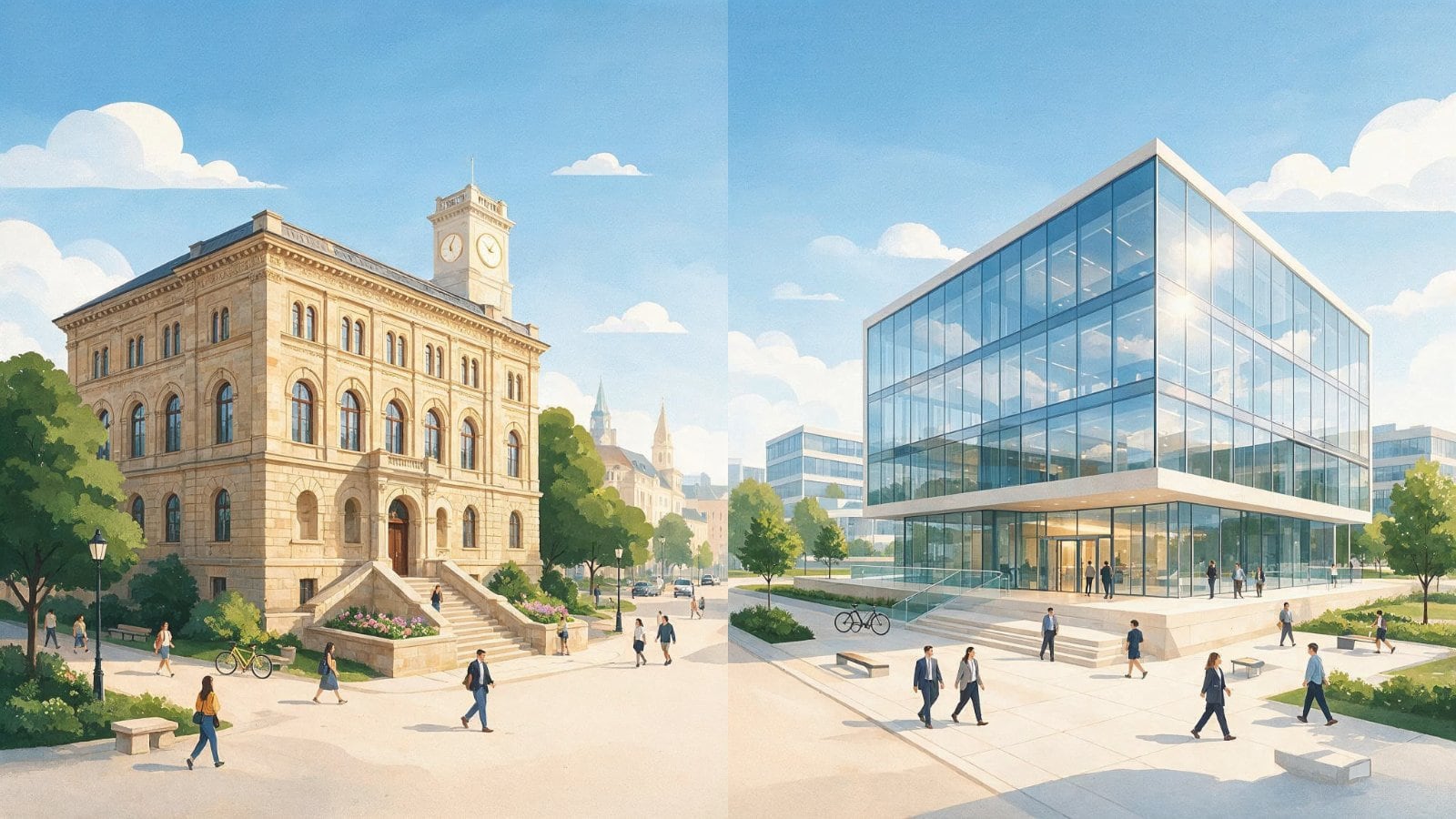
If you are planning your studies abroad, the first real decision you face is public vs private universities Germany, and it is a bigger decision than most Nigerian students realise. One route can cost you almost nothing in tuition. The other can cost you the equivalent of a Lagos car every single year. Both routes can get you a German student visa. Both can end with a German degree and a good job in Frankfurt, Munich or Berlin. But the risks, the timelines and the money are completely different, and picking the wrong one costs you either years or millions of naira.
This guide breaks down the real 2026 numbers, the visa implications, the recognition rules that decide whether your degree is even valid, and a clear decision framework so you know which route fits your situation. Everything here is written for Nigerians applying from Nigeria, not for a general European audience.
Public vs Private Universities Germany: The Short Answer
Here is the honest summary before we go deep.
Get Free Germany Scholarship and Visa Updates
Join students across Africa receiving the latest scholarship deadlines, visa tips, and application guides straight to their inbox.
Choose a public university if you have strong academic results, you can wait through a longer admission cycle, your funds are tight, and you want the cheapest genuine route to a German degree. Around 2.4 million of Germany’s roughly 2.9 million students sit in public institutions for exactly this reason.
Choose a private university if your grades are average, you were rejected by public universities, you need a fast admission decision, you want an English-taught programme with rolling intakes, and you can genuinely afford between 5,000 and 20,000 euros per year without borrowing money you cannot repay.
What you must never do is treat a private university as a shortcut to a visa. The German embassy in Abuja and the consulate in Lagos do not relax financial proof, motivation or credibility checks because you paid tuition. If anything, an expensive private admission with a weak financial profile invites more questions, not fewer.
What a Public University in Germany Actually Is
A public university, called a staatliche Hochschule, is funded and run by one of Germany’s 16 federal states. There are about 240 of them, split into three families:
- Universitäten: research universities that award bachelor’s, master’s and PhD degrees. Examples: TU Munich, Heidelberg, RWTH Aachen, Humboldt Berlin.
- Fachhochschulen (Universities of Applied Sciences, HAW/FH): practice-focused, strong industry links, mandatory internships, excellent for employability. Examples: Frankfurt UAS, HTW Berlin, Hochschule München.
- Kunst- und Musikhochschulen: art, design and music academies with portfolio-based entry.
The defining feature is the funding model. German taxpayers pay for higher education because the country treats graduates as future contributors to the pension and tax system. That policy is why a Nigerian student can sit in a lecture hall at a top-100 world university and pay zero tuition.
Tuition at public universities in 2026
In 15 of Germany’s 16 federal states, public universities charge no tuition fee for bachelor’s degrees and for consecutive master’s degrees, regardless of your nationality. You still pay a Semesterbeitrag (semester contribution) of roughly 100 to 400 euros per semester. That contribution is not tuition. It funds the student union, campus services, and in most cases a discounted public transport ticket.
The one exception is Baden-Württemberg, which introduced fees for non-EU students in 2017 and still charges 1,500 euros per semester in 2026. That is 3,000 euros per year, on top of the semester contribution. It affects popular universities such as Heidelberg, Stuttgart, Mannheim, Tübingen, Freiburg and KIT Karlsruhe. Two things soften it: students who earned their German university entrance qualification in Germany are exempt, and each institution may exempt up to 5 percent of its international students, usually through hardship or merit applications.
Non-consecutive master’s programmes are the other place public universities charge real money. If your master’s is not a direct continuation of your bachelor’s, or if it is an executive or MBA-style programme, expect fees between 5,000 and 30,000 euros for the full programme even at a public institution. Always check whether a programme is labelled konsekutiv or weiterbildend. That single German word decides whether you pay nothing or pay a lot.
What the semester contribution buys you
The semester contribution feels like an annoying admin charge until you see what is bundled inside it. Most universities now include the student version of the Deutschlandticket, which gives you unlimited regional public transport across the whole of Germany. In summer semester 2026 that student ticket costs 34.80 euros per month inside the contribution, rising to 37.80 euros per month from winter semester 2026/27, against 63 euros per month for the standard public Deutschlandticket. For a student who travels between cities for work or family visits, that alone can be worth more than the contribution itself.
What a Private University in Germany Actually Is
A private university is privately funded and survives on tuition. There are roughly 120 of them in Germany and they enrol only about 10 to 12 percent of all students. The important legal term is staatlich anerkannt, meaning state-recognised. A state-recognised private university can legally award degrees that carry the same formal weight as public university degrees.
Well-known names Nigerian students encounter include IU International University of Applied Sciences, SRH Berlin, GISMA University of Applied Sciences, Constructor University Bremen, EU Business School, Munich Business School, Arden University Berlin, Berlin School of Business and Innovation, and CBS International Business School.
Tuition at private universities in 2026
Fees vary enormously because every private institution sets its own price. Realistic 2026 ranges look like this:
- Applied sciences bachelor’s programmes: roughly 6,000 to 13,000 euros per year.
- Master’s programmes at business-focused schools: roughly 9,000 to 22,000 euros per year.
- Premium residential institutions such as Constructor University Bremen: around 20,000 euros per year in tuition alone, with campus accommodation and board charged separately.
- Executive MBA programmes: 30,000 to 65,000 euros for the full programme.
Convert that honestly before you commit. At 12,000 euros per year for three years, you are looking at 36,000 euros of tuition for a bachelor’s degree, plus roughly 12,000 euros per year of living costs. That is a serious family investment, and it is money you cannot get back if you drop out in year two.
Public vs Private Universities Germany: Full Cost Comparison Table
This table assumes a non-EU Nigerian student starting a bachelor’s or consecutive master’s degree in 2026.
| Cost item | Public university (most states) | Public university (Baden-Württemberg) | Private university |
|---|---|---|---|
| Tuition per year | 0 EUR | 3,000 EUR | 6,000 to 22,000 EUR |
| Semester contribution | 100 to 400 EUR per semester | 150 to 350 EUR per semester | Usually none, or a small admin fee |
| Application fee | uni-assist 75 EUR first course, 30 EUR each extra | uni-assist 75 EUR first course, 30 EUR each extra | 0 to 100 EUR, often waived |
| Blocked account (mandatory) | 11,904 EUR | 11,904 EUR | 11,904 EUR |
| Visa fee | 75 EUR | 75 EUR | 75 EUR |
| Health insurance | About 130 EUR per month | About 130 EUR per month | About 130 EUR per month |
| Three-year bachelor’s tuition total | Roughly 900 EUR in contributions | Roughly 9,900 EUR | 18,000 to 66,000 EUR |
Look at the last row again. The gap between the cheapest and the most expensive route across a three-year bachelor’s degree is large enough to fund an entire second degree, a business, or a deposit on property in Nigeria. That is the real weight of this decision.
Admission: Where Private Universities Genuinely Win
Cost is not the only variable. If it were, nobody would ever pay for a private university. The honest advantage of private institutions is access.
Public university admission reality
Public universities are competitive and rigid. For a Nigerian applicant this usually means:
- Your WAEC or NECO results plus at least one or two years of a recognised Nigerian university degree, or a Studienkolleg foundation year, before you qualify for a bachelor’s programme.
- Document verification through uni-assist, which takes four to eight weeks and often longer during peak season.
- Hard deadlines: 15 July for winter semester and 15 January for summer semester in most cases, with many programmes closing earlier.
- Restricted programmes with a Numerus Clausus, where a grade cut-off decides who gets in.
- Rejection without explanation, and no negotiation.
Private university admission reality
- Rolling or multiple intakes per year, sometimes January, March, July and October.
- Direct application to the school, no uni-assist queue in most cases.
- Admission decisions in days or weeks rather than months.
- More flexible entry, including interviews or motivation-based assessment instead of pure grade cut-offs.
- Almost all programmes taught fully in English, with no German requirement to start.
If you missed the 15 July deadline, if your CGPA is a 2:2, or if you need to leave Nigeria within six months rather than eighteen, a private university is often the only realistic legal route. That access is precisely what you are paying for.
Recognition: The Check That Protects Your Money
This is the section most Nigerian students skip, and it is the one that ruins people. A private university is only worth paying for if its degree is recognised. Recognition in Germany is not a marketing claim. It is a verifiable database entry.
The database is anabin, maintained by Germany’s Standing Conference of the Ministers of Education. Institutions are graded:
- H+: the institution is treated as equivalent to a German higher education institution. This is what you want.
- H+/-: some programmes qualify, others do not. Assessed case by case.
- H-: not recognised as equivalent. Avoid.
Before you pay a single euro of deposit to any private institution, do these four checks:
- Confirm the institution is staatlich anerkannt (state-recognised) and find the state ministry that recognised it.
- Confirm the specific programme is accredited, not just the institution. Programme accreditation in Germany runs through the Accreditation Council and agencies such as FIBAA, ACQUIN and ASIIN.
- Check the institution on Hochschulkompass, the official register run by the German Rectors’ Conference. If a school is not listed there, treat that as a red flag.
- Search the institution on anabin and confirm the H+ status.
Why this matters practically: an unrecognised degree can block you from a public sector job, from a professional licence, from a PhD place, and from converting your student residence permit into an EU Blue Card or skilled worker permit. Spending 45,000 euros on a certificate that cannot be used is the single most expensive mistake in this entire industry.
Does the Embassy Treat Private Admissions Differently?
Officially, no. The German student visa requirements are identical whether your admission letter comes from TU Berlin or from a private business school. You need the same admission letter, the same blocked account, the same health insurance, the same legalised documents and the same 75 euro visa fee.
In practice, visa officers are trained to spot patterns. A file that shows an applicant paying 18,000 euros per year in tuition while the sponsor’s bank statements cannot plausibly support that spending raises a credibility question. So does a candidate whose chosen private programme has no logical connection to their previous studies or work.
The fix is not to hide the private admission. The fix is coherence. Your sponsor’s income must plausibly cover tuition plus living costs. Your motivation letter must explain why this specific programme at this specific institution follows from your background. If you cannot explain that in three sentences, the visa officer will not be able to either. Our guide to writing a motivation letter for the German student visa walks through exactly how to build that logic, and our breakdown of German student visa interview questions covers what they will ask you about funding.
Money You Pay Either Way
Some costs do not care which route you choose. Budget for them from day one.
The blocked account
For 2026 the blocked account requirement is 11,904 euros for twelve months, which releases 992 euros per month to you after arrival. This applies to public and private university students equally. There is no discount because you are already paying tuition.
| Provider | Setup fee | Monthly fee | 2026 status |
|---|---|---|---|
| Fintiba | About 159 EUR | About 9.90 EUR | Active, widely accepted |
| Expatrio | About 89 EUR | About 5 EUR | Active, cheaper bundle |
| Coracle | n/a | n/a | Paused since August 2025 |
Full detail on how the money moves, what documents the bank wants and how long transfers from Nigeria take is in our guide to the blocked account for Germany for Nigerian students.
Document legalisation
Nigerian applicants must clear document checks before a visa appointment. That means WAEC legalisation for the German embassy. There is no APS step for Nigerian qualifications, as our APS certificate Nigeria guide explains. Neither of these depends on whether your university is public or private. Start them early, because they are the most common reason a well-prepared candidate misses an intake.
Health insurance and living costs
Public health insurance for students costs roughly 130 euros per month including long-term care contributions. Rent in a shared flat runs from about 350 euros per month in smaller cities like Chemnitz or Magdeburg to 700 euros or more in Munich, Frankfurt and Hamburg. Food, phone, internet and personal spending realistically add 300 to 400 euros per month.
Working While You Study
Rules here are identical for both routes. As an international student you may work 140 full days or 280 half days per year, raised from the old 120/240 limit by the 2024 skilled worker reform. Student assistant roles at your university generally do not count against that limit.
Practical earnings in 2026 sit between 13 and 16 euros per hour for typical student jobs, and higher for working student roles in IT, engineering or finance. A realistic part-time income is 500 to 900 euros per month, which covers living costs but will not cover 15,000 euros of private tuition. If your plan is to pay private school fees from a student job, the plan does not work. Be honest with yourself about that before you sign anything.
There is a genuine advantage on the private side worth noting: many private universities build paid internships and industry projects into the curriculum, and their career services are usually more hands-on than an overloaded public university office. If you use that properly, it can shorten your job search after graduation.
After Graduation: The Part That Actually Matters
Both public and private graduates from recognised institutions get the same post-study rights. You can apply for an 18-month residence permit to seek qualified employment. During that period you may take any job while you search for one matching your qualification. For 2026 you should be able to show roughly 1,027 euros per month in available funds for that permit.
Once you find a qualified role, you convert to a work permit or an EU Blue Card. From there, the path to permanent residence in Germany is short by international standards, and time spent studying counts partially toward naturalisation timelines.
This is where recognition comes back to bite people. If your private institution is not H+ rated, the immigration office may refuse to treat your degree as a qualifying higher education qualification, and the entire 18-month path narrows dramatically. Check anabin first. Every time.
A Real Example: Two Nigerians, Two Routes
Chinedu, 24, from Enugu. He finished a B.Sc. in Computer Science at UNN with a 2:1, then worked eighteen months as a backend developer in Lagos. He applied through uni-assist to four public universities of applied sciences for a master’s in Data Science, paying 75 euros for the first and 30 euros for each of the other three, so 165 euros in total. He waited eleven weeks, got two rejections and one admission from a public university in Saxony.
Total tuition for the two-year master’s: about 640 euros in semester contributions. His blocked account of 11,904 euros plus visa fee covered everything else. He now works as a working student earning 18 euros per hour in Leipzig. His full two-year study cost, tuition included, was under 25,000 euros.
Amaka, 22, from Ibadan. She finished a B.Sc. in Business Administration with a 2:2 and was rejected twice by public universities because her grade was below the cut-off for her chosen programme. She applied to a state-recognised private university of applied sciences in Berlin, was admitted in twelve days for a January intake, and paid 11,500 euros per year for an eighteen-month master’s.
Her total tuition was about 17,250 euros, and her total two-year cost was around 42,000 euros. She started in Germany fourteen months earlier than she would have with a public route, and her programme included a paid six-month internship that converted into a graduate offer.
Neither student made a mistake. Chinedu optimised for cost. Amaka optimised for time and access. What would have been a mistake is Amaka borrowing at Nigerian interest rates to fund a school she never checked on anabin, or Chinedu paying 40,000 euros for something he qualified to get for free.
Are Private Universities Good in Germany? An Honest Answer
Nigerians ask this constantly, so let us answer it plainly. Yes, many private universities in Germany are good, and some are excellent for employability. They are also not automatically better because they cost more, and Germany does not have the Ivy League dynamic where private equals prestige. The opposite is closer to the truth: Germany’s most globally respected institutions, TU Munich, RWTH Aachen, LMU Munich, Heidelberg, are all public.
What good private universities genuinely deliver is service. Smaller class sizes, faster admissions, English instruction, career coaching, structured internships, and administrative staff who answer emails. What weak private universities deliver is a diploma mill experience with an expensive invoice. The difference between the two is visible in accreditation records, employment outcomes and graduate reviews, and it takes about two hours of research to tell them apart.
Ranking reality check
If institutional prestige matters for your career plan, whether you are targeting a PhD, a research career or a highly selective employer, the public route is stronger. If practical employability in the German job market matters more, a well-accredited private university of applied sciences with strong corporate partnerships can compete very well, sometimes better than a large anonymous public university where you are one of 40,000 students.
Your Pre-Payment Checklist
Run through every line of this before you transfer money to any institution, public or private.
- Institution confirmed as state-recognised, with the recognising state ministry named.
- Institution listed on Hochschulkompass.
- Institution rated H+ on anabin.
- The specific programme is accredited by FIBAA, ACQUIN, ASIIN or another recognised agency.
- You have the full fee schedule in writing, including any registration, exam, re-sit and graduation fees.
- You have the refund and deferral policy in writing, specifically what happens if your visa is refused.
- You know whether the degree is consecutive or non-consecutive, if it is a master’s.
- You have checked the state, because Baden-Württemberg adds 3,000 euros per year for non-EU students at public universities.
- You have confirmed the language of instruction for every module, not just the programme title.
- Your documents are certified and consistent.
- Your WAEC and degree documents are legalised or in progress.
- Your blocked account provider is chosen and the 11,904 euros are available.
- Your sponsor’s financial documents plausibly support the tuition you are claiming to pay.
- You have found at least three current or former Nigerian students at the institution and spoken to them.
Common Mistakes Nigerians Make
1. Believing an agent who says a private university guarantees a visa. No institution can guarantee a visa. Any agent who says otherwise is selling you a lie, and the fee they charge is usually non-refundable.
2. Paying a deposit before checking anabin. Ten minutes of checking prevents a five-figure loss. Do it first, not after.
3. Assuming all public universities are free. Baden-Württemberg charges 1,500 euros per semester to non-EU students, and non-consecutive master’s programmes charge real fees everywhere. Read the fine print for your specific state and programme.
4. Ignoring the semester contribution. It is small but mandatory, and failing to pay it on time can de-register you from the university, which in turn threatens your residence permit.
5. Planning to pay private university tuition from a student job. The 140-day work limit and realistic wages make this arithmetic impossible. Fund tuition before you travel.
6. Choosing a city instead of a programme. Berlin and Munich are expensive. A strong programme in Ilmenau, Magdeburg, Kaiserslautern or Chemnitz will cost you far less in rent and give you the same degree recognition.
7. Missing the uni-assist window. Public applications need four to eight weeks of processing before the deadline, not on the deadline. Our uni-assist application guide for Nigeria explains the timeline properly.
8. Treating an English-taught label as a promise. Some private programmes are taught in English but require German for internships, part-time jobs and daily life. Check our list of English-taught programmes in Germany with free tuition before you accept a paid alternative.
9. Not preparing for refusal. Visa refusals happen to good candidates. Know the appeal process in advance through our guide to German student visa rejection in Nigeria.
Pro Tips From Students Who Got It Right
Apply to both in parallel. Submit to public universities through uni-assist, and hold one private admission as a backup. Most private schools allow deferral to the next intake, which means you can wait for a public decision without losing your fallback.
Use the 5 percent exemption in Baden-Württemberg. Each institution may exempt up to 5 percent of its international students from the 1,500 euro fee. Almost nobody applies. Write to the international office and ask about hardship or merit exemptions before you rule out Heidelberg or Stuttgart.
Target universities of applied sciences. Public FH and HAW institutions are less internationally famous, therefore less competitive, and their industry links often produce better employment outcomes than a large research university.
Negotiate private tuition. Private universities have scholarships, early-payment discounts and regional scholarships that are rarely advertised on the front page. Ask directly for the scholarship list. Discounts of 10 to 30 percent are common. Combine this with our roundup of Germany scholarships open in 2026.
Ask about the visa refusal refund policy in writing. A reputable private university refunds tuition minus a small administrative fee if your visa is refused. Get that in an email before you pay.
Check the actual campus. Some private institutions operate from a few floors of an office building with no library, no labs and no student life. Ask for a virtual tour. Look at the address on a map.
Which Route Fits You? A Decision Guide
| Your situation | Recommended route |
|---|---|
| Strong grades, first class or 2:1, and time to wait | Public university |
| Tight budget, family funding the blocked account with difficulty | Public university |
| Planning a PhD or research career | Public university |
| 2:2 or third class, rejected by public universities | Private university, checked on anabin |
| Missed the 15 July or 15 January deadline | Private university with a rolling intake |
| No German language ability and no time to learn | Either, but confirm English instruction module by module |
| Need to relocate within six months | Private university |
| Career changer moving into business, media or IT | Private university of applied sciences |
| Considering a foundation year | Public route via Studienkolleg |
Full Cost of Studying: What to Actually Budget
Below is a realistic first-year budget for a Nigerian student in 2026, excluding tuition, so you can add your own tuition number on top.
| Item | Cost in EUR | Notes |
|---|---|---|
| Blocked account deposit | 11,904 | Returned to you monthly at 992 EUR |
| Blocked account setup and fees | 150 to 280 | Depends on provider |
| Visa fee | 75 | Non-refundable |
| uni-assist | 75 first course, 30 each extra | Public applications only |
| Document legalisation and translation | 200 to 500 | WAEC, degree, transcripts |
| Flight Lagos or Abuja to Germany | 500 to 900 | Book early |
| Health insurance | About 130 per month | Mandatory for enrolment |
| Rent | 350 to 700 per month | City dependent |
| Semester contribution | 100 to 400 per semester | Public universities |
A deeper breakdown sits in our guide to the cost of studying in Germany from Nigeria, and the funding proof rules are explained in proof of funds for the German student visa.
Get the Weekly GrandRoyal Travel Briefing
Every week we send Nigerians one practical email on studying, working and relocating to Germany: deadline reminders, fee changes, scholarship openings and embassy updates before they trend on social media. No noise, no agent sales pitch. Join the GrandRoyal Travel newsletter here and get the next issue free.
If you want your documents and eligibility checked properly before you spend money, our team walks through your file step by step at visa.grandroyaltravel.com. Official requirements are published by the DAAD and the German Federal Foreign Office, and you should always cross-check current figures there.
Frequently Asked Questions
Is a private university degree in Germany respected by employers?
Yes, if the institution is state-recognised and the programme is accredited. German employers care about accreditation and practical experience more than about public or private status. An unaccredited degree, however, is close to worthless in the German labour market.
Can I get a German student visa with a private university admission?
Yes. The visa requirements are identical. You need the admission letter, a blocked account of 11,904 euros, health insurance, your certified documents and the 75 euro visa fee.
Why do Nigerians pay for private universities when public ones are free?
Access and speed. Private universities admit students with lower grades, run several intakes per year, decide in weeks rather than months, and teach in English. You are paying for entry and time, not for a better degree.
Which German states charge tuition at public universities?
Only Baden-Württemberg charges non-EU students, at 1,500 euros per semester. All other states charge no tuition for bachelor’s and consecutive master’s programmes.
How much is private university Germany tuition per year?
Realistically 6,000 to 13,000 euros per year for bachelor’s programmes at universities of applied sciences, 9,000 to 22,000 euros per year for master’s programmes at business schools, and around 20,000 euros per year at premium residential institutions such as Constructor University Bremen.
Do I still need a blocked account if I pay private tuition?
Yes. Tuition payment does not replace the blocked account. You need the full 11,904 euros for 2026 in addition to whatever tuition you have paid.
Can I transfer from a private to a public university later?
Sometimes. Credit transfer depends on accreditation and on the receiving university’s rules. Transfers are easier between accredited institutions and within the same subject area. Never assume it will work. Confirm with the target university before you enrol anywhere.
Are private universities easier to graduate from?
Admission is easier. Graduation is not automatically easier. Accredited programmes must meet the same academic standards, and private universities have a strong incentive to protect their accreditation. Expect real exams.
Do private universities in Germany offer scholarships?
Yes, and they are underused. Many offer merit awards, early-payment discounts and regional scholarships worth 10 to 30 percent of tuition. Ask the admissions office directly rather than relying on the website.
Is Studienkolleg required for private universities?
Often not. Many private institutions run their own foundation or preparatory programmes and admit Nigerian students who would otherwise need a Studienkolleg. This is one of the clearest practical advantages of the private route.
Can I work while studying at a private university?
Yes. The rule is the same for everyone: 140 full days or 280 half days per year. Realistic earnings are 500 to 900 euros per month, which supports living costs but will not fund private tuition.
What happens to my tuition if my visa is refused?
It depends entirely on the institution’s refund policy. Reputable private universities refund tuition minus an administrative fee. Get this policy in writing by email before you pay any deposit.
Which is better for permanent residence in Germany?
Both work equally, provided the institution is recognised. After graduation you can apply for an 18-month residence permit to seek qualified employment, then move to a work permit or EU Blue Card, and then to permanent residence.
Should I use an agent to apply?
You do not need one. Public applications go through uni-assist, and private universities accept direct applications. If you use support, use a service that shows you the official requirements rather than one that promises outcomes it cannot control.
Final Verdict
The choice between public vs private universities Germany comes down to three honest questions: how strong are your grades, how much time do you have, and how much money can your family actually part with without pain. If your grades are strong and you can wait, the public route gives you a globally respected degree for almost nothing, and that remains the single best value in international education anywhere in the world.
If your grades are average or your timeline is short, a properly accredited private university is a legitimate and often smart investment, provided you check anabin, confirm accreditation, and get the refund policy in writing before you pay.
What matters most is not the label on the building. It is whether the degree is recognised, whether you can afford the full journey including the 11,904 euro blocked account, and whether you finish. Verify first, pay second, travel third. Do it in that order and Germany will work for you.
Join our Telegram channel for the latest Germany study, visa and relocation updates for Nigerians: https://t.me/+I2s3n-gtMIQ0ZjQy
Never miss a deadline. Join the GrandRoyal Travel newsletter for weekly intake dates, scholarship openings and visa rule changes for Nigerians heading to Germany.
Keep reading
Stay Ahead of Every Scholarship Deadline
Get free updates on fully funded scholarships, visa requirements, and relocation guides for Germany. No spam, just what you need.
Get GrandRoyal in your Google feed — add us as a preferred source
Free GrandRoyal verified directories
Browse our regularly checked, no-cost directories for studying, training and funding in Germany:
- Study in Germany directory: 81 verified English-taught university programmes
- Scholarships for Germany: 51 verified scholarships with deadlines and official links
- Ausbildung in Germany: paid vocational training, the visa route and verified programmes
- German language courses: courses and recognised exams for your visa or university
Frequently asked questions
Public or private university in Germany — which is better?
For most Nigerians, public universities win on cost and recognition. Private can suit specific English programmes or flexible entry, but tuition is high.
Do private universities help with visas?
The visa requirements are the same — admission, €11,904 proof of funds and health insurance — regardless of public or private.
Are private degrees recognised?
Reputable accredited private universities are recognised, but always verify accreditation before paying.