
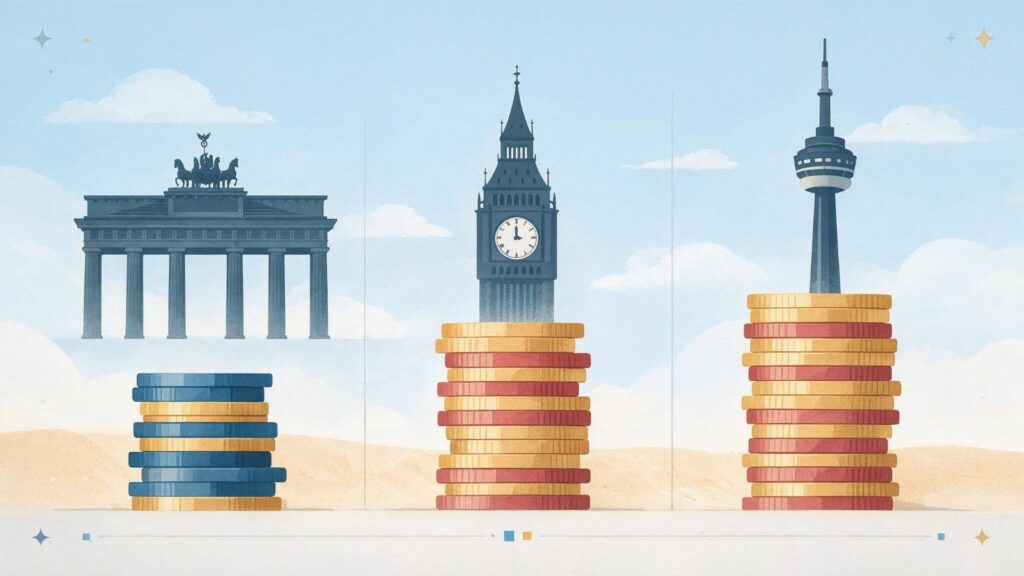
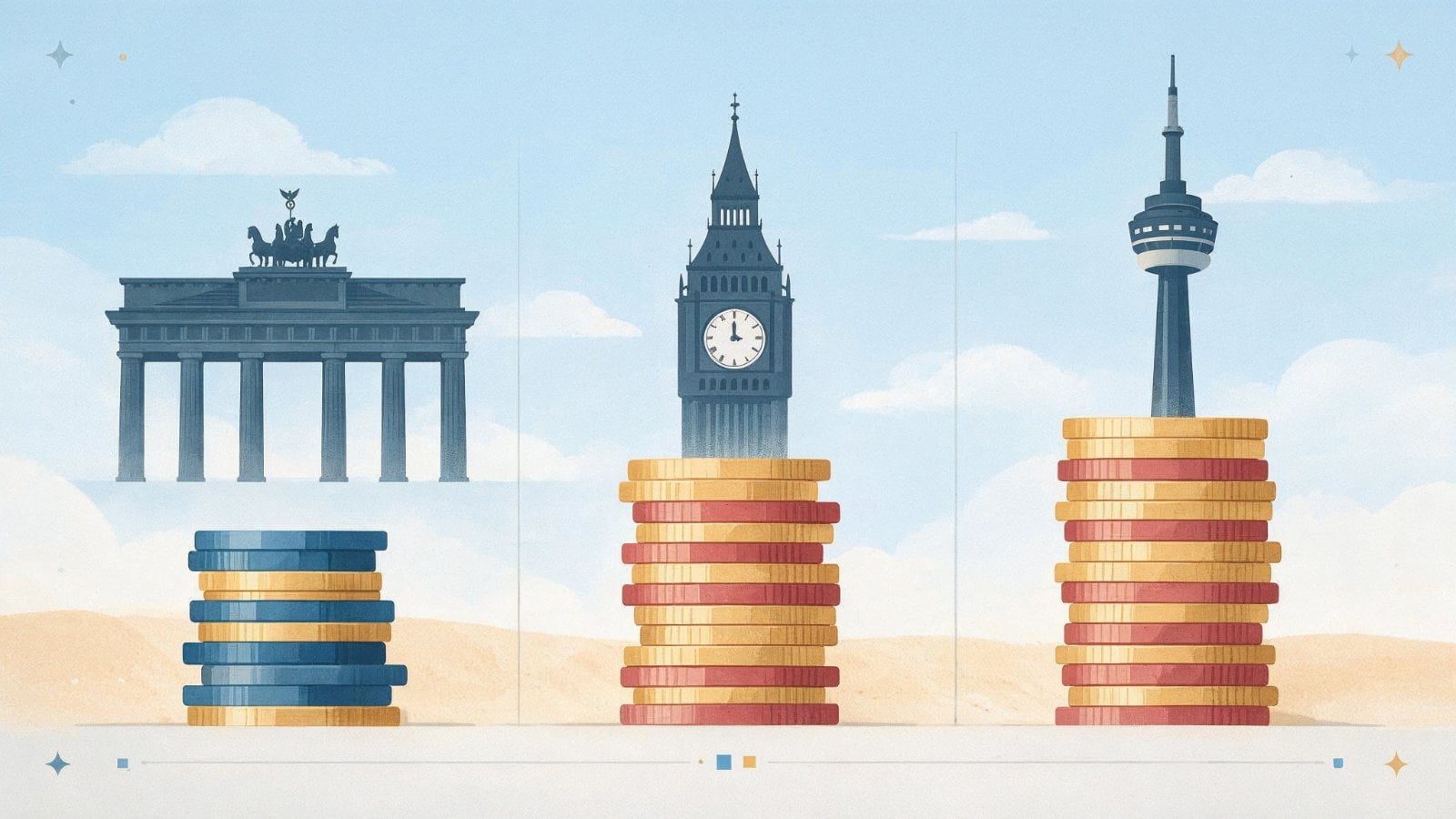
Every year thousands of Nigerians open three browser tabs and try to work out whether to study in Germany vs UK vs Canada. The marketing from all three sounds equally good. The actual bill does not. When you strip out the brochures and compare real 2026 numbers, one of these countries costs roughly a fifth of what the other two cost for the same level of qualification.
This is a straight cost comparison built for Nigerian applicants, using current 2026 tuition, visa fees, proof of funds thresholds, work rights and post-study rules. No sales pitch, no agent commission, just the arithmetic and what it means for your family.
Study in Germany vs UK vs Canada: The 60-Second Answer
Germany is the cheapest of the three by a very large margin, because public universities charge no tuition. Your main cost is the blocked account of 11,904 euros, and most of that money comes back to you as living allowance after you arrive.
Get Free Germany Scholarship and Visa Updates
Join students across Africa receiving the latest scholarship deadlines, visa tips, and application guides straight to their inbox.
Canada is the most expensive on paper for undergraduate study, because tuition is high and you must also show around 20,635 Canadian dollars in living funds on top of first-year tuition.
The UK sits in the middle on total cost but has the shortest degrees, which is a real financial advantage. A one-year master’s in the UK can end up cheaper overall than a two-year master’s in Canada.
The catch with Germany is admission. It is the hardest of the three to get into and the slowest process, and it usually requires German language ability for undergraduate study. You trade money for time and effort.
Tuition Compared: What Each Country Actually Charges
Tuition is where the three countries separate most sharply.
| Country | Undergraduate tuition per year | Master’s tuition per year |
|---|---|---|
| Germany (public universities) | 0 EUR in 15 of 16 states, plus 100 to 400 EUR semester contribution | 0 EUR for consecutive master’s, plus semester contribution |
| Germany (Baden-Württemberg, non-EU) | 3,000 EUR | 3,000 EUR |
| Germany (private universities) | 6,000 to 20,000 EUR | 9,000 to 22,000 EUR |
| United Kingdom | 11,400 to 38,000 GBP | 9,000 to 32,000 GBP |
| Canada | Average about 41,746 CAD, Ontario highest at about 49,802 CAD | Average about 24,028 CAD |
Read that table twice. A Nigerian student at a public German university pays nothing in tuition for a degree that is recognised worldwide. The same student in Ontario could pay close to 50,000 Canadian dollars per year for an undergraduate degree.
The only country of the three where a full degree can cost you zero in tuition is Germany. That single fact drives most of the total cost gap, and it is why our guide to the cost of studying in Germany from Nigeria is the most read piece on this site.
Visa Costs and Proof of Funds Compared
The second big difference is how much money you must show before anyone gives you a visa.
| Item | Germany | United Kingdom | Canada |
|---|---|---|---|
| Visa or permit fee | 75 EUR | 558 GBP | 150 CAD plus 85 CAD biometrics |
| Health surcharge | None, but insurance about 130 EUR per month | 776 GBP per year of visa | Provincial or private plan, varies |
| Proof of funds | 11,904 EUR blocked account | 1,529 GBP per month London or 1,171 GBP outside, up to 9 months | 20,635 CAD living funds plus first-year tuition |
| Is the money returned to you? | Yes, released at 992 EUR per month | It stays your money, held in your account | Yes if held as a GIC, released monthly |
| Extra document step | None for Nigerian qualifications | CAS from the university | PAL or TAL from the province, except master’s and doctoral at public institutions |
On maintenance alone, the UK asks for about 10,539 pounds outside London and about 13,761 pounds in London for the maximum nine months. Canada asks for 20,635 Canadian dollars plus your entire first-year tuition, which for many programmes means proving more than 60,000 Canadian dollars in total.
Germany asks for 11,904 euros and nothing else. That is the whole financial requirement, and it is explained fully in our guide to proof of funds for the German student visa.
The Real First-Year Cost, Side by Side
Here is a realistic first-year total for a Nigerian master’s student, excluding flights and personal spending. Figures are in each country’s own currency because exchange rates move constantly, so convert at the rate on the day you are budgeting.
| Cost line | Germany (public) | UK (outside London) | Canada (outside Quebec) |
|---|---|---|---|
| Tuition | 0 | 18,000 GBP typical | 24,000 CAD typical |
| Application fees | 75 EUR uni-assist first course | Usually free, some charge 50 to 75 GBP | 100 to 150 CAD per university |
| Visa or permit | 75 EUR | 558 GBP | 235 CAD with biometrics |
| Health cover | About 1,560 EUR for the year | 776 GBP IHS per visa year | 600 to 900 CAD depending on province |
| Funds you must show | 11,904 EUR | 10,539 GBP | 20,635 CAD |
| Money you get back to live on | 11,904 EUR over 12 months | Your own funds, no lock-in | GIC released over 12 months |
| Unrecoverable first-year spend | Roughly 1,700 EUR | Roughly 19,300 GBP | Roughly 25,000 CAD |
The last row is the number that matters. It strips out money that comes back to you and shows what you actually lose. In Germany that figure is under 2,000 euros. In the UK and Canada it runs into the tens of thousands because tuition is money gone.
If your family is funding this from Nigeria, that difference is not academic. It is the difference between one child studying abroad and three.
Living Costs: Where Your Monthly Money Goes
Tuition is the headline, but you live in the country for years. Monthly costs matter.
| Monthly item | Germany | United Kingdom | Canada |
|---|---|---|---|
| Shared room or flatshare | 350 to 700 EUR | 550 to 1,000 GBP | 700 to 1,400 CAD |
| Food | 200 to 280 EUR | 200 to 300 GBP | 350 to 500 CAD |
| Transport | About 37.80 EUR with the student Deutschlandticket | 60 to 180 GBP | 90 to 160 CAD |
| Health insurance | About 130 EUR | Covered by the IHS you already paid | 50 to 90 CAD |
| Phone and internet | 20 to 35 EUR | 20 to 40 GBP | 50 to 80 CAD |
Germany’s transport deal is the quiet winner here. The student version of the Deutschlandticket is bundled into your semester contribution and gives unlimited regional travel across the entire country for about 37.80 euros per month from winter semester 2026/27. Nothing in the UK or Canada comes close.
Rent is the reverse of what most Nigerians expect. Munich and Frankfurt are expensive, but Leipzig, Chemnitz, Magdeburg and Kaiserslautern are far cheaper than almost any UK or Canadian university city.
Work Rights While You Study
All three countries let you work, but the limits differ in ways that change your budget.
- Germany: 140 full days or 280 half days per year, raised from 120/240 by the 2024 skilled worker reform. Typical pay is 13 to 16 euros per hour, higher for working student roles in IT and engineering.
- United Kingdom: 20 hours per week during term time for degree-level students, full-time during official vacations. Ten hours per week for below-degree courses.
- Canada: 24 hours per week off campus during terms, full-time during scheduled breaks. This 24-hour cap replaced the old 20-hour rule.
Canada looks the most generous on paper, and for cash flow it is. But Canadian tuition is so much higher that the extra earnings rarely close the gap. A Canadian student working 24 hours a week is often just servicing a bill a German student never receives.
After Graduation: The Part Nobody Compares Properly
Post-study rights decide whether your degree turns into residence or into a return ticket.
| Country | Post-study stay | Route to permanent residence |
|---|---|---|
| Germany | 18-month residence permit to seek qualified employment, any job allowed while searching | Work permit or EU Blue Card, then settlement. Study time counts partially |
| United Kingdom | Graduate Route, 2 years for those finishing on or before 31 December 2026, then 18 months from 1 January 2027. PhD graduates keep 3 years | Skilled Worker visa with a sponsoring employer, then settlement after 5 years |
| Canada | PGWP up to 3 years, with language test and field-of-study rules for non-degree graduates | Express Entry or provincial nomination |
Two 2026 details Nigerians keep missing. First, the UK Graduate Route drops to 18 months for students who complete after 1 January 2027, so if you are starting in 2026, your finish date decides whether you get two years or eighteen months.
Second, Canada’s PGWP now includes a language test and a field-of-study screen for college diploma graduates. Bachelor’s, master’s and doctoral graduates from degree programmes remain exempt from the field-of-study list, which makes degree programmes the safer Canadian choice.
Germany’s 18-month permit is the simplest of the three. There is no employer sponsorship needed to stay and search, and you can work any job while you look. You do need to show roughly 1,027 euros per month in available funds for 2026.
Dependants: A Deciding Factor for Married Applicants
If you are married or have children, this section may matter more than tuition.
The UK no longer allows dependants for taught master’s, undergraduate, foundation or language students. Only research postgraduate students such as PhD candidates, and government-sponsored students on courses of six months or more, can bring family.
Germany allows spouses and children to join a student on a family reunification permit, subject to accommodation and financial proof.
Canada has tightened spousal open work permits, and eligibility now depends on your programme level and field. Check the current rules for your specific programme before you plan around it.
For a married Nigerian applicant doing a taught master’s, this alone rules the UK out.
Admission Difficulty and Timelines
Cost is only half the story. How hard is it to actually get in?
| Factor | Germany | United Kingdom | Canada |
|---|---|---|---|
| Typical decision time | 4 to 12 weeks through uni-assist | 2 to 6 weeks | 4 to 10 weeks |
| Main deadlines | 15 July for winter, 15 January for summer | Rolling, with January and September intakes | Rolling, with September, January and May intakes |
| Undergraduate entry from WAEC alone | No, needs Studienkolleg or Nigerian university study | Often yes with foundation year | Often yes directly |
| English test | Not always required, some programmes waive it | Almost always required | Almost always required |
| Country-specific document step | APS certificate, but not for Nigerian qualifications | CAS number and financial evidence rules | PAL or TAL, and the study permit cap |
Germany is the slowest and the most document-heavy. There is no APS step for Nigerian qualifications, so that is one hurdle you can cross off, even though many guides still list it. Our guide to the APS certificate in Nigeria covers the full process.
The UK is the fastest. Canada sits in between but adds the international student cap and the PAL requirement, which introduces uncertainty that did not exist three years ago.
Language: The Hidden Cost in the German Route
English-taught programmes exist in all three countries, but the distribution is uneven. In the UK and Canada, everything is in English. In Germany, most master’s programmes have English options while most undergraduate programmes are taught in German.
If you are going to Germany for a bachelor’s degree, budget six to eighteen months of German study to B2 or C1 level. That is real time and real money, and it is the most underestimated cost in the German route.
For master’s applicants the picture is far friendlier. Hundreds of programmes are fully English-taught with no German requirement to enrol. Our list of English-taught programmes in Germany with free tuition is the fastest way to find them.
Even so, learn German. Part-time jobs, internships and the graduate job market all improve dramatically at B1 and above, and it is the single highest-return investment you can make in the German route.
Visa Refusal Risk for Nigerian Applicants
No embassy publishes a friendly refusal rate for Nigeria, and all three countries scrutinise Nigerian files closely. The refusal reasons, though, differ by country.
Germany refuses most often on weak financial credibility, unclear academic progression and poor interview performance. The blocked account is objective, so once it is funded the fight moves to your motivation and your study logic.
The UK refuses most often on the 28-day rule for funds, missing CAS details and credibility interviews where the applicant cannot explain their course choice.
Canada refuses most often on ties to home country, purpose of visit and financial sufficiency, and refusal rates for African applicants have been a documented concern.
In all three cases the fix is the same: a coherent story, clean documents and money that has been in the account long enough to look normal. Our guide to German student visa rejection in Nigeria explains how to remonstrate if it goes wrong, and the full document list sits in German student visa requirements for Nigeria.
Three Nigerians, Three Countries: A Real Comparison
Tunde chose Germany. He did a two-year master’s in Mechanical Engineering at a public university in Saxony. Tuition across two years came to about 700 euros in semester contributions. He funded an 11,904 euro blocked account, paid 75 euros for the visa, and worked as a working student for 17 euros per hour. Two years later he had a degree, no debt, and an 18-month permit to find work.
Ifeoma chose the UK. She did a one-year master’s in Public Health outside London. Tuition was 19,500 pounds, the visa was 558 pounds, the health surcharge was 776 pounds, and she had to show 10,539 pounds in maintenance. Her total unrecoverable spend was above 21,000 pounds, but she finished in twelve months and started earning a year earlier than Tunde.
Chuka chose Canada. He did a two-year master’s in Ontario. Tuition was about 26,000 Canadian dollars per year, he showed 20,635 Canadian dollars in living funds through a GIC, and he worked 24 hours per week. His total tuition bill was over 52,000 Canadian dollars, but he had a clear three-year PGWP and a documented immigration pathway at the end.
All three are working today. Tunde spent the least. Ifeoma finished the fastest. Chuka has the clearest permanent residence route. Cost is not the only variable, but it is the one people underestimate most.
Cheapest Country to Study Abroad from Nigeria
If your only question is which is the cheapest country to study abroad from Nigeria among these three, the answer is Germany, and it is not close.
A German public university master’s can be completed for less than the tuition of a single semester in Ontario. Even factoring the blocked account, most of that money returns to you as monthly living allowance.
Germany also wins on the cost of failure. If something goes wrong in year one, a German student has lost a visa fee and some living costs. A Canadian student has lost a year of tuition that could exceed 40,000 Canadian dollars.
The UK’s advantage is duration. A one-year master’s means one year of tuition and one year of living costs, so the total can undercut a two-year Canadian programme even though the annual figures look similar.
Germany vs Canada for Nigerians: The Head-to-Head
This is the comparison most Nigerians actually agonise over, so here it is directly.
| Factor | Germany | Canada |
|---|---|---|
| Tuition | Free at public universities | High, 24,000 to 50,000 CAD per year |
| Funds to show | 11,904 EUR | 20,635 CAD plus first-year tuition |
| Work during study | 140 full days per year | 24 hours per week |
| Post-study stay | 18 months | Up to 3 years |
| Permanent residence clarity | Good, employment-driven | Excellent, points-driven |
| Language barrier | Real, German needed for daily life and most jobs | None for English speakers |
| Admission difficulty | Higher, slower, document-heavy | Easier, faster, but capped |
Choose Germany if money is the constraint. Choose Canada if permanent residence and English-only life are the priority and your family can fund the tuition without strain. Anyone telling you one is universally better is selling something.
Your Decision Checklist
- Write down the total amount your family can lose without pain. Not the total you can raise, the total you can lose.
- Multiply the annual tuition by the number of years, not by one.
- Check whether your target programme is a taught master’s, because that removes UK dependant rights.
- Confirm the language of instruction module by module, not by programme title.
- For Germany, start your uni-assist assessment before anything else. Nigerians need no APS.
- For Canada, confirm whether your programme needs a PAL or TAL.
- For the UK, check your expected completion date against 1 January 2027 for the Graduate Route.
- Confirm your funds have been in the account long enough to satisfy the 28-day rule if you are applying to the UK.
- Compare unrecoverable spend, not headline cost.
- Check scholarship options in all three before assuming the cheapest sticker price wins.
Common Mistakes Nigerians Make
1. Comparing tuition only. Visa fees, health surcharges, maintenance requirements and programme length change the ranking completely.
2. Forgetting that degree length multiplies cost. A one-year UK master’s and a two-year Canadian master’s are not comparable on annual figures.
3. Assuming Germany is free for everything. Baden-Württemberg charges non-EU students 1,500 euros per semester, and non-consecutive master’s programmes charge real fees.
4. Treating the blocked account as a fee. It is your money. It is released to you at 992 euros per month. Full detail is in our guide to the blocked account for Germany for Nigerian students.
5. Planning to fund tuition from part-time work. No student job in any of these three countries covers 25,000 in annual tuition. Fund it before you travel.
6. Ignoring the post-study clock. The UK Graduate Route change from January 2027 has already made some 2026 intakes materially worse than others.
7. Skipping scholarships. Nigerians routinely pay full price in the UK and Canada without applying for a single award. Start with our list of Germany scholarships open in 2026 and check UK and Canadian university awards too.
8. Choosing a country before choosing a programme. The programme decides your employability. The country decides your bill.
Pro Tips
Apply to two countries, not three. Application fees, English tests and document legalisation are expensive. Pick your cost-driven option and your speed-driven option, then commit.
Look outside the famous cities. Leipzig, Dresden and Magdeburg in Germany, Newcastle and Sheffield in the UK, and Manitoba or Newfoundland in Canada all cut living costs substantially.
For Germany, target universities of applied sciences. They are less competitive than research universities and often produce better employment outcomes.
Check the exchange rate on the day. Naira volatility can change your ranking between countries within a single quarter. Convert all three totals on the same day before you decide.
Do not borrow at Nigerian interest rates for a two-year foreign tuition bill. If the only way to fund Canada or the UK is expensive debt, Germany is not just the cheaper option, it is the responsible one.
Which Country Should You Choose?
| Your priority | Best choice |
|---|---|
| Lowest total cost | Germany |
| Fastest degree | United Kingdom, one-year master’s |
| Clearest permanent residence path | Canada |
| No language learning at all | United Kingdom or Canada |
| Bringing a spouse on a taught master’s | Germany |
| Strong engineering or manufacturing career | Germany |
| Weak grades needing flexible entry | Canada, or a German private university |
| Smallest amount of money at risk if things go wrong | Germany |
Get the Weekly GrandRoyal Travel Briefing
Every week we send Nigerians one practical email on studying, working and relocating abroad, with fee changes, deadline reminders and scholarship openings before they trend on social media. Join the GrandRoyal Travel newsletter here and get the next issue free.
Official requirements are published by the DAAD for Germany, GOV.UK for the United Kingdom and Canada.ca for Canada. Always cross-check current figures there before you transfer money. If you want your file reviewed before you spend, our team works through it with you at visa.grandroyaltravel.com, and the German route is mapped end to end in our German student visa guide for Nigeria 2026.
Frequently Asked Questions
Which is cheapest overall, Germany, the UK or Canada?
Germany, by a wide margin. Public universities charge no tuition in 15 of 16 states, so your main outlay is the 11,904 euro blocked account, and that money is released back to you at 992 euros per month after you arrive.
How much money do I need to show for each country in 2026?
Germany asks for 11,904 euros in a blocked account. The UK asks for 1,529 pounds per month in London or 1,171 pounds outside London, for up to nine months. Canada asks for 20,635 Canadian dollars in living funds plus your full first-year tuition.
What are the visa fees for each country?
Germany charges 75 euros. The UK charges 558 pounds plus the immigration health surcharge of 776 pounds per year. Canada charges 150 Canadian dollars for the study permit plus 85 Canadian dollars for biometrics.
Can I study in Germany without learning German?
For a master’s, often yes. Hundreds of programmes are fully English-taught. For an undergraduate degree, you will usually need German at B2 or C1 level, plus either Studienkolleg or completed study at a Nigerian university.
How many hours can I work as a student in each country?
Germany allows 140 full days or 280 half days per year. The UK allows 20 hours per week during term time for degree-level students. Canada allows 24 hours per week off campus during academic terms.
Which country gives the best post-study work rights?
Canada, with a PGWP of up to three years. Germany gives an 18-month permit to seek qualified employment. The UK gives two years for students finishing on or before 31 December 2026, dropping to 18 months from 1 January 2027, with three years retained for PhD graduates.
Can I bring my spouse?
Not on a UK taught master’s, undergraduate, foundation or language course. Germany allows family reunification subject to financial and accommodation proof. Canada’s spousal open work permit rules now depend on your programme level and field, so check the current position for your specific course.
Do I need an APS certificate for all three countries?
No. The APS certificate is a German requirement, but it does not apply to Nigerian qualifications at all. It covers applicants who studied in China, India, Vietnam or Mongolia. The UK requires a CAS from your university, and Canada requires a Provincial or Territorial Attestation Letter for most applicants.
Is a UK one-year master’s cheaper than a Canadian two-year master’s?
Often yes. One year of tuition and one year of living costs can total less than two years of Canadian tuition and living costs, even though the annual UK figure looks higher.
Which country is easiest to get admitted to?
The UK is generally fastest and most flexible, followed by Canada. Germany is the slowest and most document-heavy, mainly because of uni-assist processing and document legalisation. The APS does not apply to Nigerian qualifications.
Does Germany charge tuition anywhere?
Yes. Baden-Württemberg charges non-EU students 1,500 euros per semester at public universities, and non-consecutive or executive master’s programmes charge fees across the country. Private universities charge 6,000 to 22,000 euros per year.
Is Canada still capping international students in 2026?
Yes. Most applicants need a Provincial or Territorial Attestation Letter confirming a place within their province’s allocation. Master’s and doctoral students at public institutions no longer need one.
Which country is best for engineering graduates from Nigeria?
Germany, on balance. Tuition is free at public universities, the manufacturing and engineering labour market is deep, and working student roles pay well. The trade-off is the language requirement.
Can I switch countries after starting?
You can apply elsewhere, but credits rarely transfer cleanly and you restart the visa process from the beginning. Decide properly before you pay tuition anywhere.
Final Verdict
When you compare study in Germany vs UK vs Canada on real 2026 numbers rather than brochures, Germany wins clearly on cost, the UK wins on speed, and Canada wins on the permanent residence pathway. The right answer depends on which of those three you actually need most.
For most Nigerian families funding this from Nigeria, the honest recommendation is Germany, because it puts the least money at risk and still produces a globally recognised degree. If you can afford the tuition without strain and permanent residence is the goal, Canada earns its price. If you need to finish and start earning quickly, the UK is worth the premium.
Whichever you choose, compare unrecoverable spend rather than sticker price, convert all three totals on the same day, and start your documents early. That is how this decision gets made well.
Join our Telegram channel for the latest Germany study, visa and relocation updates for Nigerians: https://t.me/+I2s3n-gtMIQ0ZjQy
Never miss a deadline. Join the GrandRoyal Travel newsletter for weekly intake dates, scholarship openings and visa rule changes for Nigerians heading to Germany.
Keep reading
Stay Ahead of Every Scholarship Deadline
Get free updates on fully funded scholarships, visa requirements, and relocation guides for Germany. No spam, just what you need.
Get GrandRoyal in your Google feed — add us as a preferred source
Frequently asked questions
Is Germany cheaper than the UK or Canada?
Usually yes — public tuition is free or minimal in Germany, while the UK and Canada charge substantial tuition.
What is Germany's main cost?
The €11,904 blocked account, which is your own money spent on living costs after you arrive.
How do I choose between them?
Weigh total cost, language, and post-study work rights — Germany often wins on affordability.